
Warsh’s remarks kept rate-risk signals alive
Federal Reserve Chairman Kevin Warsh’s remarks were followed by a 10-basis-point rise in the 2-year Treasury yield as stocks edged higher.
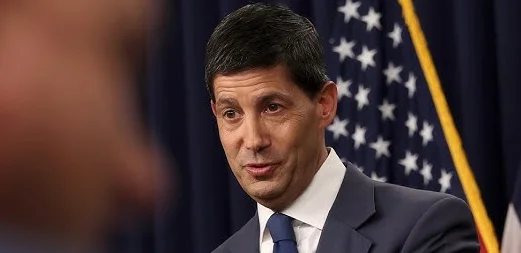
Federal Reserve Chairman Kevin Warsh addressed the Federal Reserve inflation fight; the 2-year Treasury yield rose 10 basis points. Stocks edged higher.
Warsh spoke at the Kansas City Fed's annual conference in Jackson Hole, Wyoming, where his remarks signaled that policymakers may not be finished pressing against inflation. The message kept attention on whether interest rates could still move higher if price pressures persist.
The speech landed in a market already waiting for a clearer read from Warsh, who has offered fewer public guideposts than some predecessors. Traders had been watching for any indication that the central bank remained prepared to raise rates again if incoming data required it.
Two-year yield moves 10 basis points
The 2-year Treasury yield recently traded at 4.33%, up from about 4.23% before the remarks, a move of roughly 10 basis points. The 10-year Treasury yield was at 4.710%, higher by 3.6 basis points from the prior level cited in the market update.
Equities moved in the other direction after the speech, with the S&P 500 at 7,743.30, up 12.31 points, or 0.16%. The Dow industrials stood at 53,668.38, higher by 98.94 points, or 0.18%, while the Nasdaq was at 26,568.81, up 27.46 points, or 0.10%.
The mixed reaction showed a market separating rate sensitivity from broader equity momentum. Shorter-dated Treasury yields are often more closely tied to expectations for central bank policy, while stock indexes also reflect earnings, sector positioning and investor appetite for risk.
Warsh puts AI costs under review
Warsh also used the address to frame artificial intelligence as an economic question rather than only a technology story. He asked, "Will the application of AI cause a significant, sustained rise in productivity across the economy? And if so, when?"
Another question in the prepared remarks focused on the cost of building the next generation of models. Warsh asked, "Will the next generation of AI models demand even greater capital intensity, or will the models themselves help devise a capital-light solution?"
Those questions matter for monetary policy because productivity gains can affect growth, inflation and corporate margins, though timing is uncertain. The remarks also pointed to token pricing for large language model access, including whether frontier systems will command premium prices while older models become low-cost commodities.
Marvell tests AI earnings bar
The AI discussion came as chip stocks moved lower after Marvell Technology's results. Marvell raised its guidance and reported higher revenue and profit, but its shares fell after the announcement, indicating that investors had set a higher bar for companies tied to AI demand.
That reaction places Marvell at the center of a broader sector test. If AI infrastructure spending keeps rising but earnings expectations rise faster, semiconductor companies may need to show not only sales growth but clearer evidence of margin durability and order visibility.
Oil added another cross-market signal, with Brent crude futures at $88.14 a barrel, down 38 cents, or 0.43%. Energy prices feed into inflation readings with a lag, so the direction of crude remains relevant for policymakers even when the immediate market focus is on bonds and equities.
Scenarios hinge on rate signals
If Warsh's message continues to be read as keeping rate increases available, short-term yields may remain more exposed to incoming inflation data. For global markets, that would keep US rates as a high benchmark for financing, while Marvell and other AI-linked companies would face a stricter valuation test.
If later Fed communication instead reassures investors that policy is near a holding pattern, pressure on front-end yields could ease and equity investors may give more weight to earnings growth. In that case, the semiconductor sector's next test would shift toward whether AI revenue can translate into returns on capital across chipmakers, model developers and corporate users.
The main open question is whether inflation data justify Warsh's caution or allow the Fed to pause without weakening its price-stability message. The answer will shape Treasury pricing first, then the discount rates applied to AI shares, and finally the cost assumptions behind the industry's next investment cycle.
More stories
- Natacha Polony joins France's 2027 presidential race
- IMF urges US deficit cuts as debt costs strain economies
- Lagarde urges France to tackle debt through fiscal consolidation
- Fed rate outlook splits as Williams sees limited tightening
- US ETF issuers add nearly 1,100 funds in leveraged push
- Johnson & Johnson lifts 2026 outlook after 6% Q3 growth
- Workday slide contrasts with Dell's $20 billion AI lift
- France economy stalls as first-half GDP clouds budget plan
- AI shares boost U.S. stocks after Bessent signals Iran deal
- SpaceX short squeeze risk rises as lock-up expires Thursday
Latest news
- Publicis beats Q3 forecasts with 5% organic revenue growth
- Türkiye Desk: Tencent’s Flow Games move tests Türkiye’s mobile thesis
- Iran changes Hormuz attack tactics, senior officials say
- Nifty IT jumped 5.2% after HCLTech profit beat
- Fusion CX IPO to cut promoter stake to 80%
- Nasdaq falls 0.15% as chipmakers extend losses