

Natacha Polony joins France’s 2027 presidential race
The 51-year-old journalist is pitching a sovereignty-led campaign as a provisional field of nearly 30 figures takes shape.
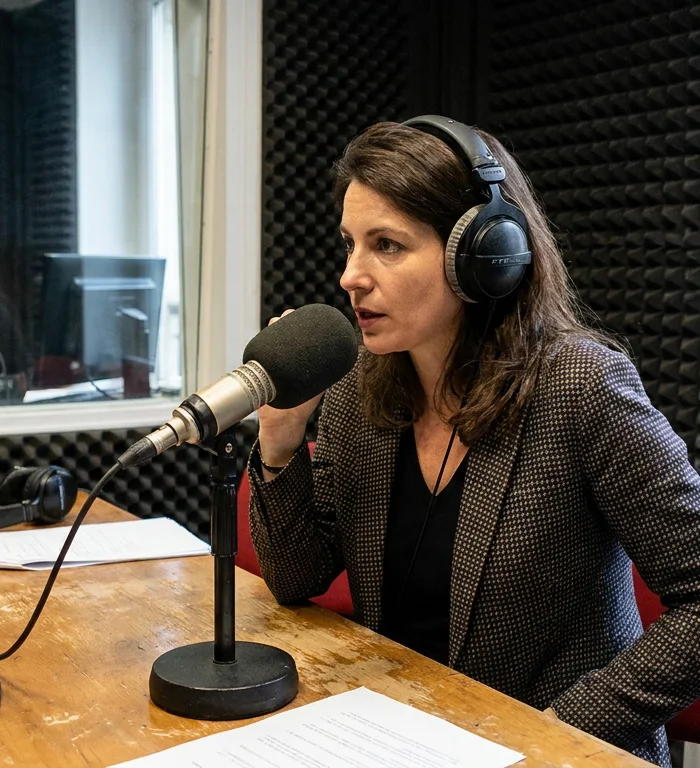
Natacha Polony, a 51-year-old journalist and essayist, said on France Inter radio on Wednesday, Oct. 14, that she would run in France’s 2027 presidential election, Euronews reported.
Her bid adds to a provisional field of nearly 30 public figures, Euronews reported, while official candidates for the Apr. 18, 2027 first round need 500 sponsorships from elected officials.
Polony, a former editor-in-chief of Marianne magazine, said she wanted to “shake up the political landscape.” Euronews reported that she described France as facing a “complete loss of standing.”
In a video posted after the radio interview, Polony argued for economic, energy and food sovereignty. “A nation that no longer produces what it needs is no longer truly free to fund our schools and hospitals, preserve our social model, create skilled jobs and prepare for artificial intelligence,” she said.
“We must produce...We must produce at home, on our own terms,” Polony said. Her platform calls for reindustrialisation to revive activity and improve state finances.
The fiscal backdrop gives that message an economic edge. Atlas360 reported on Oct. 10 that French bond yields rose near 5% as the deficit reached 5.1% of GDP, with public debt and political gridlock weighing on markets.
Polony began building a campaign vehicle before the announcement. Euronews reported that she launched “Nous sommes la France” at the end of August, aimed at people she described as politically unrepresented, and told France Inter the movement had 60,000 members.
Her positioning puts national sovereignty at the centre of her appeal, though Euronews reported that she rejects the “sovereigntist” label. In late September, she accused Foreign Minister Jean-Noël Barrot during a televised debate of viewing France as a “small country.”
Polony has also criticised Emmanuel Macron’s approach to European unity, saying Paris seeks to be “Europe’s star pupil” at the cost of French interests. Euronews cited her objections to the cancellation of a Franco-German fighter jet project and to defence-procurement choices she sees as unfavourable to France.
The field remains unsettled. Euronews listed Marine Le Pen of the National Rally, Jean-Luc Mélenchon of La France insoumise, and former prime ministers Édouard Philippe and Gabriel Attal among main contenders.
On the centre-left, Raphael Glucksmann hopes to position himself as an alternative to Mélenchon after winning the first round of a social-democratic primary, Euronews reported. Former president François Hollande, former prime minister Dominique de Villepin and Bruno Le Maire, economy minister from 2017 to 2024, have not said whether they intend to run.
Polony’s declared candidacy does not by itself place her on the ballot. The formal hurdle is the requirement to collect 500 sponsorships from elected officials before the first round scheduled for Apr. 18, 2027.
On Apr. 18, 2027, the first-round ballot will show whether Polony has cleared the 500-sponsorship threshold required of presidential candidates.
The same Apr. 18, 2027 vote will test how a crowded field, described by Euronews as nearly 30 announced or potential contenders, translates into the official first-round contest.
Also on Apr. 18, 2027, the first-round result will indicate whether sovereignty and reindustrialisation arguments gain measurable electoral support against established figures including Le Pen, Mélenchon, Philippe and Attal.
Source: news article, Euronews, Oct. 14, 2026; Atlas360 background, Oct. 10, 2026
More stories
- IMF urges US deficit cuts as debt costs strain economies
- Lagarde urges France to tackle debt through fiscal consolidation
- Fed rate outlook splits as Williams sees limited tightening
- US ETF issuers add nearly 1,100 funds in leveraged push
- Johnson & Johnson lifts 2026 outlook after 6% Q3 growth
- Centerra targets 70% of Azimut projects with $16 million earn-in
- US 10-Year Treasury Yield Hits 5.04% Ahead of Fed Decision
- Hedge funds win fresh capital as AI trade lifts returns
Latest news
- Publicis beats Q3 forecasts with 5% organic revenue growth
- Türkiye Desk: Tencent’s Flow Games move tests Türkiye’s mobile thesis
- Iran changes Hormuz attack tactics, senior officials say
- Nifty IT jumped 5.2% after HCLTech profit beat
- Fusion CX IPO to cut promoter stake to 80%
- Nasdaq falls 0.15% as chipmakers extend losses