

European coffin makers seek EU case with ranks down to 90
A new coalition argues low-priced Chinese products and possible customs gaps are damaging a sector that had no dedicated lobby representation.
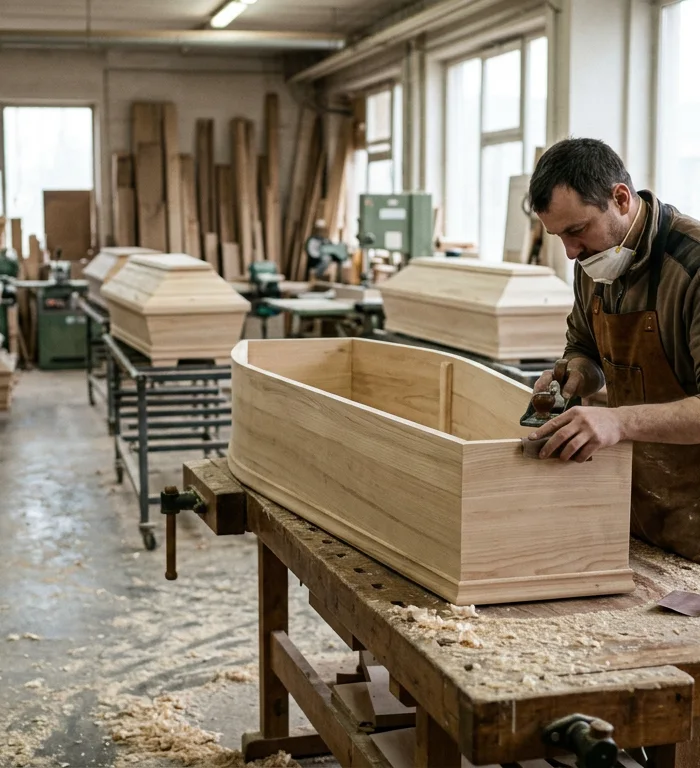
European coffin manufacturers are preparing an EU anti-dumping complaint after their ranks fell to about 90 from 120 over five years, Politico Europe reported in an Oct. 29 news article.
The planned filing would bring another traditional industry into Brussels’ trade-defense system, after the EU opened 32 new trade-defense investigations in 2025, nearly matching the prior year’s record.
The manufacturers have formed a coalition and met European Commission officials, including staff from the trade department, the organizers told Politico. The group wants Brussels to examine whether Chinese coffin producers sell into the EU at unfairly low prices.
“Smaller companies were unable to withstand competition from non-European importers,” Folco Ciulli, a consultant helping coordinate the complaint, told Politico. He said surviving producers had taken on only half the output previously supplied by the companies that closed.
The industry’s case starts with price. Manufacturers estimate that making a coffin in China costs about one-third of producing an equivalent item in Italy, even when the same wood is used, Politico reported.
The coalition attributes that gap to factors it says include state subsidies, export-linked tax benefits, lower labor costs and cheaper timber. It also argues that higher U.S. tariffs on Chinese goods have helped push more Chinese output toward Europe.
Low prices alone are not enough for EU anti-dumping duties. Producers must show that imports are sold below “normal value,” that the EU sector has suffered material injury, and that dumped imports caused that injury.
The manufacturers are gathering cost, wood, labor and factory-price data to compare similar coffins made in China and Europe. The Commission declined to confirm contacts with the group, telling Politico that discussions with industries over possible trade-defense complaints are confidential.
“The EU takes robust action to protect its industries from unfairly traded imports and at present has over 200 measures in place,” a Commission spokesperson told Politico.
The coalition is also examining whether some Chinese coffins are being recorded under other customs categories. Emiliano Inguscio, a mathematician hired by the industry, told Politico his calculations found an unexplained discrepancy equal to about 30,000 coffins a year in Italy.
“In theory, the number of coffins available for consumption should broadly correspond to domestic production plus imports, minus exports and adjusted for changes in inventories,” Inguscio told Politico. He argued that because demand follows mortality patterns closely, large gaps could point to imports that are not captured correctly.
The industry has dubbed one theory the “IKEA loophole”: coffins shipped flat-packed and declared as wooden parts, then assembled in Europe. The Commission told Politico that customs rules can still treat unassembled goods as finished products if the parts have the essential characteristics of the completed item.
The initiative follows an appeal last year by EU lawmakers to Trade Commissioner Maroš Šefčovič over Chinese competition. In January, the Commission imposed anti-dumping duties of 56% to 60% on Chinese candles after an investigation involving an EU industry with about 9,000 workers across 80 companies.
More stories
- Japan faces ASEAN doctrine test after Fukuda dies at 90
- Palm oil buyers face EU deforestation risk from Dec. 30
- Undocumented learners face South Africa matric barriers
- CIR places 25 Sudan commanders at reported sexual-violence sites
- Brent heads for fourth monthly gain as Middle East risk persists
- Arab-led parties win record 19 seats in Israel vote
- Burnham faces Brexit test over 55% EU return support
- Ruto seeks Russian investment in Kenya's $380m trade push
- Sudan teachers seek 20% budget share with 8m children outside school