Senate confirms Jay Clayton to lead pared-back ODNI office
Jay Clayton will take charge of U.S. intelligence coordination after a 51-47 Senate vote and recent ODNI staff cuts under President Trump.
Lauren Collins ·
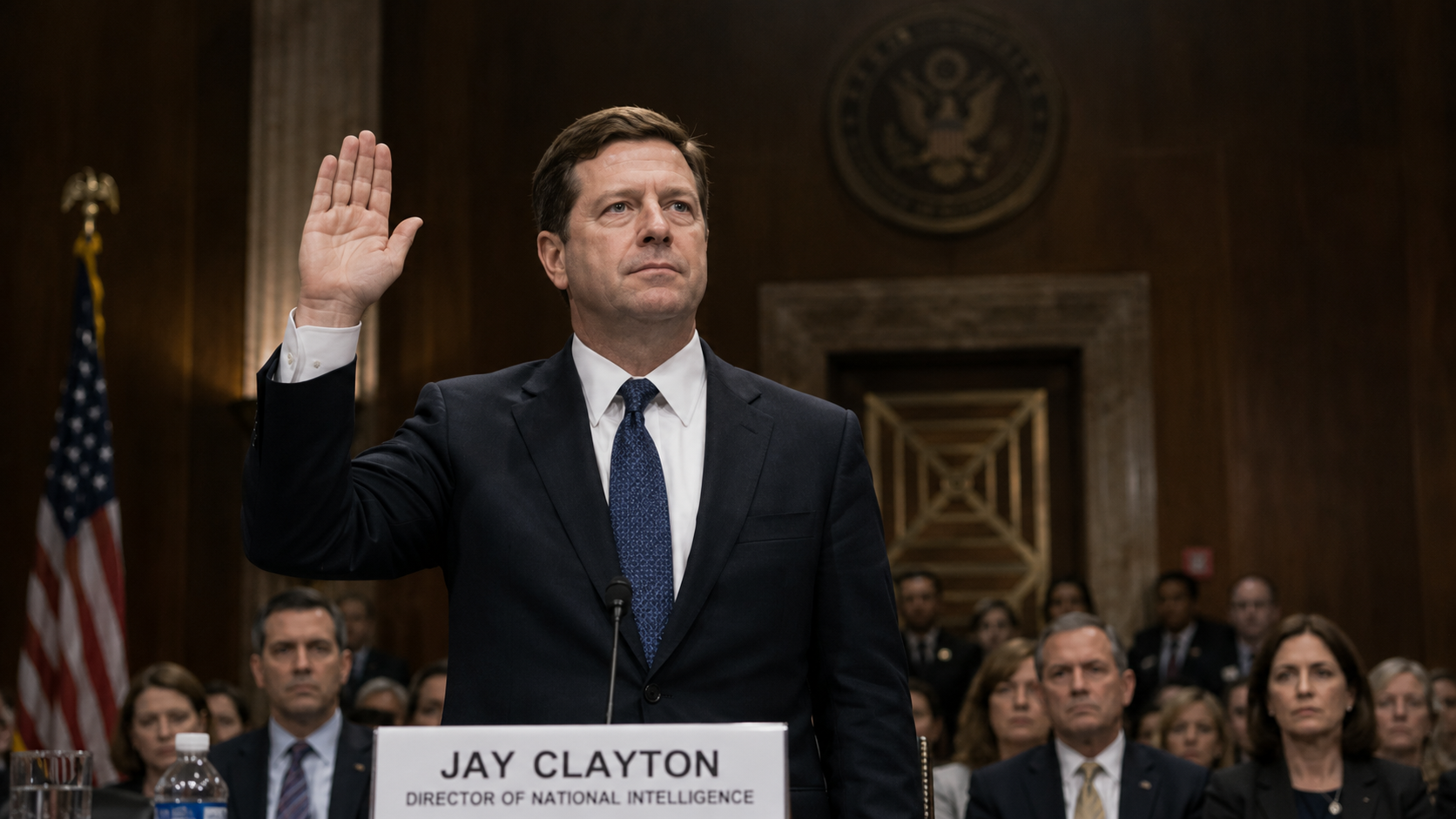
Jay Clayton will take charge of U.S. intelligence coordination after a 51-47 Senate vote and recent ODNI staff cuts under President Trump.
The confirmation gives Clayton command of the Office of the Director of National Intelligence at a moment when the office is smaller, politically exposed and facing a surveillance-law deadline. The vote on Tuesday split along party lines, underscoring how even a nominee viewed as comparatively acceptable still moved through a polarized Senate.
Five layoff rounds reshape ODNI
Clayton inherits an office that coordinates 18 federal intelligence agencies and units, a role created to impose direction across a sprawling national-security system. In recent weeks, President Trump named Bill Pulte as acting director and instructed him to reduce the office’s workforce.
Pulte said on X on Tuesday that he had carried out five rounds of layoffs and reduced staff by about 30% from levels several weeks earlier. Sen. James Lankford, an Oklahoma Republican on the Senate Intelligence Committee, said a number of affected employees had gone back to the agencies that originally detailed them to ODNI.
The reductions have created a basic governance question for Clayton: whether ODNI should operate as a lean overseer or retain enough in-house capacity to challenge the agencies it supervises. That question has divided lawmakers who support streamlining from those who fear the office could lose the leverage Congress expected it to have.
Clayton brings law, not spycraft
Clayton arrives with a legal and regulatory résumé rather than the conventional intelligence background held by many previous spy chiefs. He is the U.S. Attorney for the Southern District of New York and previously chaired the Securities and Exchange Commission.
That profile made him unusual for the intelligence post, but it also helped frame him as less combative than Pulte for some on Capitol Hill. Pulte also leads the Federal Housing Finance Agency and has used that role to make mortgage-fraud allegations against several people seen as opponents of President Trump.
At Clayton’s confirmation hearing this month, Sen. Susan Collins, a Maine Republican, warned that the debate had moved beyond efficiency. “I am deeply disturbed that some administration officials, and indeed some senators, have called for not just a reduction in the size of ODNI, but that we abolish it altogether,” Collins said.
Clayton answered by describing ODNI as an oversight body rather than an operating agency. “To the extent that the ODNI has gotten into operations or started to play the roles of some of those other agencies, it probably should pull back,” he said.
Section 702 returns to Congress
The next fight is likely to test Clayton’s ability to work with lawmakers who just divided over his nomination. Once he takes office, he will need Congress to reauthorize Section 702 of the Foreign Intelligence Surveillance Act, a surveillance authority that expired in June.
President Trump had insisted that neither Clayton’s confirmation nor the FISA renewal should advance until Congress passed a Republican voter-identification bill. That linkage placed an intelligence tool inside a broader election-policy fight, raising the risk that national-security legislation becomes hostage to unrelated voting disputes.
If Clayton can persuade lawmakers that a trimmed ODNI still provides disciplined oversight, the office may gain room to stabilize after the staff cuts while pressing for Section 702 renewal. If the cuts are viewed as hollowing out its capacity, the confirmation vote could be followed by sharper congressional scrutiny of whether ODNI can still coordinate the intelligence community effectively.
The winners from Clayton’s approach would likely be agencies seeking clearer boundaries around ODNI’s role and lawmakers who want a smaller coordinating office. The losers could be officials who relied on ODNI as an independent center for cross-agency review, especially if returned staff take expertise back to their home agencies.
For the intelligence sector, the immediate signal is narrower management from the top, not a broad expansion of central authority. The policy consequence will depend on whether Clayton can separate two fights now running together: ODNI’s internal redesign and the renewal of a surveillance power Congress must revisit.