India's voter rolls dispute tests election panel's standing
Delhi police removed Indian opposition leader Rahul Gandhi and other MPs from a protest over India's voter rolls' revision process on Tuesday night…
Mei Lin ·
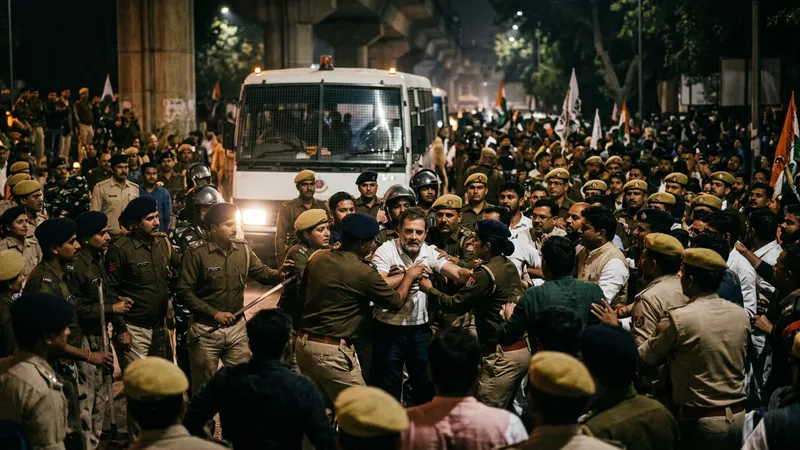
Delhi police removed Rahul Gandhi and other MPs from a protest over India's voter rolls on Tuesday night, escalating an election dispute.
The opposition lawmakers sought Chief Election Commissioner Gyanesh Kumar's resignation over allegations that revisions to electoral registers favor the governing Bharatiya Janata Party (BJP). The BJP and the Election Commission deny that accusation, leaving both the administration of voter lists and the commission's impartiality under political challenge.
A march becomes a sit-in
The opposition put participation at 237 lawmakers representing several parties; police provided no total for those detained. Officers blocked streets between parliament and the commission's headquarters, and police official Manjeet Sheoran said MPs attempting other routes were taken by bus to police stations.
Gandhi and Priyanka Gandhi Vadra were briefly held before being freed, after which they continued toward the commission and later staged a sit-in at Akashvani Bhavan. The nighttime removal followed that renewed protest; police said their intervention was necessary to preserve public order and avoid escalation.
Footage circulating online showed officers putting Gandhi into a bus and stopping him from exiting through a window. The confrontation followed his earlier explanation that the lawmakers wanted an opportunity to question election commissioners about the revision, rather than being prevented from reaching the institution.
Election Commission sets meeting conditions
The commission said it remained open to discussions but rejected the proposed arrangement involving a delegation of 240 people meeting at parliament. In its Tuesday night statement, it said a political party's representative needed to seek an appointment and that discussions take place at its own offices.
Those competing accounts identify a procedural dispute alongside the broader political one: Gandhi described an attempt to obtain answers, while the commission cited its appointment requirements. Its statement did not rule out a meeting, but it did not resolve the opposition's objections to how the electoral revision was being conducted.
Voter eligibility drives the dispute
The contested program, formally called the Special Intensive Revision (SIR), started in Bihar in June 2025 and subsequently reached additional regions. According to the commission, its purpose is to eliminate duplicate entries and remove people who do not qualify for inclusion on electoral registers.
Opposition parties and activists contend that the process has also excluded eligible citizens and has been administered improperly. That allegation is distinct from the accusation of partisan favoritism: establishing whether qualified voters were wrongly removed would not, by itself, establish that officials acted to benefit a political party.
The commission has separately defended its internal procedures, saying disagreements are part of an institution's work and that its eventual decisions were unanimous. Its position leaves the substantive dispute unresolved: opposition leaders continue to demand Kumar's departure, while the commission maintains its defense of the revision and its decision-making.
Pressure is also coming from the Cockroach Janta Party, a youth-backed satirical online movement that organized Delhi and Mumbai demonstrations four days before the lawmakers' protest. The group describes its effort as a national campaign and has announced further protests for October 10, providing another scheduled occasion for demands over Kumar's position.