

Madrid teachers march for funding and oppose strike rules
Madrid teachers marched for smaller classes and more funding as restrictions on school-based strike promotion added a legal dispute to their labor campaign.
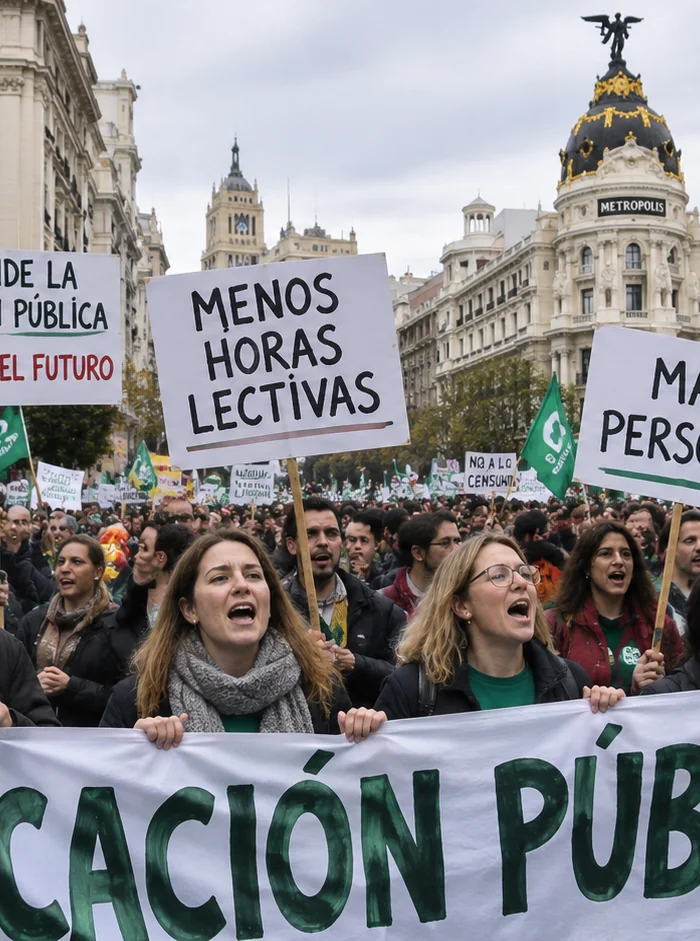
Madrid teachers marched Friday for smaller classes and more funding as a dispute over school strike restrictions added to their labor action.
The Spanish government's delegation in Madrid estimated attendance at about 12,000, with educators demonstrating during an indefinite strike that started October 14. Their demands combined changes to classroom conditions with opposition to regional instructions limiting strike promotion inside schools.
Classroom demands reach Gran Vía
Teachers and other education employees moved through central Madrid along Gran Vía. Video footage showed drums, chanting and banners supporting public education, while placards called for reduced class sizes and a lighter teaching timetable.
The demands extended beyond additional school funding. Demonstrators sought better employment conditions, and educational counsellor Diego Recio called for more support personnel as well as a reduction in teaching hours.
Secondary school teacher Jara Gil described difficulty responding to increasingly complex student needs. She pointed particularly to pupils needing psychological assistance or language support, presenting the dispute as a question of the services educators can provide.
Gil said: "We want the best for our students, and it really frustrates us greatly not being able to provide them with the service we need." Her comments linked the teachers' workplace demands to their assessment of shortcomings in student support.
School restrictions divide authorities and unions
The funding and staffing campaign now also encompasses a disagreement over what forms of labor protest belong in schools. New regional instructions restrict classroom promotion of strikes and the exhibition of banners connected to industrial action on school premises.
Regional authorities describe those measures as a means of preserving neutrality in education. Unions reject that explanation, characterize the restrictions as censorship and say they intend to contest them through the courts.
Recio voiced that objection directly: "We want to put an end to censorship in classrooms, because claiming our rights is not a crime." The allegation of censorship is the position of opponents of the measures, rather than an established judicial finding.
The two sides are therefore advancing different accounts of the same restrictions. Authorities emphasize neutrality, while the unions' announced legal challenge concerns limits on promoting their strike and displaying its messages within schools.
Regional leadership faces resignation demands
Protesters also demanded that regional Education Minister Mercedes Zarzalejo leave office. They accused the administration led by Madrid President Isabel Diaz Ayuso of not responding to their demands, bringing the region's political leadership directly into the demonstration.
The campaign combines requests for resources with opposition to rules governing protest. A change in funding or staffing would address a different set of demands from a change in restrictions on school-based strike activity.
If unions proceed with litigation, the scope of those restrictions would become the focus of a legal contest alongside the continuing labor dispute. Even a resolution of that disagreement would leave the separate demands over class sizes, teaching hours and student support to be addressed.
More stories
- Estonia to close 5 Russia road crossings for six months
- Mashatile seeks GBVF action after 1-in-3 violence finding
- Milan tenants seek lease safeguards as housing costs rise
- Costa proposes EU budget cuts and 3% digital turnover tax
- Liberia seeks bigger US exports as AGOA runs to 2028
- SAF-RSF fighting worsens 10-year oil pollution crisis, groups say
- Germans’ democracy satisfaction falls to one-third
- Sudan authorities leave Ahmed Haroun arrest reports unconfirmed
Latest news
- Young adults overestimate life insurance costs by 10 times
- Greece targets 2.3% growth in 2027 budget
- US stocks face Goldman warning on further forced selling
- Al-Fatlawi recasts Iraq on screen with about $2.5m debut
- Bitcoin falls below $57,742 as investors seek other bets
- Vance declines to back Iran strikes as Trump defends war