

Dubai’s 100-speaker tech forum puts US chip reviews in focus
The UAE event adds visibility to Gulf AI ambitions as Washington weighs license controls for advanced semiconductors and China-diversion risks.
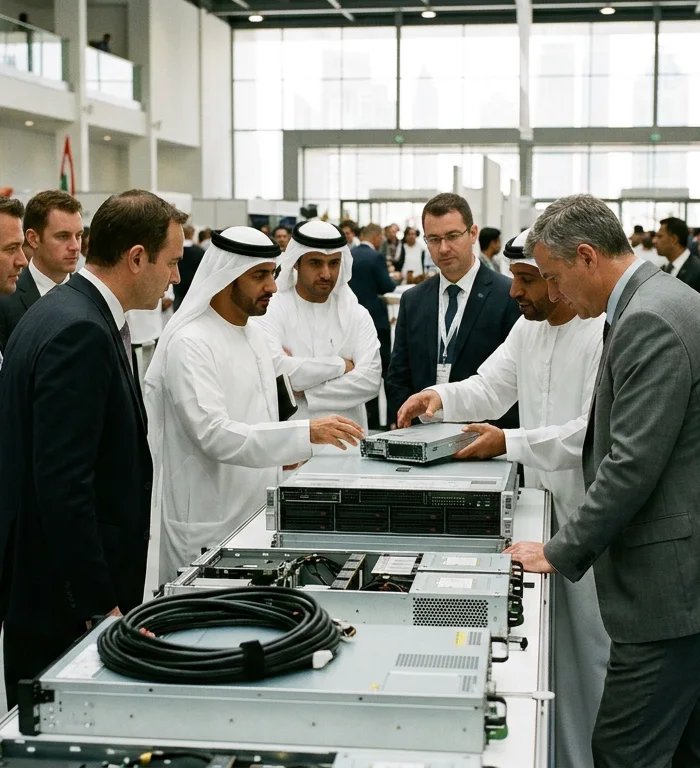
Dubai Future Week 2026 will host more than 100 UAE and international speakers on The Big Stage, an industry news report said.
For Washington, the forum lands as Gulf AI ambitions overlap with US export controls and Microsoft’s $1.5 billion investment in Abu Dhabi’s G42, a benchmark for managed US-UAE tech integration.
Dubai Future Week
The event is billed as a gathering of government, industry and academic figures focused on future technology and governance. Its scale gives the UAE another platform to present itself as a global hub for artificial intelligence policy, investment and infrastructure.
That positioning matters to the White House, the Commerce Department and Congress because advanced AI chips are dual-use goods, meaning they can support commercial models as well as military or surveillance applications. US rules created during President Biden’s administration require specific licenses for some advanced AI accelerators shipped to Middle Eastern destinations to reduce the risk of diversion to China.
The Microsoft-G42 deal showed one route for US-UAE technology alignment. The $1.5 billion investment was tied to G42 moving away from Chinese hardware suppliers, according to the background provided for the transaction, giving Washington a template for pairing Gulf AI capital with US security conditions.
Capitol Hill remains the harder audience. National security hawks have warned that Gulf state-backed technology entities can have opaque exposure to Chinese suppliers, making licensing decisions politically sensitive even when Gulf governments present themselves as US partners.
The next test is whether President Trump’s Commerce Department treats Gulf AI hubs as trusted partners subject to case-by-case compliance checks, or as a higher-risk channel requiring tighter physical inspections and vendor-exclusion rules. If Commerce moves toward stricter conditions, Gulf projects could face slower hardware deployments while US suppliers gain a clearer legal pathway. If approvals become broader, UAE-based initiatives could scale faster, but congressional pressure over China exposure would likely intensify.
The falsifiable marker is public Commerce Department guidance or a House Select Committee on China hearing that names Middle Eastern advanced AI semiconductor rules before Dubai Future Week 2026 convenes.
More stories
- Germans oppose Ukraine aid as poll shows support slipping
- Kim Jong-un receives 10 envoys after constitutional shift
- Ukraine claims Libya strike sinks Russian naval corvette
- COP31 climate talks collapse over fossil fuels and funds
- Russian military faces 1,087 recorded suicides in Ukraine war
- US faces China, Russia in Africa minerals contest
- Madrid teachers march for funding and oppose strike rules
- Milan tenants seek lease safeguards as housing costs rise
- Eisenkot wins 67 endorsements for Israel mandate
- Guinea-Bissau halts hepatitis B trial involving 14,000 babies
Latest news
- Trump prepares tariffs on China and other major exporters
- New-car buyers pay record average $50,087 in October
- Banks face ECB reserve debate over liquidity and profits
- Investors see Anthropic debut gains fade below $83 a share
- Iraq orders federal control over Kurdish-area oilfields
- Nvidia shares retreat as AI rally cools before PCE data
- Macy’s parade faces balloon limits as storm winds approach