Chemistry Nobel honors foundations of molecular research
Henri Kagan and Kenso Soai won the 2026 chemistry Nobel for discoveries in asymmetric organic synthesis, the award-giving body said.
Jason Kwon ·
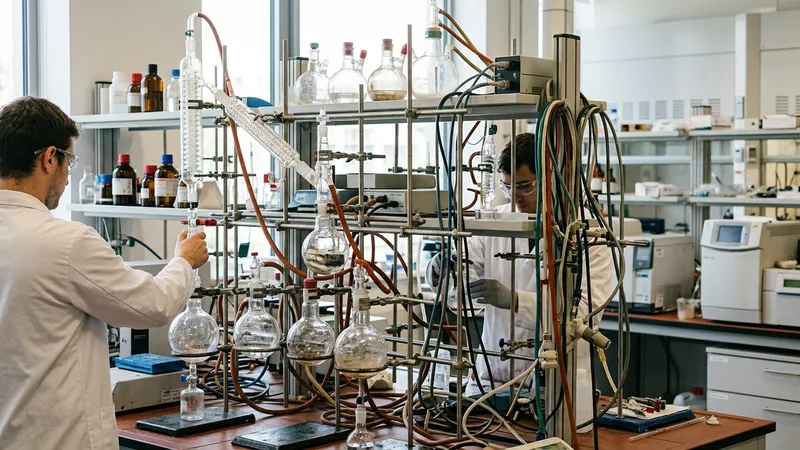
Henri Kagan and Kenso Soai won the 2026 chemistry Nobel for discoveries in asymmetric organic synthesis, the award-giving body said.
The announcement in Stockholm on October 7 recognizes research involving molecules whose mirror-image forms look alike but are not identical. The award citation credits the scientists “for the discovery of non-linear effects and autocatalysis in asymmetric organic synthesis,” placing the recognition in the foundations of chemistry.
Mirror images define the chemistry
Heiner Linke, Chair of the Nobel Committee for Chemistry, described the subject as “foundational chemistry.” He explained the molecular distinction through a comparison with human hands: the left and right resemble each other, yet cannot be superimposed to make an identical match.
Linke identified these molecules as chiral, a term derived from the Greek word for hand. His explanation gives a starting point for understanding the award: visual resemblance between two molecular forms does not mean that their structures are interchangeable.
The recognition differs from the previous year's chemistry prize, which went to Susumu Kitagawa, Richard Robson and Omar Yaghi for developing metal–organic frameworks. Those molecular constructions can help address problems involving climate change and freshwater scarcity; this year's citation instead names discoveries in asymmetric synthesis.
Chemistry follows medicine and physics
The chemistry announcement was the third scientific prize of Nobel week, after medicine on Monday and physics on Tuesday. It maintains the established sequence in which the chemistry winners are named after those two awards, before the laureates gather for the December ceremonies.
The chemistry prize has previously recognized discoveries ranging from nuclear fission to genetic sequencing techniques. That history places Kagan and Soai's recognition within an award whose scope extends across different kinds of chemical research, rather than a single branch or practical application.
The Nobel prizes originated in the will of Alfred Nobel, the Swedish inventor and businessman who was himself a chemist. His 19th-century fortune came largely from inventions connected with warfare, including dynamite, while his bequest established awards for achievements in science, literature and peace.
Those awards have been presented since 1901, apart from interruptions largely associated with the world wars. The economics prize came later and is funded by Sweden's central bank, distinguishing its origins from the prizes established through Nobel's will.
Stockholm ceremony brings medals and money
Kagan and Soai will share 12 million Swedish crowns, equivalent to $1.2 million, according to the award announcement. That amount is the joint prize, rather than a separate payment of that size to each scientist; the recognition also includes Nobel medals.
The laureates are scheduled to receive their medals from Sweden's King Carl XVI Gustaf in Stockholm on December 10, the anniversary of Nobel's death. A banquet at Stockholm City Hall follows the awards ceremony, while the peace prize is presented separately in Oslo.