

David Parr House to honor Victorian art-workman with blue plaque
The Cambridge charity is crowdfunding £6,000 for a ceramic marker, film and exhibition tied to the house’s Arts and Crafts history.
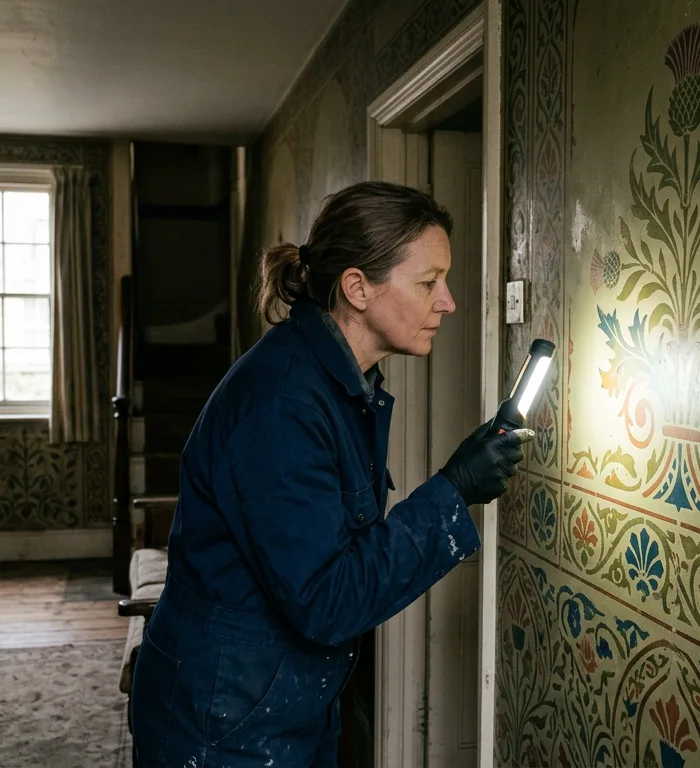
David Parr House & Gallery charity is seeking £6,000 and plans to unveil a blue plaque on Feb. 8, 2027, for David Parr’s Cambridge home, The Guardian reported in a Sunday culture article.
The recognition puts institutional weight behind a worker whose 40 years of private decoration were hidden for more than 80 years after his 1927 death, while William Morris’s designs became canonical.
Parr was a working-class Victorian labourer who decorated private mansions and Cambridge colleges with Morris patterns by day, then worked on his own two-bedroom terrace house at night. The home stands on Gwydir Street in Cambridge.
“The Victorians used the term ‘art-workman’ for the skilled painters, carvers and craftsmen who turned designers’ ideas into finished work, usually as employees of a decorating firm,” Annabelle Campbell, director of the David Parr House & Gallery charity, told The Guardian. “Their work demanded great accuracy and artistry, yet they sat at the bottom of a hierarchy of client, designer and firm, and were rarely named.”
The Guardian reported the plaque is thought to be the first dedicated to a working-class Victorian art-workman. The cautious wording leaves the claim short of definitive confirmation, but the commemoration is aimed at a category of labour usually absent from named cultural histories.
Parr’s home survived because his granddaughter Elsie preserved it during her lifetime. It was discovered by accident in 2009, when social historian Tamsin Wimhurst knocked on the 93-year-old’s door and entered the decorated living room of the small Victorian worker’s cottage.
The charity later acquired the property after Elsie’s death. The house opened to the public in 2019 as the David Parr House, preserving walls and ceilings that Parr covered with his own designs, influenced by Morris and the architect George Bodley.
Campbell said Parr worked for F R Leach & Sons, a Cambridge decorative arts company, and was among workers who executed schemes linked to better-known Arts and Crafts figures. In surviving work records, she said, Parr’s name appeared only as initials in a wage list, if it appeared at all.
“The plaque recognises the importance of the art-workman within the successful Victorian decorative arts economy,” Campbell said. “It also recognises the vision and aspiration of a working-class family man.”
The plaque date carries a biographical link: Feb. 8 is the anniversary of the day in 1886 when Parr signed the mortgage on the house. The charity’s crowdfunding target would pay for a ceramic plaque by local artist David Stonehouse, a short film documenting its making and an exhibition.
Campbell framed the plaque as part of a broader change in who is commemorated in Cambridge, where existing blue plaques include elite academics such as Bertrand Russell and John Maynard Keynes. “Lots of these houses were occupied by highly skilled working-class Victorian artisans,” she said. “Who is commemorated with a blue plaque is changing.”
The unveiling is scheduled for Feb. 8, 2027, at David Parr House in Cambridge.
Source: culture article, The Guardian, Nov. 22, 2026
More stories
- Al-Fatlawi recasts Iraq on screen with about $2.5m debut
- Strictly expands stage for 8 couples in Blackpool return
- Anoop Lokkur seeks backers for $1.3m Bengaluru dark comedy
- Jeff Buckley track tops 500,000 TikTok uses this year
- Some schools remove David Walliams books after allegations
- Sotheby’s raises $378.7m as collectors stay selective
Latest news
- Iran's attacks hit 25 tankers near Strait of Hormuz
- FCC approves prison cellphone jamming despite 2.5-mile warning
- Russia strikes Ukraine as Odesa faces electricity strain
- Bahrain reports two injuries after Iranian aerial attacks
- Congress tests Black Democrats' growing policy influence
- Baltic responders fight Sparta II fire after drone strike
- Dietitians advise small swaps for plant-based eating
- Europe faces attribution gap after 16 cyber, physical incidents