Apple CEO change puts Ternus atop AI supply strain today
Apple CEO John Ternus has replaced Tim Cook, who becomes executive chairman as Apple faces AI supply pressure and policy disputes.
Jason Kwon ·
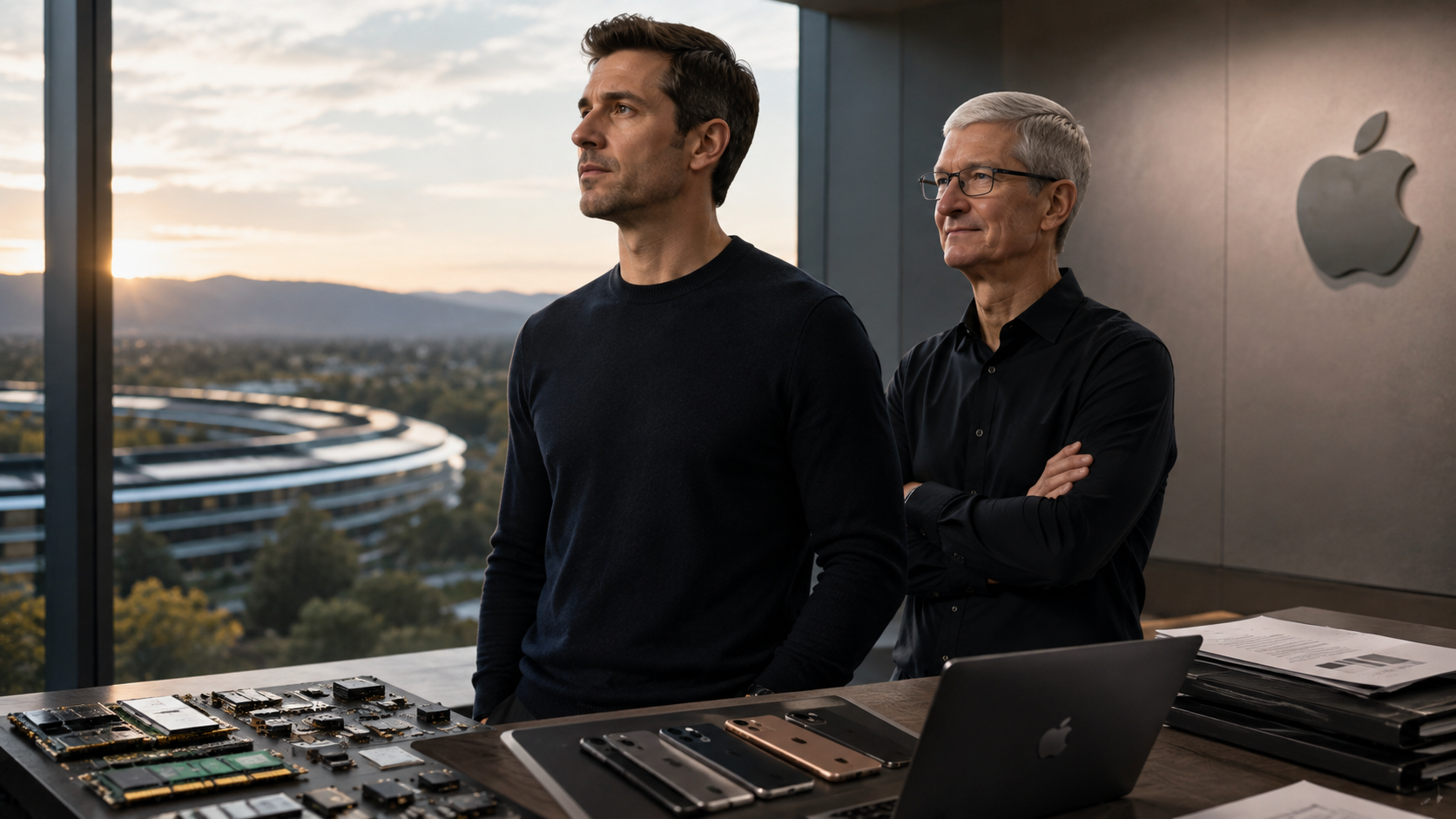
Apple CEO John Ternus took over on September 1, 2026, ending Tim Cook's 15-year run and putting Apple's AI and supply-chain strategy under new leadership.
Ternus takes Cook's seat
The handoff gives Apple its first CEO change since 2011, when Cook succeeded Steve Jobs and began a period defined by the iPhone franchise, services expansion and deeper political engagement. Cook will stay inside the company as executive chairman of Apple's board, keeping him close to strategy and government relationships.
Cook used his final employee note as CEO to frame the transition around continuity rather than rupture. "This place is proof that culture triumphs over everything. We share a belief that what we build matters, and that we have both the opportunity and the responsibility to leave the world better than we found it," he wrote.
AI strains Apple's supply chain
Ternus inherits Apple as AI demand has tightened supplies of RAM and other components, the report said. For a hardware company whose launch cadence depends on disciplined procurement, tighter memory availability can affect costs, product timing and margin management.
The pressure is not limited to parts. Apple is also navigating a more complicated political and economic environment, including policy dealings with President Trump's administration and government affairs work tied to platform rules.
Ternus' background as senior vice president of hardware engineering gives him direct experience with the product engine that underpins Apple’s largest lines. The job now extends beyond device execution: he will be judged on how Apple integrates AI features without weakening battery life, privacy claims or supply reliability.
Cook remains a policy asset
The senior team is also changing around the CEO role. Apple's revised leadership roster keeps Cook as executive chairman and lists Phil Schiller as an Apple Fellow, while Schiller no longer carries the same day-to-day responsibilities over the App Store and Apple events described in the report.
Katherine Adams' senior vice president role for government affairs is shown as vacant in the updated roster, with some responsibilities moving to Jennifer Newstead and Cook. That structure keeps policy work near the top of Apple while Ternus takes formal control of operations.
The App Store remains central to Apple's platform strategy because it links consumer devices to developer economics, payments and software distribution. A leadership reset around the store and events business may give Ternus room to adjust operations, but it also reduces the number of long-serving executives who worked through both the Jobs and Cook eras.
Three paths for Ternus
If component shortages ease, Ternus can use Apple’s hardware discipline to keep product cycles steady while adding AI features at a measured pace. That path would support supplier planning across the electronics sector, limit cost pressure from premium components and give Apple time to defend margins.
If AI-related demand keeps memory and other parts tight, Apple may face harder trade-offs between availability, pricing and feature timing. The mechanism would run through procurement costs first, then through gross margins at Apple and capacity allocation across chipmakers, memory producers and contract manufacturers.
If political pressure intensifies instead, Cook’s move to executive chairman could matter as much as Ternus' operational control. In that scenario, global effects would come through trade rules and platform regulation, Apple would need to balance compliance with product strategy, and the wider technology sector would watch how much policy work remains centralized at the top.
The main open questions are specific: how quickly Ternus names or empowers lieutenants, whether Apple can secure enough AI-linked components for its launch calendar, and how much Cook handles external negotiations from the boardroom. Those answers will show whether the succession is mainly a management handoff or the start of a broader redesign of Apple’s operating model.