Apple CEO transition puts Ternus in charge of AI catch-up
Apple will move John Ternus into the CEO role as Tim Cook becomes executive chairman after 15 years of sales growth.
Jason Kwon ·
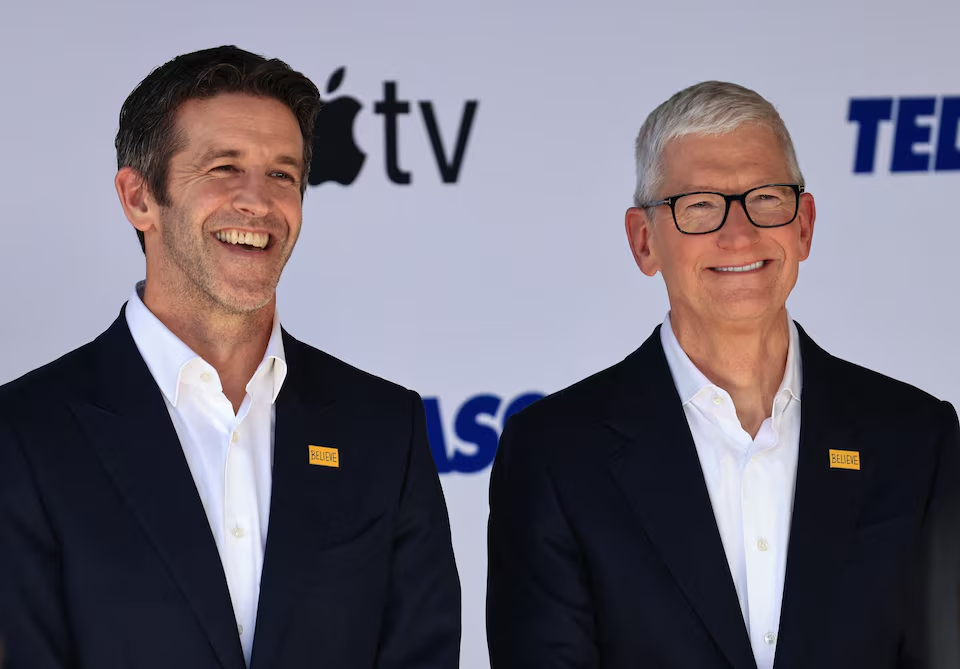
Apple will move hardware chief John Ternus into the CEO job on September 1, placing its AI catch-up effort under a longtime operator.
Cook is due to become executive chairman the same day, after taking Apple from a company valued around $350 billion to more than $4.5 trillion. The handover gives Ternus a larger and more profitable business than Cook inherited, but one facing a faster product cycle around artificial intelligence.
The transition shifts day-to-day control from a CEO defined by operations and supply chains to an executive who has risen through Apple’s hardware ranks. Cook will remain involved in policy and government relations as Apple manages tensions between the US and China, where much of its manufacturing base was built.
Cook’s $416 billion sales base
Apple’s annual revenue rose to $416 billion in the last fiscal year, compared with $108 billion near the start of Cook’s tenure. Profit increased more than fourfold to $112 billion over the same period, helped by scale, pricing power and a larger services business.
Cook also turned Apple’s installed device base into a recurring revenue engine. The iPhone user base reached 2.5 billion, while wearables such as Apple Watch and AirPods generated $35 billion in fiscal 2025 sales.
Christopher Brown, a financial adviser at Synovus Securities, which holds Apple shares, said Cook changed the company without trying to imitate Steve Jobs. “Not only did Cook create his own path of operational and supply chain success but, he also created a ‘values-driven’ culture within Apple,” Brown said.
That approach helped Apple widen its customer lock-in after the initial hardware sale. Brown said the result was “a consumer brand loyalty and dependency flywheel that generated trillions of dollars in revenue.”
Ternus faces Apple’s AI gap
Ternus inherits a company whose central product question is no longer only the next iPhone cycle. Critics of Cook’s tenure have argued that Apple has not established a successor platform with the same pull as the smartphone.
The list of uneven launches gives Ternus little room for drift. Apple abandoned a decade-long electric-vehicle project in 2024, stumbled with Apple Maps in 2012 and has seen the Vision Pro headset, introduced in 2023 at $3,499, fail to deliver broad sales momentum.
Artificial intelligence is the more immediate test. Apple has delayed parts of its Siri overhaul, while rivals have used generative AI features to refresh phones, computers and consumer software.
Brian Mulberry, chief market strategist at Zacks Investment Management, which owns Apple stock, said Ternus must show that AI changes the company’s core products rather than sits beside them. “AI is the single biggest challenge for Ternus. Apple needs to demonstrate that AI will be more than an app on the iPhone, more than Siri,” he said.
India and Vietnam supply shifts
Cook’s manufacturing model gave Apple cost efficiency for years, but reliance on China has become harder to manage as tariffs and geopolitical disputes affect supply chains. Apple has already begun moving more production to India and Vietnam to reduce that concentration risk.
The company is expected to make most US-bound iPhones in India by the end of 2026, while some AirPods and iPads are assembled in Vietnam. If those shifts hold, Apple could soften tariff exposure without fully abandoning the supplier network that helped support its margins.
The scenario for Ternus turns on two connected tests. If AI features arrive in a way that lifts iPhone upgrades, Apple would gain a new services and hardware cycle, suppliers would get clearer demand signals, and global electronics spending could shift toward premium devices.
If AI delays persist, Apple may lean harder on pricing, services and buy-in from its installed base. That would protect near-term cash generation, but it could leave handset and software competitors more room to define the next interface for consumers.
A third path depends on manufacturing. If India and Vietnam absorb more production without cost pressure, Apple’s supply chain becomes less exposed to a single country, the broader electronics sector accelerates diversification, and trade shocks carry less force for US consumer-tech prices.