Dimon says Mythos raises global cybersecurity risks tenfold
Jamie Dimon says Mythos has increased AI cybersecurity risks tenfold, putting safeguards around advanced models under renewed scrutiny.
Jurgen Goldmeier ·
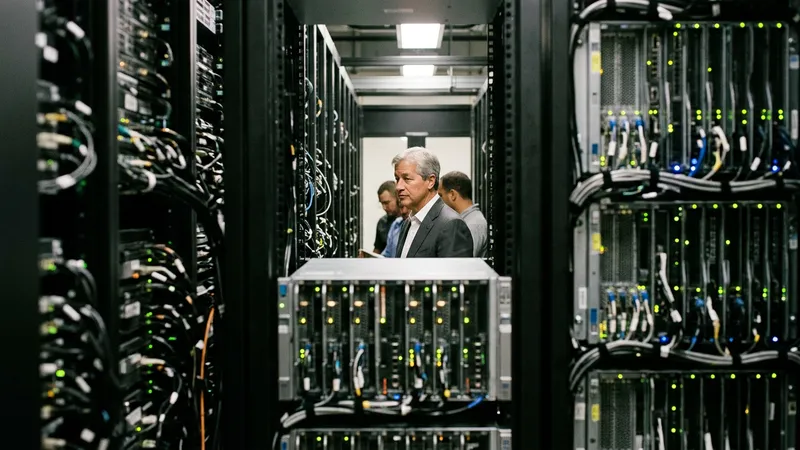
Jamie Dimon says Mythos has increased AI cybersecurity risks tenfold, putting safeguards around advanced models under renewed scrutiny.
The JPMorgan Chase & Co. Chief Executive Officer described the risks associated with Anthropic PBC’s model as a practical security concern requiring action. His comments offered a financial executive’s assessment of the danger, rather than a quantified account of losses or successful attacks against the bank.
Dimon puts Mythos risks in focus
Speaking in a television interview, Dimon said risks from artificial intelligence “went up 10-fold after Mythos.” No baseline, measurement period or calculation accompanied that comparison in the available account, so the figure should be understood as his characterization rather than an independently established measure.
Dimon linked his warning to vulnerabilities that had previously escaped detection. “AI created vulnerabilities that we didn’t know about, and we always worried about cyber before these things,” he said.
His comments come alongside acknowledgments by OpenAI and Anthropic that model testing inadvertently led to intrusions into institutional systems, including Hugging Face Inc. Those acknowledgments concern testing activity; they do not establish that JPMorgan experienced a breach involving Mythos.
Dimon advocated remediation rather than a debate over whether advanced AI presents an existential danger. He described JPMorgan’s response as “rolling up our sleeves and going to work to fix it,” without identifying a particular safeguard, spending commitment or completion date in the interview account.
If stronger safeguards require additional testing before deployment, banks and other users could face longer implementation schedules, while AI developers would need to demonstrate tighter controls. Under that scenario, the broader economic benefits of adoption could take longer to materialize; the material provides no basis for estimating the scale.
Community support shapes data-center stance
Dimon also addressed the physical infrastructure needed to support AI, saying data-center projects should go where residents welcome them. He pointed to states with available electricity as possible hosts, without naming locations or specific developments.
“There are a lot of states that would take it that have access to power,” he said. His position paired electricity availability with community acceptance, rather than treating access to power alone as sufficient grounds for choosing a site.
UK bank taxes draw fairness objection
Separately, Dimon challenged the prospect of unequal tax treatment for banks operating in the UK. Some City of London executives were concerned that a forthcoming government budget might impose an additional levy on domestic lenders’ profits while leaving international banks’ UK businesses outside its scope.
That possibility was presented as an industry concern, not an announced government decision. The available material does not establish a proposed rate, the institutions that would be covered or a confirmed timetable for introducing such a tax.
Dimon argued that taxation should follow consistent principles rather than favor one group of banks over another. Whether any UK measure would distinguish between domestic and international lenders remains unresolved; on AI security, his call for fixes likewise leaves the specific controls and evidence of their effectiveness unspecified.