Halzen wins physics Nobel for Antarctic neutrino detector
Francis Halzen won the 2026 physics Nobel for using Antarctic ice to detect neutrinos, opening another route to studying the universe.
Jason Kwon ·
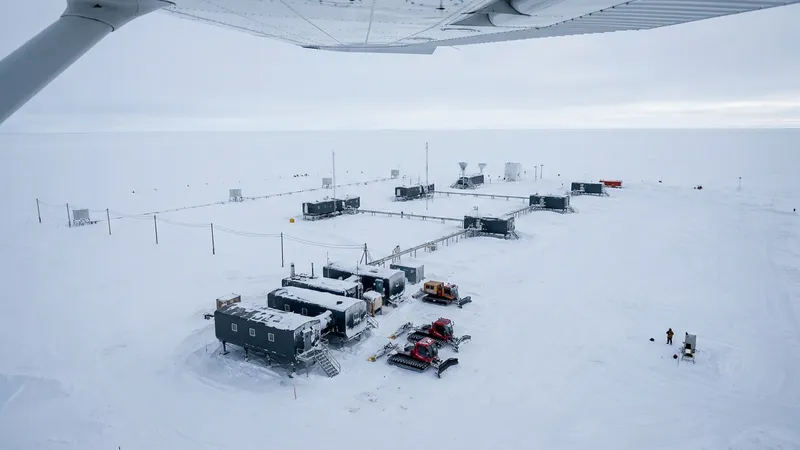
Francis Halzen won the 2026 physics Nobel for using Antarctic ice to detect neutrinos, opening another route to studying the universe.
The Royal Swedish Academy of Sciences announced the Belgian-American scientist’s award in Stockholm on October 6. It recognized his work developing IceCube Neutrino Observatory, which records rare particle interactions rather than gathering light like a conventional telescope.
The Academy said those observations help researchers investigate the origins of energetic particles and offer opportunities to identify unfamiliar phenomena. Halzen, a professor at the University of Wisconsin–Madison, cautioned that the scientific possibilities remained difficult to define.
Antarctic ice becomes a detector
IceCube uses more than 5,000 sensors distributed through a cubic kilometer of ice near Amundsen-Scott South Pole Station. Its instruments reach 2,500 meters beneath the surface, turning a volume of the Antarctic ice sheet into an astronomical observatory.
Neutrinos interact so infrequently with matter that enormous numbers can pass through Earth without leaving a detectable signal. IceCube’s sensors wait for the exceptional interactions that produce observable traces, with roughly one high-energy detection expected daily across the installation.
The particles carry information from environments that researchers cannot investigate directly. The Academy described them as messengers capable of revealing processes in remote galaxies and stellar explosions, giving scientists another means of examining energetic events beyond Earth.
IceCube has identified high-energy neutrinos arriving from both the Milky Way and beyond it. That establishes a geographical range for the search, but identifying the particular objects and physical processes responsible remains a scientific task rather than a settled result.
Halzen’s proposal takes decades to build
Halzen put forward his South Pole concept in 1988; construction reached completion in 2011. The interval illustrates the distance between proposing ice as a detection medium and operating an instrument capable of registering rare interactions.
Speaking by telephone at the announcement, Halzen said doubts about whether the project would succeed had extended to him. He also emphasized his collaborators, describing relief that work he believed deserved recognition had received the prize.
Keeping the observatory functioning presents a separate challenge from constructing it. A small winter team maintains the equipment during the Antarctic cold season, when temperatures below minus 50 degrees Celsius can prevent aircraft from landing and restrict access to supplies.
IceCube expansion targets more detections
The proposed successor, IceCube-Gen2, would instrument eight cubic kilometers of ice, compared with the existing installation’s one cubic kilometer. Its development plan targets operation in 2033 and a detection rate 10 times the current level, including fainter neutrino signals.
If that expansion meets its stated goals, researchers would have more observations with which to investigate cosmic sources. The promised increase in detections is a project objective, however, not an accomplished scientific result or a guarantee of any particular discovery.
Halzen said the field would require larger instruments and additional observatories before its possibilities became clear. “And what this will bring is impossible to predict,” he said.
The award also connects his work with earlier Nobel recognition for neutrino research, including the 2015 prize awarded to Takaaki Kajita and Arthur McDonald. Halzen’s presentation ceremony is scheduled for December 10 in Stockholm; the longer scientific timetable centers on expanding the observations and determining what their sources reveal.