AI self-regulation deal tests Trump's safety approach
Trump and Johnson are preparing an AI self-regulation pact with frontier labs as the White House rolls out America.gov and a terminology order.
Lauren Collins ·
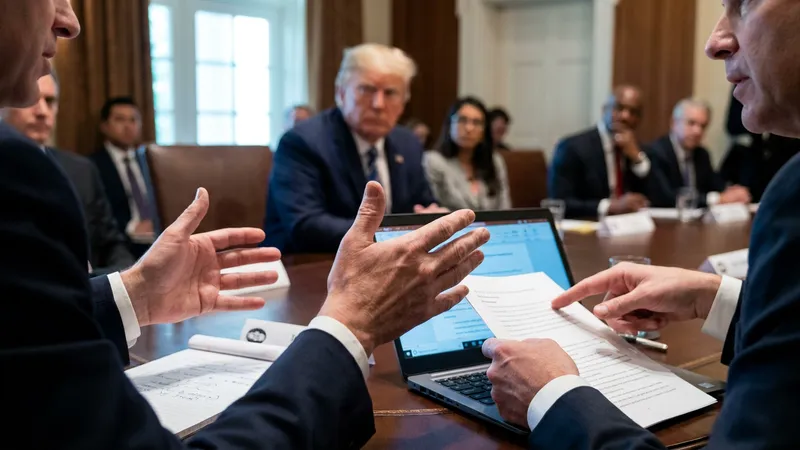
President Trump and House Speaker Mike Johnson are preparing an AI self-regulation pact with more than a dozen tech CEOs, putting enforcement in focus.
Johnson sets enforcement line
The agreement has not been released, leaving its legal weight, review process and penalty structure unclear. Johnson told reporters there would be “consequences” for AI companies that fall short, but he did not specify what those consequences would be or who would impose them.
Trump framed the administration’s approach in voluntary terms after a White House meeting and lunch with executives from AI and technology companies. “There should be tremendous self-regulation,” he said, while Johnson described the coming pact as “robust internal controls and layers of internal and external review.”
The meeting came as the administration introduced America.gov, an AI-powered site intended to make government services easier to use. The rollout tied the safety discussion to a more practical promise: using the technology inside government while asking the companies building it to police their own systems.
Voluntary controls leave legal gap
The policy choice places company governance near the center of federal AI oversight, at least for now. Without the text of the pact, the main unresolved issue is whether external review means independent audits, government access, third-party testing or a narrower process selected by the companies themselves.
For frontier labs, a self-regulatory accord could preserve speed and flexibility compared with formal rulemaking. It also creates reputational and political exposure if the controls later appear too weak, especially after Johnson publicly attached the word “consequences” to the arrangement.
For Congress, Johnson’s role gives the House a visible place in a policy area where legislation has struggled to keep pace with model development. A voluntary pact can move faster than a bill, but it cannot answer the same questions about statutory authority, liability or enforcement unless those mechanisms are written into the agreement.
Trump also said he would sign an executive order replacing “artificial intelligence” with “superintelligence” in government communications. The terminology shift does not by itself create a regulatory framework, but it signals that the White House wants agencies to describe the technology in broader and more ambitious terms.
Three paths for frontier labs
If the pact names outside reviewers, requires incident reporting and sets defined penalties, it could give the US a faster governance template for advanced AI systems. Frontier labs would gain a clearer operating standard, while the wider industry would face pressure to align internal testing and disclosure practices with that model.
If the pact relies mainly on company attestations, the effect would be narrower. The administration could claim cooperation with major labs, but enforcement would depend more on political pressure and public credibility than on a durable legal process, leaving smaller companies and open-source developers under looser expectations.
If America.gov becomes the administration’s main public example of AI deployment, federal agencies may become the first test of whether the safety language matches operational practice. That would matter for the technology sector because government adoption can shape procurement standards, cybersecurity requirements and the kind of AI tools vendors choose to build.
The immediate test is the text itself: who reviews the labs, what failures trigger penalties and whether the White House claims authority beyond a voluntary agreement. Until those details are public, the pact is best understood as an opening policy signal rather than a settled enforcement regime.