Ukraine defence minister shake-up exposes Kyiv tensions
Zelenskiy named Yevhenii Khmara as acting defence minister after Mykhailo Fedorov's dismissal triggered protests and exposed wartime command tensions.
Lauren Collins ·
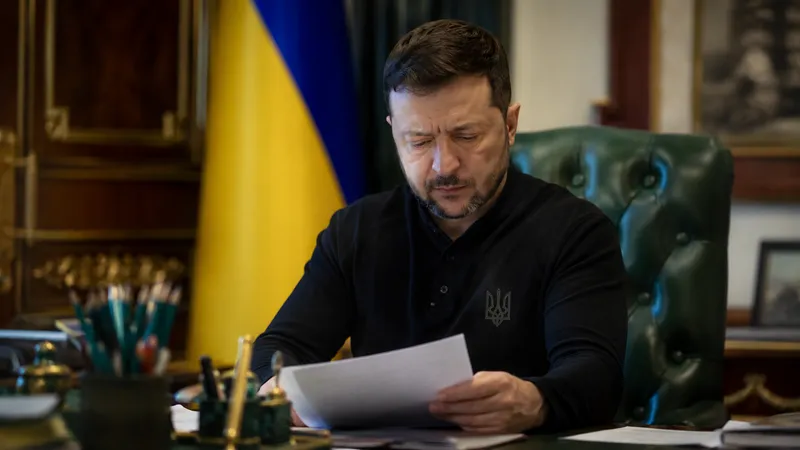
Ukraine defence minister turmoil deepened as Volodymyr Zelenskiy named Yevhenii Khmara to calm protests over Mykhailo Fedorov's dismissal.
The decision puts a security official associated with long-range operations against Russia at the center of Kyiv's most sensitive wartime ministry. It also gives parliament a new confirmation fight after a reshuffle that has exposed strains between reformers, commanders and the presidency.
Khmara enters a charged ministry
Zelenskiy said he was appointing Khmara, the acting head of the SBU domestic security service, as acting defence minister. He added that he would ask parliament to approve Khmara for the permanent post.
The president framed the appointment around battlefield technology rather than party politics. In a statement on X, Zelenskiy wrote: "Yevhenii Khmara has gained extensive and, in many respects, unprecedented experience with technological combat operations."
He added: "This is exactly where our defence efforts should be focused during this war." The wording matters because it links the ministry's next phase to technical operations, not only troop management or conventional procurement.
Fedorov exit exposes command split
Fedorov, 35, told reporters in Kyiv that he had turned down Zelenskiy's offer to become an adviser. He said he did so after the president declined to include him in the next government.
His removal triggered public demonstrations in Kyiv and other Ukrainian cities, with hundreds calling for him to be restored to office. The protests were unusual in wartime Ukraine, where political dissent has often been muted by the demands of national defence.
Fedorov had promoted changes intended to make Ukraine's smaller military more efficient against Russia's larger forces. His departure also surfaced a dispute with Kyiv's top general during Zelenskiy's second major government shake-up within 12 months.
The pressure was not limited to street demonstrations. A senior commander involved in Kyiv's air war also resigned, according to the source account, adding to the sense that the reshuffle had touched operational as well as political nerves.
Long-range strikes shape the choice
Khmara's appeal to the presidency appears tied to Ukraine's long-range campaign against Russian oil infrastructure and defence industry sites. Those attacks have been presented by Kyiv as a way to weaken Moscow's war capacity and support morale at a difficult stage of the war.
The SBU's Alpha team, which Khmara previously led, has played a central role in such operations, according to the account provided. That background gives him a different profile from a traditional defence minister focused mainly on budgets, personnel systems and military administration.
The appointment therefore signals a possible tilt toward integrating security-service methods more tightly with defence ministry priorities. If Khmara is confirmed, the ministry may place greater weight on technology-enabled strikes, coordination with intelligence units and rapid operational adaptation.
Parliament sets the next test
The timing of a confirmation vote remains unresolved. Parliament approved a new government under energy executive Sergii Koretskyi earlier on Thursday, while the next scheduled session is August 18.
If lawmakers confirm Khmara quickly, Zelenskiy could shorten the political disruption and give the defence ministry a clearer chain of authority. That path would help Kyiv present continuity to foreign partners and to domestic constituencies unsettled by Fedorov's dismissal.
If the vote is delayed or public opposition grows, the reshuffle could keep draining attention from military administration. The mechanism is straightforward: uncertainty at the top can slow decisions, deepen rivalries and make reform plans harder to execute.
For the wider defence sector, the main signal is whether Ukraine doubles down on technology-centered operations after Fedorov's exit. The open questions are when parliament acts, whether Fedorov's supporters remain mobilized, and whether Khmara can translate security-service experience into ministry-wide control.