

Hull City 2–0 Brighton: When Resilience Beat Reputation
At the MKM Stadium, Hull City delivered the kind of result that cannot be explained by league positions, squad valuations or possession statistics.
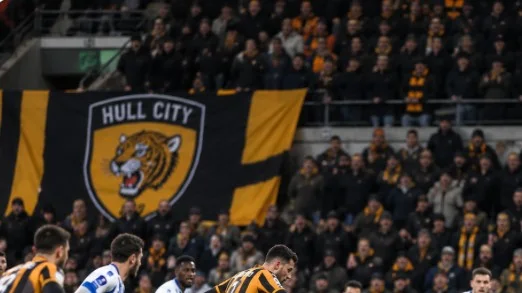
Football has a habit of reminding us that the game is not played on paper.
Brighton arrived as the clear favourites. Their technical quality, attacking depth and superior league position suggested a difficult afternoon for Hull City. On almost every conventional measure, Brighton had the stronger hand.
But football is not a spreadsheet.
Hull produced a performance built on organisation, defensive commitment and an understanding of exactly what the game required. They did not need to dominate possession or dictate the rhythm for 90 minutes. They needed to remain competitive, frustrate Brighton and make their opportunities count.
They did all three.
Brighton had the ball. Hull understood the game.
The defining feature of the contest was the contrast in approaches.
Brighton wanted to establish control through possession, technical combinations and attacking movement. Their game is built around creating numerical advantages, moving opponents out of position and finding spaces between the lines.
Hull's response was disciplined and pragmatic.
Rather than getting drawn into an open contest, they concentrated on maintaining their defensive shape, protecting central areas and making Brighton work for every opportunity. The objective was not necessarily to stop Brighton having the ball, but to stop them doing meaningful damage with it.
That distinction matters.
Possession can create the appearance of control without necessarily producing control of the result. Hull understood that they could concede territory without conceding the game.
The psychology of an upset
There is another dimension to victories like this that statistics often fail to capture.
As the game progresses without the favourite finding a breakthrough, the psychological balance begins to change.
The pressure gradually moves from the underdog to the team expected to win. Every missed opportunity becomes more frustrating. Every defensive intervention increases the belief of the team protecting its goal.
For Hull, the challenge was to remain composed and recognise that the opportunity was becoming increasingly real.
For Brighton, the challenge was to avoid allowing frustration to influence their decision-making.
Hull handled that equation better.
The decisive difference: Execution
The 2–0 scoreline tells the ultimate story.
Hull converted the opportunities that mattered and protected their advantage. Brighton, despite entering the match with considerably higher expectations, left without a goal.
Oli McBurnie's dramatic stoppage-time goal was a defining moment in the contest, turning a frustrating afternoon into a memorable one for the home supporters.
The second goal made the victory even more emphatic.
This was not simply about taking advantage of an opponent's mistakes. It was about sustaining concentration, executing a plan and delivering under pressure.
What this means for both clubs
For Hull City, this is the kind of result that can become a reference point for the rest of the season.
It reinforces the belief that tactical organisation and collective commitment can bridge considerable differences in individual quality. More importantly, it gives the squad evidence that they can compete with opponents who might look superior on paper.
For Brighton, the defeat should prompt some uncomfortable questions.
Technical superiority is valuable, but it must translate into decisive actions in both penalty areas. When a team struggles to convert its territorial advantage into goals, it becomes vulnerable to precisely this kind of result.
The lesson is not that possession is unimportant. It is that possession without sufficient penetration, composure and finishing can become an illusion of superiority.
The bigger lesson
There is something refreshing about a result like this.
Modern football increasingly revolves around data, sophisticated tactical systems, expected goals and increasingly detailed assessments of squad quality. These tools help us understand the game, but they cannot fully capture its human dimension.
Confidence, concentration, collective belief and the ability to withstand pressure remain decisive.
Hull City demonstrated that football still rewards teams that understand their strengths, commit to a collective plan and refuse to be intimidated by the reputation of their opponent.
Brighton may have arrived with the greater pedigree.
Hull left with the three points.
Sometimes the best team on paper is not the best team on the pitch. At the MKM Stadium, Hull City made that distinction emphatically clear.
More stories
- Aleksey Batrakov Attracts Barcelona Transfer Interest
- Manchester United weigh Osimhen move, transfer report says
- Ravens 20, Chargers 23: A season at the edge
- Billie Jean King ties 39 majors to equal-pay fight
- Cavaliers list Jarrett Allen questionable for Hornets game
- Liverpool face Arsenal with 3-point gap at stake
- FIFA Presidential Eligibility Challenged by Advocacy Group
- Finlay Tarling dies at 19 after Tour of Portugal race crash
Latest news
- David Parr House to honor Victorian art-workman with blue plaque
- Iran's attacks hit 25 tankers near Strait of Hormuz
- FCC approves prison cellphone jamming despite 2.5-mile warning
- Russia strikes Ukraine as Odesa faces electricity strain
- Bahrain reports two injuries after Iranian aerial attacks
- Congress tests Black Democrats' growing policy influence
- Baltic responders fight Sparta II fire after drone strike
- Dietitians advise small swaps for plant-based eating