Trump Tells UN the US Will Rename AI 'Super Intelligence'
President Trump’s UN address signals a shift from "artificial" to "super" AI, favoring deregulation over UN guardrails. No executive order is in place.
Atlas Newsdesk ·
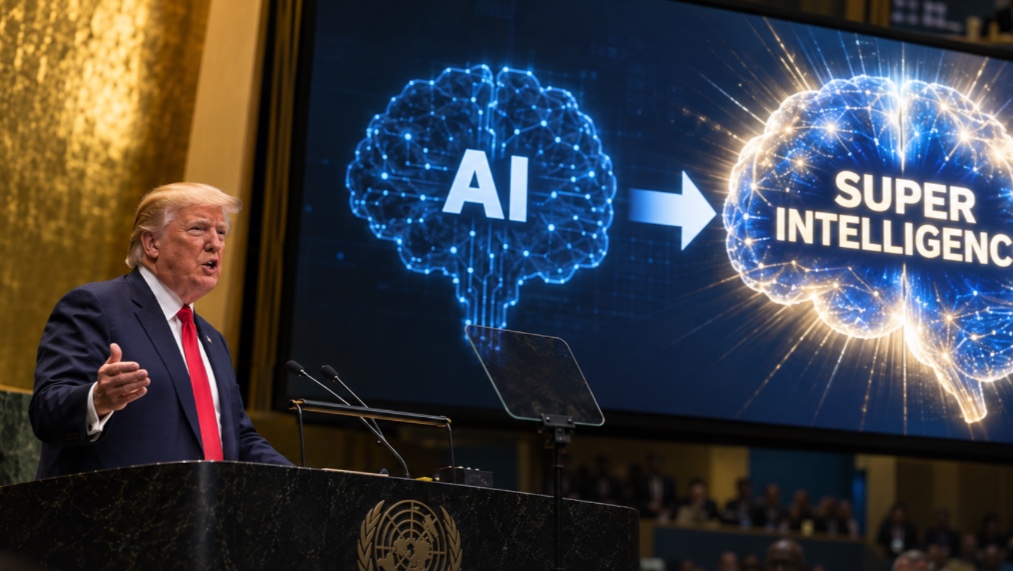
President Donald Trump told the 81st session of the United Nations General Assembly on Tuesday, September 22, 2026, that the United States will stop calling the technology "artificial intelligence" and begin calling it "super intelligence," saying the change should apply across US government documents and, he hoped, worldwide. "From this point forward, all of United States documents, and hopefully the world's will be changed to use the much more accurate term 'super' as opposed to artificial. So it's super intelligence," Trump said in the speech, according to reports. Reports indicated that he also repeated his earlier characterization of AI safety warnings as a hoax.
The remark matters because it moves a naming idea Trump floated in weekend social-media polls onto the highest-profile diplomatic stage in the world, and because it lands squarely against the direction the UN itself is taking on AI. The declaration carries no legal force: as of Tuesday there is no executive order or statute renaming AI, and federal law still defines "artificial intelligence" in 15 U.S.C. § 9401. The moment crystallized a widening gap between Washington's deregulatory, race-with-China posture and a multilateral effort, launched by the General Assembly in 2025, to build shared oversight of the technology.
The remark in context
Trump was the second head of state to speak in Tuesday's general debate, following Brazilian President Luiz Inácio Lula da Silva, who by custom opens the assembly. The morning session began at 9:00 a.m. Eastern at UN Headquarters in New York, with Trump taking the podium roughly 15 minutes after Lula. Secretary-General António Guterres and General Assembly President Khalilur Rahman opened the session before the country statements.
Coverage of the address itself quoted a single verbatim sentence on the renaming, with wire services noting that Trump reprised his recent framing of AI-safety alarms as overblown. Much of the fuller argument that accompanied the "super intelligence" push during the week appeared in Trump's Truth Social posts rather than in the confirmed podium text. The speech ranged widely across Iran, Venezuela, Cuba, Greenland and migration; the Cuban delegation walked out as Trump said the island's government "will fall," according to live coverage.
Secretary of State Marco Rubio, quoted in reports, said the administration is examining a potential AI "hotline" with China, framing AI as a technology the US cannot afford to fall behind on while still guarding against harm.
The weekend polls that set it up
The renaming idea originated days earlier. On Saturday, September 19, 2026, Trump posted a Truth Social poll asking followers to choose among "Superior Intelligence (SI)," "Extreme Intelligence (EI)" and "Supreme Intelligence (SI)," writing that "many people think that the words 'Artificial Intelligence' are inaccurate, and very ineloquent." He later dropped "Supreme Intelligence" and, on Monday, September 21, ran a runoff between "Super Intelligence" and "Superior Intelligence." He then adopted "Super Intelligence (SI)" in a post that dismissed AI-doom warnings, writing that critics of AI were spreading a "Hoax" comparable to what he called earlier hoaxes over Russia and climate change, and asserting "Whoever wins AI, WINS! We are leading now over China, and everyone else."
The same weekend, Trump announced he was forming an "AI Force," modeled on the Space Force he created in his first term, and said he would soon name an AI "czar," adding "Only High I.Q. individuals need apply!" Neither the AI Force nor the czar role has been formally defined. The announcements followed California Governor Gavin Newsom's Executive Order N-9-26, signed September 18, 2026, directing the state's Government Operations Agency to submit recommendations by November 16, 2026 on requiring a "kill switch" for frontier AI models; Newsom said, "We're not waiting to act — we're going to speed up our work on substantial and responsible AI oversight before it's too late." The federal announcements came days before a planned state visit by Chinese leader Xi Jinping.
The legal reality
Renaming AI by presidential preference does not change US law. Federal statute at 15 U.S.C. § 9401(3), enacted in the National Artificial Intelligence Initiative Act of 2020, defines "artificial intelligence" as "a machine-based system that can, for a given set of human-defined objectives, make predictions, recommendations or decisions influencing real or virtual environments." That definition is embedded across executive orders and agency guidance. Trump's existing AI executive orders — including the January 2025 order removing what it called barriers to AI leadership and the December 2025 order on a national policy framework — do not rename the technology. Changing the statutory term would require Congress; changing agency usage would require formal rulemaking or a new executive order. As of Tuesday, neither had occurred, and the "super intelligence" label remained a verbal and social-media declaration.
UN AI governance and the international backdrop
Trump's remark cut against a governance track the General Assembly created a year earlier. On August 26, 2025, the assembly adopted by consensus Resolution A/RES/79/325, establishing two bodies: the Independent International Scientific Panel on Artificial Intelligence and the Global Dialogue on Artificial Intelligence Governance. The 40-member panel was seated in 2026, and the Global Dialogue held its first session in Geneva on July 6–7, 2026, with a second set for New York on May 3–4, 2027. The resolution implemented a commitment in the Global Digital Compact, adopted in 2024 as part of the Pact for the Future.
The United States has repeatedly rejected that multilateral approach. At the 80th General Assembly in September 2025, Michael Kratsios, then director of the White House Office of Science and Technology Policy, told a Security Council session, "We totally reject all efforts by international bodies to assert centralized control and global governance of AI," arguing the path forward lay in "the independence and sovereignty of nations." In February 2026, at the AI Impact Summit in New Delhi, Kratsios reiterated that the US "totally" rejects global governance of AI. In that same 2025 speech, Trump nonetheless proposed that the US would lead an effort to enforce the Biological Weapons Convention "by pioneering an AI verification system that everyone can trust," offering the one area where he invited UN cooperation.
Guterres, in his final high-level week before leaving office at year's end, has pressed the opposite case. At a pre-UNGA press conference at UN Headquarters on September 16, 2026, he warned that "the world cannot afford a race to the bottom on AI safety" and called on leading AI nations to establish "common guardrails," language widely read as a direct contrast with Trump's position.
Stakeholders
The renaming push reflects an alliance between Trump and the deregulatory wing of the AI industry, including Nvidia CEO Jensen Huang, who in an interview aired Sunday, September 21, 2026 dismissed extinction warnings as "doomsday narratives," saying, "2030 is not going to be the end of the world. There is 0% chance that's going to be the end of the world. Scaring people is unnecessary. It is irresponsible." It runs against a safety-focused camp led by Anthropic CEO Dario Amodei, who in an essay titled "We Must Pace the Frontier," published Saturday, September 12, 2026, wrote, "We must slow the pace at which we improve the capabilities of AI models. Progress will still seem fast, and we must make wise use of the time we gain." Foreign governments and the UN Secretariat largely favor coordinated oversight; China has supported a UN-anchored framework even as it competes intensely with the US for AI leadership. Domestic polling suggests public unease: a poll conducted September 13–15, 2026 among 2,064 US adults found 48% favor pausing development of more advanced AI models compared with 31% who favor continued development, and 63% said AI could destroy humanity one day.
Market reaction
US equities were muted during and after the speech, with no clear move attributable to the AI-naming remark. As of late Tuesday morning, the Nasdaq Composite was modestly higher and the Dow was slightly lower, extending a Monday rally that was driven by AI optimism tied to new product news rather than by the UN address. Any connection between the speech and intraday moves is not established.
What comes next
Attention turns to whether the administration converts rhetoric into policy: a possible executive order or agency guidance adopting "super intelligence," the promised naming of an AI czar, and the shape of the "AI Force." The planned Xi visit and reported US-China contacts on an AI incident channel will test whether Washington's competitive posture leaves room for bilateral risk management. At the UN, the Global Dialogue's May 2027 New York session and the scientific panel's reporting will proceed without US endorsement of centralized governance.