

Midterm elections 2026: Final hours of voting
Americans vote Tuesday with every House seat at stake, as Democrats seek at least three Republican seats to challenge President Donald Trump’s congressional…
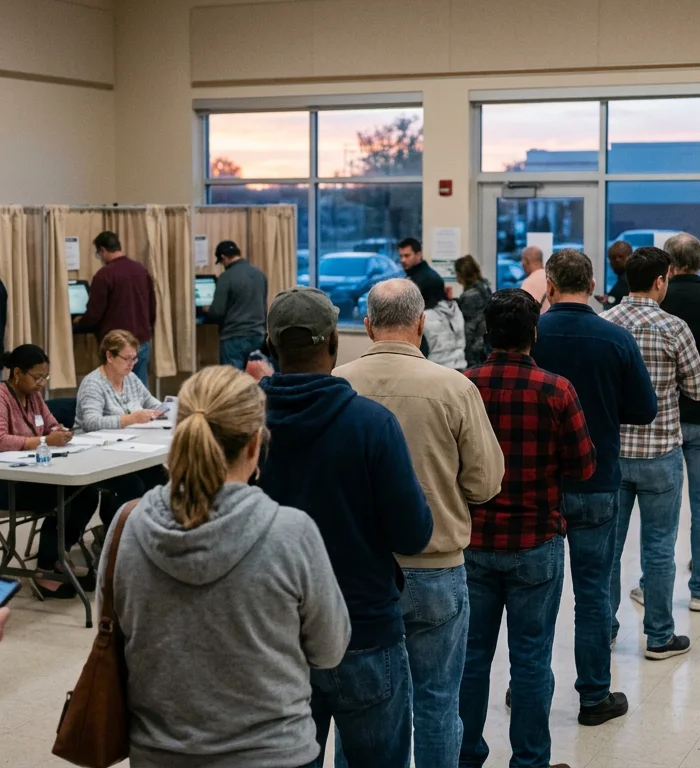
Americans vote Tuesday with every House seat at stake, as Democrats seek at least three Republican seats to challenge President Donald Trump's congressional hold.
A Democratic majority requires a minimum of three House pickups or four Senate pickups, with the party also needing to defend its existing seats. Roughly one-third of Senate positions are being contested, leaving voters to determine the congressional balance during Trump's second term.
The ballot extends beyond Washington: voters are choosing governors in 36 races, alongside thousands of legislative contests and ballot measures at the state level. The congressional races nevertheless provide the direct test of whether Republicans retain their majorities alongside the presidency.
Redrawn districts complicate House arithmetic
The House contest combines Democratic efforts to gain Republican seats with defensive races in districts whose boundaries Republican lawmakers have changed. That makes the pickup threshold only part of the calculation: any Democratic losses would require additional victories elsewhere.
Florida Republicans revised the congressional map with the aim of gaining four seats in areas previously regarded as securely Democratic. Democrats remain competitive in three of those redrawn districts, leaving the outcome of that effort unsettled as voting proceeds.
One such contest involves Democrat Jared Moskowitz and Scott Singer, a Republican who previously served as Boca Raton's mayor. Their race in Florida's 25th District is among the tests of whether the revised boundaries translate into Republican representation.
In North Carolina, Democratic Representative Don Davis is defending a district that became more Republican under its new boundaries. Trump's three-percentage-point margin under the earlier configuration compares with a double-digit margin across the redrawn district.
Democrats have spent $22 million on the North Carolina contest, compared with $17 million for Republicans. That spending advantage accompanies a less favorable electoral map for Davis; it does not establish how voters will decide the race.
South Texas tests Republican map changes
Texas Republicans pursued a larger redistricting target: five additional seats held by Democrats, compared with four sought in Florida. Three of the targeted Texas districts remain competitive, all located in the state's southern region.
A separate South Texas contest puts Republican Representative Monica De La Cruz on defense in the 15th District. Her constituency was also redrawn in a more Republican direction, but the race remains competitive.
De La Cruz faces Bobby Pulido, a Democratic challenger known for his career in Tejano music. His candidacy adds an established entertainment figure to a congressional contest that is testing the limits of the Republican map advantage.
Congressional control depends on defensive races
If Democrats preserve their vulnerable districts, Republican-held seats such as De La Cruz's offer opportunities to reach the House majority threshold. If redistricting instead produces Democratic losses, the party would need a broader set of Republican defeats to compensate.
The Senate has its own four-seat threshold, so a House victory would not by itself deliver control of Congress. The immediate unresolved questions are which party holds the competitive districts and whether those results produce a change in either chamber's majority.
More stories
- Democrats hold Michigan Senate seat with El-Sayed victory
- Democrats face limits on gains as midterm voting arrives
- Stevens backs Rogers for Senate after a Democratic defeat
- Senate contests put Trump's remaining agenda on the line
- Rubio says Trump remains open to another meeting with Kim
- Trump administration escalates election suits before vote
- Trump’s 2028 Joke Reopens the Republican Succession Question
- Paper leaks force India education minister out of office
Latest news
- British Airways restores daily Dubai-Heathrow flights
- Türkiye Desk: e2vc opens $150m growth fund for games and tech
- Data centers face backlash after Democratic midterm wins
- Pedro Sánchez ties US midterms to Spain’s election fight
- Townsquare suspends dividend after $4m Q3 net loss
- Democratic sweep lifts stock futures, dents dollar, yields
- Ethiopian Human Rights Commission puts Shirka toll at 48
- Abu Dhabi draws private-equity firms as secondary deals hit $121bn