

Rubio says Trump remains open to another meeting with Kim
Trump remains willing to meet Kim Jong-un, Rubio said, but no talks are scheduled as Washington and its allies maintain their nuclear demands.
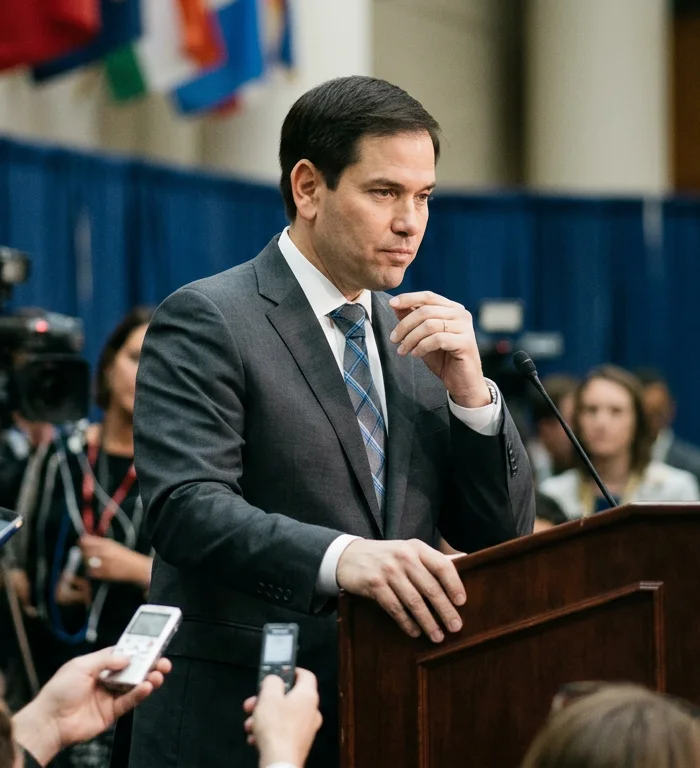
President Donald Trump remains willing to meet Kim Jong-un, Marco Rubio said, but no talks are scheduled as allies retain their nuclear demands.
US Secretary of State Marco Rubio described the president’s willingness to engage as conditional on discussions addressing American and allied concerns. His remarks left a distinction between openness to a summit and an agreement to hold one.
Rubio separates access from concessions
Speaking at a press conference, Rubio said Trump did not regard meeting another leader as a “concession.” He contrasted that position with a diplomatic approach in which invitations or direct contact can be treated as conferring legitimacy.
Rubio said the president would consider renewed dialogue if North Korea and its leader were willing to discuss matters important to Washington and partners including South Korea. He also tied that willingness to the prospect of a useful result, rather than announcing an unconditional invitation.
The secretary’s description concerned Trump’s approach to diplomacy, not an announced change in US nuclear policy. Rubio offered no meeting announcement and said nothing had been scheduled.
Allies retain their nuclear objective
A separate diplomatic engagement set out the position Washington shares with Seoul and Tokyo. Rubio held discussions with South Korean Foreign Minister Cho Hyun and Japanese Foreign Minister Toshimitsu Motegi in Atlanta on October 30, alongside the G20 gathering of foreign ministers.
The ministers restated their goal of complete denuclearization for North Korea and pledged to keep coordinating on its nuclear activities. They also committed to carrying out the relevant UN Security Council resolutions.
The US State Department said it supported enforcing measures that restrict revenue used to sustain Pyongyang’s nuclear and ballistic missile programs. That position places financial restrictions alongside the possibility of direct diplomacy; the supplied account contains no announcement that Washington would relax those measures to secure talks.
South Korea and Japan therefore feature in both strands of the US position: as partners in the coordinated nuclear policy and as allies whose concerns Rubio said discussions should address. His comments did not specify an agenda or explain how those concerns would be incorporated into a leaders’ meeting.
APEC speculation lacks a scheduled meeting
The remarks follow repeated approaches by Trump seeking nuclear discussions with Pyongyang. They also coincide with speculation about a possible encounter with Kim at the APEC summit in China next month, although Rubio did not confirm such plans.
If the willingness Rubio described leads to preparations, an agreed date and an agenda would distinguish a developing negotiation from a general offer of engagement. A substantive opening would also leave Washington, Seoul and Tokyo to coordinate their approach against the nuclear objective they have just reaffirmed.
If no meeting is arranged, the announced position remains continued allied coordination and enforcement of restrictions, with dialogue still available in principle. For now, Rubio’s comments establish the president’s stated willingness to talk, not a timetable, a negotiated framework or a change in North Korea’s position.
More stories
- Senate contests put Trump's remaining agenda on the line
- Trump administration escalates election suits before vote
- Trump holds back on Bolsonaro claim to Brazil leadership
- Judge Rules Trump Administration Illegally Fired Maurene Comey, Prosecutor in Epstein and Diddy Cases
- Trump targets El-Sayed with extremist claims in Michigan
- Damages dispute puts Trump finances at center of lawsuit
- Pentagon plans for limited Iran ground operation
- Colombian economy struggles despite high oil prices
Latest news
- Indian banks cite up to 50% gains from AI systems
- Acemoglu urges Democrats to rebuild working-class appeal
- Russian state-affiliated media raise UK posts 15% in September
- Binance withdrawals resume after $6 billion-plus cyber theft
- Delhi protests demand election chief quit over voter rolls
- US tip-off in Moscow case points to security cooperation
- US tip-off in Moscow case points to security cooperation
- AI-displaced workers face one-month rehiring lag