

Trump nears midterms at 32% approval with Democrats ahead
President Trump’s approval edges up to 32% before the midterms, an Ipsos poll shows, while Democrats retain a national congressional polling lead.
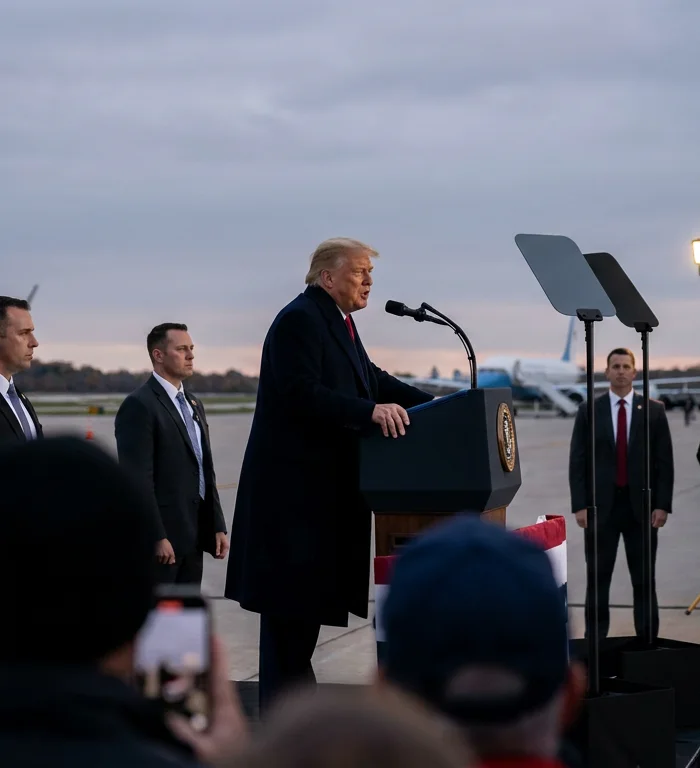
President Trump's approval edges up to 32% before the midterms, an Ipsos poll shows, while Democrats retain a national congressional polling lead.
The survey, completed October 26, puts Trump's rating one percentage point above the previous week's low. Republicans are defending both congressional chambers on November 3; losing either could constrain his legislative agenda during the remainder of his second term.
Among registered voters, 47% chose Democrats for Congress and 36% chose Republicans, according to the poll. That 11-percentage-point advantage narrowed from 12 points in the survey completed October 19, while 11% remained undecided.
Democratic leads depend on the measure
When interviewers asked undecided respondents which party they leaned toward, Democratic support reached 50%, against 41% for Republicans. That produces a nine-point advantage, rather than the 11-point gap recorded before those preferences were included.
Respondents identified as most likely to participate also preferred Democrats by nine points, with 53% supporting them and 44% choosing Republicans. These are different measures of voter preference, not interchangeable estimates of the eventual election result.
The national congressional question measures party preference across the country, rather than support for individual candidates in particular contests. House districts and statewide Senate elections determine congressional control, so the Democratic advantage cannot be translated directly into a seat forecast.
Household costs accompany an economic reversal
Financial dissatisfaction was widespread: 73% of voters said their living costs were moving in an unfavorable direction. That finding measures respondents' experience and perceptions; it is not a measure of the inflation rate or the size of household price increases.
Democrats also held an advantage on economic management, with 37% choosing their approach against 33% favoring Republicans, according to the survey. Earlier polling before the Iran war had placed Republicans ahead on that question, marking a reversal in the party preference recorded by the surveys.
The economic findings give Republicans another unfavorable measure alongside Trump's approval rating. They do not establish how much any single issue will influence voting, or whether dissatisfaction with prices will outweigh other considerations in individual congressional races.
Turnout and polling limits shape stakes
Enthusiasm differed between the parties: 46% of Democrats described themselves as very enthusiastic about voting, compared with 30% of Republicans. If that difference carries through to participation, it could help Democrats convert favorable national sentiment into votes; enthusiasm alone does not establish who will cast a ballot.
The online survey ran for five days and included 1,679 adults, of whom 1,280 were registered voters. Its reported margin of error was two percentage points for adults and three points for registered voters, providing context for the one-point movement in Trump's approval.
The next test is whether those preferences survive the transition from survey responses to district and state results. If Republicans retain both chambers, they would preserve their congressional majorities alongside the presidency; if Democrats capture either, Trump would face an opposition-controlled chamber with greater leverage over legislation.
More stories
- South African parties split over Cape Town's 30,000-home annual gap
- Ruto seeks Russian investment in Kenya's $380m trade push
- Sudan teachers seek 20% budget share with 8m children outside school
- Spain rail network faces scrutiny after 64 killed near Toledo
- Spain reports at least 30 dead in high-speed train crash
- Villa Vie disembarks 203 passengers in Cambodia over fuel costs
- Jayakumar backs Singapore GRC safeguards after online attacks
- Tomorrow's Netanyahu election bid tests Israel's coalition arithmetic
- Congress weighs AI safety standards before year-end vote
- US housing starts drop while mortgage costs pressure demand