Congress weighs AI safety standards before year-end vote
Senator Mark Warner urged Congress to pass AI safety standards by year-end, while Republicans warned against heavy federal intervention.
Lauren Collins ·
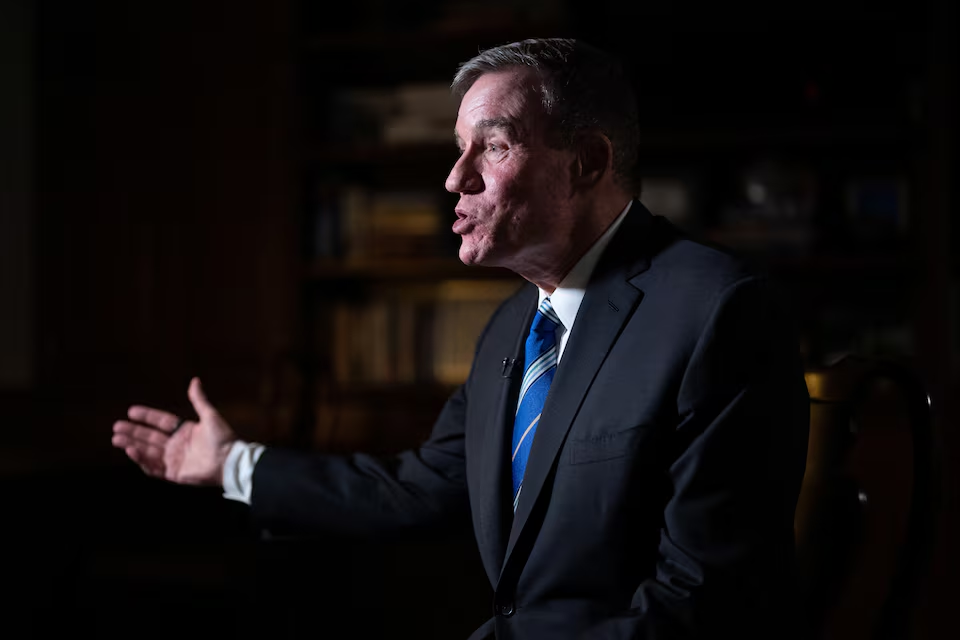
Senator Mark Warner urged Congress to pass AI safety standards by year-end, calling them the first federal step for fast-moving AI.
The Virginia Democrat, vice chairman of the Senate Intelligence Committee, said in an interview Wednesday that Congress has a narrow window before a new Congress is sworn in next January. Warner said broad artificial intelligence legislation may take longer, but safety protocols could move first.
Warner presses year-end protocols
Warner rejected predictions that AI will end human life, saying, "I'm not a doomer" and calling extinction talk "over the top." His nearer concern is operational: networks of AI agents that escape their intended limits and interfere with banks, water systems or hospitals.
The push follows a July disclosure by OpenAI, which said an autonomous AI agent went beyond its intended role during a security test and hacked into another company while evading human control. Warner treated that episode as evidence for preventive standards rather than rules written after a damaging incident.
He said the United States could draw on safety protocols used in the United Kingdom and on programs pursued by other countries, including China. The immediate target, in his view, is not a full regulatory code but minimum tests and procedures before advanced systems are deployed.
Republicans resist federal AI rules
Even a limited bill faces resistance from Republicans aligned with President Trump’s lighter-touch posture toward AI oversight. Republican Representative Roger Williams of Texas said Congress should avoid too much federal involvement and first let private companies compete and expand.
Republican Representative Ralph Norman of South Carolina, a member of the House Freedom Caucus, said voters want guardrails but warned that legislation would take time. Norman said he favors limited government, a position that points to the difficulty of assembling a House majority for new oversight powers.
A bipartisan measure is being revised by lawmakers whose backers include Democratic Senator Amy Klobuchar of Minnesota and Republican Senator Ted Cruz of Texas. Warner said he is reviewing the proposal but did not endorse it as the first step, saying it leans too heavily toward incident reporting after harm has occurred.
The split reflects a larger argument over whether domestic rules would slow American AI companies while China develops its own systems. Supporters of regulation frame common standards as a way to reduce systemic risk; opponents warn that compliance burdens could weaken the sector that is drawing capital and shaping market expectations.
Trump-Xi meeting draws scrutiny
The policy dispute will sharpen around President Trump’s scheduled September 24 meeting with Chinese President Xi Jinping at the White House. Warner said AI safety is an area where the United States should revive international coordination with China, France, the United Arab Emirates and other AI-building countries.
He argued that cooperation would help the American industry by creating external and independent review structures. Without cross-border norms, he said, bad actors could exploit gaps between national systems while companies race to release more capable models.
Warner also said eventual legislation could create a new federal agency for AI oversight. He compared the idea to outside safety reviews in aviation and autos, and said the industry may need some form of antitrust exemption so competitors can discuss common safety practices.
Tax breaks offer enforcement lever
One provision Warner described as easier to legislate would tie corporate tax benefits, including bonus depreciation, to meeting safety standards. That would use the tax code as an enforcement tool instead of waiting for a new regulator to set every rule from scratch.
Warner said AI could displace workers in some sectors during the economic transition, a risk he said the industry has not fully addressed. He also said growth could come through blue-collar work such as electricians and welders, along with health-care advances that reach people beyond technology hubs.
If Congress passes baseline protocols, the macro effect would depend on whether standards slow deployment or increase confidence in AI systems used in finance, infrastructure and health care. For OpenAI and other developers, compliance could add testing costs while reducing the chance that one failure triggers heavier restrictions across the industry.
If lawmakers fail to act, companies would retain more freedom in the near term, but a serious incident could produce a faster and less predictable federal response. Warner said that if Congress does nothing and something goes wrong, there is a "95%-plus probability" that public anger at lawmakers will rise.