Taiwan concerns test Trump-Xi summit as trade gains loom
US allies are pressing President Trump to preserve Taiwan policy as Xi Jinping prepares to raise the island at a September 24 summit.
Lauren Collins ·
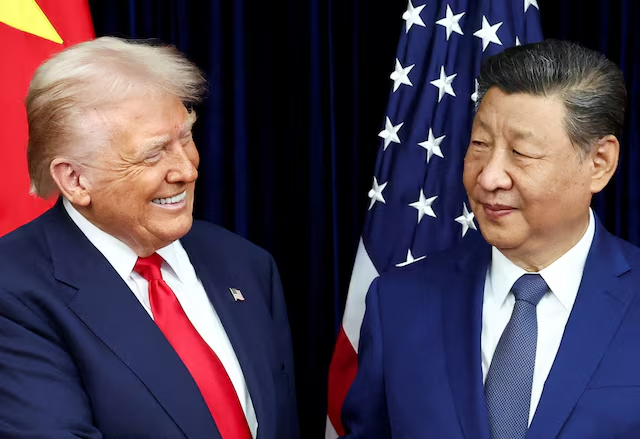
Taiwan policy is becoming a central test of President Trump's September 24 meeting with Xi Jinping as allies warn against concessions.
Officials, lawmakers and analysts in Taipei, Tokyo and Washington said even a small shift in US language could unsettle an already tense security balance. Their concern has intensified since Trump described US arms sales to Taiwan in May as a "negotiating chip" while seeking economic commitments from Beijing.
Emma Chanlett-Avery, political-security affairs director at the Asia Society Policy Institute, said allies were watching for signs of a change in Washington's China policy. "Any indication of a softness on Taiwan would be quite alarming," she said.
September 24 summit pressure
China describes Taiwan as the "core of core interests" in its relationship with the United States and has not ruled out using force to bring the island under Beijing's control. President Trump has said Xi personally assured him China would not attack Taiwan while Trump is in office.
The contrast with Joe Biden is central to allied unease. Biden repeatedly said the United States would defend Taiwan if China attacked, while Trump has declined to make the same commitment.
At a defense forum in Beijing on Tuesday, Cui Tiankai, China's former ambassador to Washington, said "reunification" with Taiwan would create stability that is "in the interest of the United States." The remark showed how Beijing may frame Taiwan as a matter of regional order rather than only Chinese sovereignty.
Tokyo seeks Taiwan assurances
Taiwanese officials are trying to make their position clear before the summit. Shen Yu-chung, a senior Taiwanese official, told reporters in Taipei on Monday that Taiwan hoped there would be "no situation that harms Taiwan."
Taiwan Foreign Minister Lin Chia-lung said Tuesday he expected Xi to raise the island in talks with Trump. Lin said Washington had repeatedly told Taipei that US policy toward Taiwan had not changed.
Japan's leader, Sanae Takaichi, is also seeking contact with Trump before the meeting with Xi, according to two Japanese government sources who requested anonymity because of the sensitivity of the matter. The sources said a senior foreign ministry official visited Washington last week to help arrange an exchange, with the United Nations General Assembly in New York viewed as the most likely venue.
Japan's foreign ministry declined to comment on working-level travel and said no decision had been made on contact between Takaichi and Trump. The ministry said Japan would closely follow the summit and wanted US-China relations to support international stability.
A $14 billion bargaining point
The most concrete issue is a $14 billion US arms package for Taiwan that has awaited Trump's approval for months. After meeting Xi in May, Trump said he was holding the package and called it a "very good negotiating chip."
Wu Xinbo, a Fudan University professor who advises China's foreign ministry, told the Beijing forum that Washington must take Beijing's objections to arms sales seriously. The US follows a one China policy, under which it acknowledges Beijing's position that Taiwan is part of China but does not endorse that claim or take a formal position on Taiwan's sovereignty.
Xi asked Biden at a 2023 summit to clearly reject Taiwanese independence, but Washington did not do so. Japanese government sources said Trump's tendency to speak off the cuff creates a specific risk when phrasing on Taiwan carries diplomatic weight.
Taiwan scenarios shape choices
If Trump keeps established US wording and separates Taiwan from trade bargaining, the immediate macro effect would likely be lower regional risk premia, while Taipei gains policy continuity and chip supply chains avoid a fresh political shock. That outcome would still leave unresolved questions over the $14 billion arms package and the pace of future deliveries.
If Trump instead frames arms sales or Taiwan language as tradable for Chinese purchases of US goods, Beijing may read the shift as greater room to press Taipei. That path could tighten global supply-chain risk, weaken Taiwan's security position and force semiconductor customers to reassess exposure to an island described by experts as producing over 90% of the world's advanced semiconductors.
Raja Nushirwan Zainal Abidin, Malaysia's director general of national security, said during a Washington visit that Western governments underestimate Taiwan's importance to Beijing. A Chinese invasion, he said, "will change the world as we know it, and because of that we have to be very, very careful."