North Korea minister defends nuclear buildup in Beijing
North Korea used a Beijing security forum to defend nuclear expansion, linking the move to US-led military cooperation with South Korea and Japan.
Lauren Collins ·
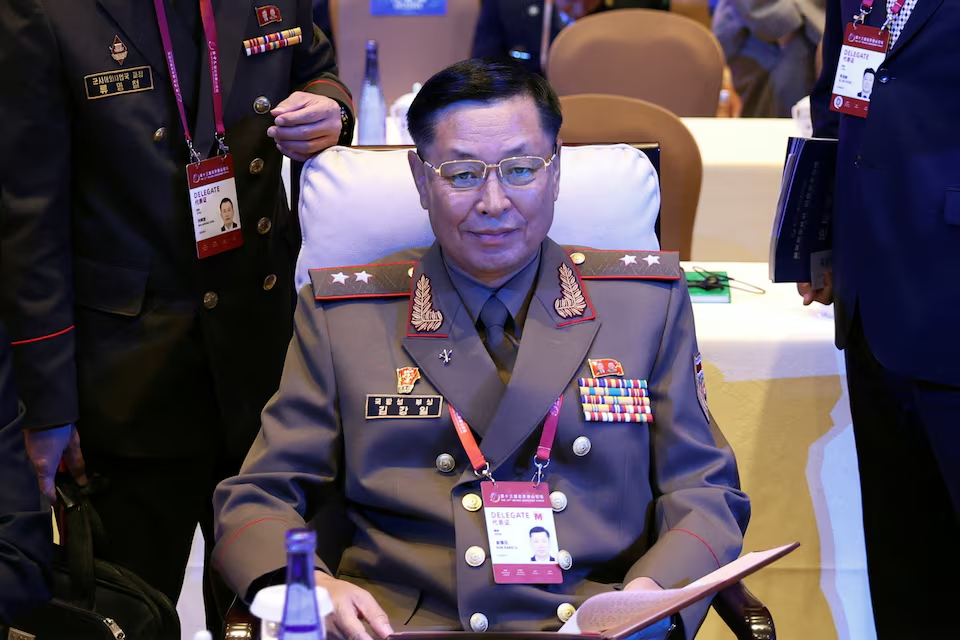
North Korea defended its nuclear expansion against a three-country US alliance, hardening its rejection of denuclearization at a Beijing security forum.
Vice Defence Minister Kim Kang Il used the Beijing Xiangshan Forum on Thursday to say Pyongyang would keep enlarging its arsenal. He tied that position to a US-led military buildup and to cooperation among Washington, Seoul and Tokyo, which he characterized as a nuclear alliance.
Kim said the country's constitutional nuclear status was the "line of no retreat," and told governments pressing for denuclearization to drop what he called a "daydream." The formulation put legal permanence at the center of Pyongyang's argument, rather than leaving its arsenal as a bargaining chip.
Kim makes Beijing case
At the forum, Kim described the Democratic People's Republic of Korea as a state responding to external threats, not initiating escalation. "The ceaseless nuclear arms buildup of the enemy states fully justifies the building of a solid nuclear shield of the DPRK," he said.
His appearance gave Pyongyang a rare senior platform at China's flagship international security conference. The timing also placed North Korea's message in front of regional officials as it seeks closer ties with Beijing and faces pressure from Washington and its allies.
Denuclearization language closes
Kim's remarks followed a separate statement from Kim Yo Jong, the sister of Kim Jong Un, rejecting renewed calls for denuclearization after discussions at the annual meeting of the International Atomic Energy Agency. According to state media KCNA, she said the country's nuclear status was "absolute" and had been established both physically and legally.
The two statements pointed to a shared message: Pyongyang is presenting its arsenal as a settled feature of the regional security map. That position narrows the space for talks that start from the premise that North Korea's nuclear program can be dismantled.
Asked whether President Trump could meet Kim Jong Un, Kim Kang Il said he was not in a position to discuss such a summit. Stephen Biegun, former U.S. Special Representative for North Korea, said North Korea's limited public response to Trump's repeated claims of communication with Kim suggested Pyongyang was "not closing the door" to talks.
Biegun said it "would not be a surprise at all" if President Trump proposed a meeting after the APEC summit in China in November, including possibly in Pyongyang. That was an outside assessment of diplomatic signals, not a North Korean commitment.
Military planning draws warning
A North Korean defense ministry spokesman also criticized recent US-South Korean planning on weapons-of-mass-destruction response. The spokesman called those discussions and related exercises an open confrontation and warned that Pyongyang could invoke provisions of its nuclear force policy law.
Lim Eul-chul, a professor at Kyungnam University's Institute for Far Eastern Studies in Seoul, described the series of statements as coordinated messaging on nuclear policy. Lim said Pyongyang was trying to lock in an irreversible-stage claim and create justification for future military or nuclear activity against what it portrays as US and South Korean pressure.
Three paths for Pyongyang
If diplomatic contact resumes, the immediate macro effect would likely run through security risk rather than trade data, with governments testing whether talks can lower military signaling. For North Korea, that path could preserve its nuclear claim while reopening leader-level diplomacy; for the wider defense sector, it could slow the pace of exercises if political talks gain traction.
If the current pattern holds, Pyongyang is likely to keep using allied military activity as the stated mechanism for nuclear expansion. That would leave regional governments planning around a more entrenched North Korean arsenal, while missile defense, deterrence coordination and sanctions enforcement remain central industry and policy channels.
If US, South Korean and Japanese planning expands further, North Korea could frame additional launches or policy steps as self-defense under its nuclear doctrine. The main open question is whether any diplomatic channel can separate a future summit from Pyongyang's claim that denuclearization is no longer negotiable.