Trump says Iran war may near end as Yemen risks widen again
President Trump said the Iran war may be nearing its end as Saudi-Houthi fighting widened energy risks and kept Brent above $100.
Lauren Collins ·
President Trump said the Iran war could be nearing an end after seven months, even as Yemen fighting widened risks to Saudi oil flows.
Seven months and wider fronts
Trump spoke on Wednesday evening after fresh reports of fighting between Saudi Arabia and the Iran-backed Houthis, whose campaign has moved the conflict deeper into the Red Sea corridor. "Well, hopefully we are towards the end of the war," Trump told reporters.
The war began on February 28 with US and Israeli strikes on Iran, followed by Iranian attacks on Israel and US bases in Gulf states. Trump s public goals and timelines have shifted during the conflict, but he said Iran wanted an agreement and that he had heard from Tehran "directly," without giving details.
The diplomatic track remains hard to measure. A report citing unidentified sources said Trump was expected to meet leaders or foreign ministers from Gulf Cooperation Council countries on the sidelines of the UN General Assembly, while the White House and State Department did not comment.
Oil routes set the stakes
The military expansion matters most for energy markets. The Strait of Hormuz carried about 20% of global oil and LNG before the conflict, and the war has already disrupted shipping through that route.
Damage to Saudi Arabia s East-West pipeline has added another pressure point. Traders said a prolonged closure could remove as much as 4% of global oil supply, while Saudi Arabia has not said when operations might resume.
Brent crude hovered near $108 a barrel on Wednesday, close to its highest level since May. In early Thursday trading, Brent fell $1.24, or 1.2%, to $104.59 by 0049 GMT, while West Texas Intermediate dropped $1.14, or 1.1%, to $101.29.
US diesel prices have also moved into politically sensitive territory, with the average retail price topping $6.30 a gallon for the first time. Higher fuel costs during the war have become an issue for Trump s Republican Party before the November midterm elections.
Yemen claims sharpen the threat
The United States tightened its travel warning for Saudi Arabia as the fighting spread. The advisory barred US government employees from traveling within 20 miles (30 km) of the Yemen border, a limit that links the security risk directly to the southern frontier.
Houthi military spokesman Yahya Saree said the group had launched new drone and missile strikes on Yanbu, a major Saudi Red Sea oil port, and on an airbase at Khamis Mushait in southern Saudi Arabia. He did not say when the strikes took place.
Saree also said Saudi forces had carried out as many as 450 airstrikes on Yemen this week. Officials in the Saudi-backed government that controls southern Yemen acknowledged that their forces and Saudi Arabia s were striking Houthi positions, while Riyadh has not confirmed the operations.
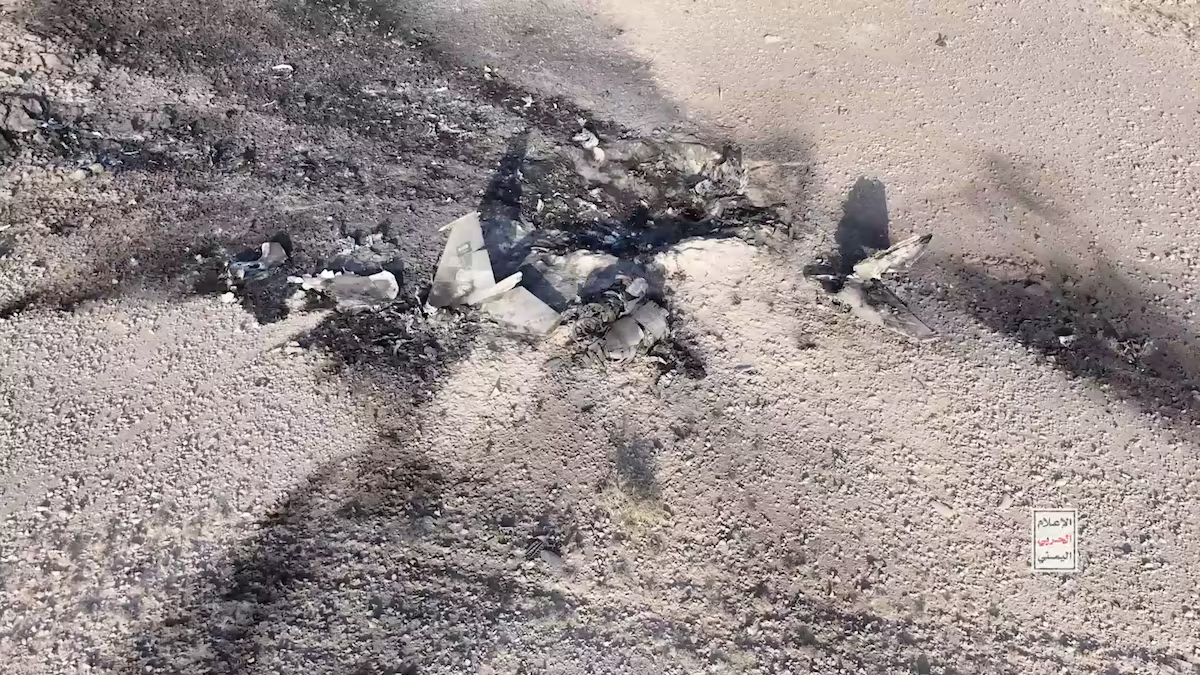
The Houthis released battlefield video showing fighters taking armored vehicles from Saudi-backed forces. The footage also showed warplanes overhead and explosions rising from desert terrain, but the images did not independently establish the timing or scale of the fighting.
Conditional paths for energy markets
If the East-West pipeline returns quickly and Hormuz traffic remains open, the global macro effect would likely run through prices rather than physical shortages. In that case, Saudi Arabia would preserve a key export route, while refiners and shippers would still price in a higher risk premium for Gulf cargoes.
If pipeline disruption lasts and Houthi attacks continue near Saudi energy assets, the mechanism changes from risk pricing to constrained supply. That would put more pressure on importing economies, leave Saudi Arabia managing both border security and export capacity, and force the energy industry to compete for alternative barrels and safer shipping routes.
If diplomacy advances after Gulf consultations, the first test would be whether attacks on Saudi territory and maritime routes slow. For global markets, that could steady crude benchmarks; for Saudi Arabia, it could narrow the immediate security burden; for the wider energy sector, it would reduce the need to reroute cargoes through costlier channels.