

Spain reports at least 30 dead in high-speed train crash
Spain’s regional authorities said at least 30 people died in a high-speed rail collision Wednesday on the Madrid to Andalusia route.
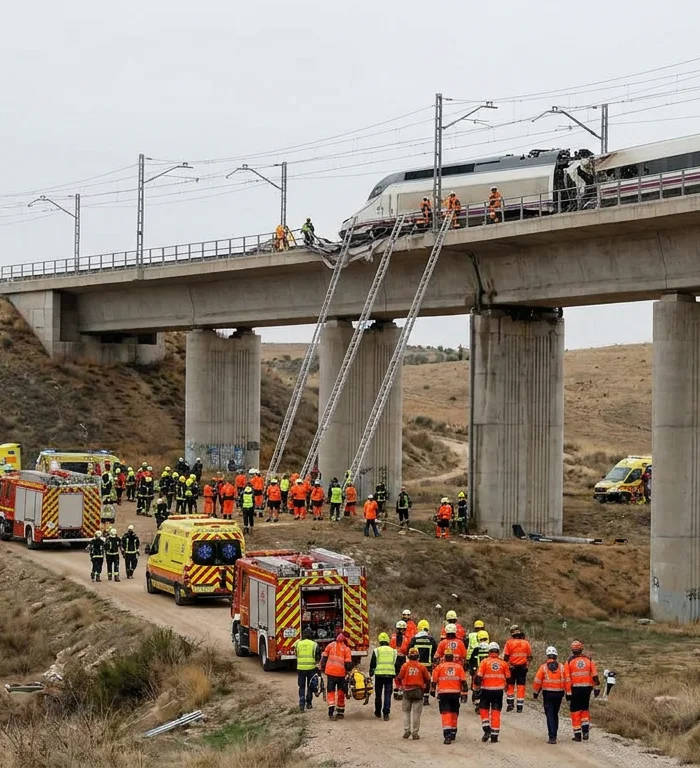
Spain's regional authorities said at least 30 people died in a high-speed rail collision Wednesday on the Madrid to Andalusia route.
The October 28 crash was the route's second fatal accident within a year, according to regional authorities. The reported toll is a minimum, rather than a final accounting of everyone killed in the collision.
Stopped train account names Iryo
A person briefed on the incident described a collision near Toledo involving services run by Iryo and Renfe. That account places one train at a standstill before the impact, but it has not been independently corroborated in the supplied information.
The person said infrastructure manager ADIF instructed an Iryo express to halt following a signaling fault. A Renfe service subsequently hit the stopped train while traveling at high speed, the person said.
Several carriages from each service left the rails following the impact, according to the same account. No measured speed was supplied, and the description does not establish the technical cause of the collision.
The distinction between the reported stopping instruction and the cause of the crash is important. Even if the account is confirmed, a signal fault preceding a collision would not, by itself, establish how the second train reached the stationary service.
Wreckage extends below elevated track
Regional television images showed a derailed train, with some carriages still on a raised stretch of railway. Debris, including damaged panels and metal wreckage, lay on the embankment below.
The footage documents the position of some wreckage after the crash, rather than the sequence leading to it. It does not independently establish the reported signaling problem or the instructions described by the person briefed on the incident.
A passenger identified as Miguel was riding with colleagues in a rear carriage of one service. Describing the impact in a radio interview, he said: "We heard a massive roar, a truly enormous thud that went on for 10 seconds, as if the train were about to derail."
Earlier fatal crash on same route
The connection between Madrid and southern Andalusia had already experienced a deadly accident less than a year earlier, regional authorities said. The supplied information does not establish a shared cause between that incident and Wednesday's collision.
If the stopped-train account is confirmed, the instructions issued by ADIF and the movements of the Iryo and Renfe services would be central to reconstructing the incident. Confirmation would still leave a separate question: what allowed the trains to collide after the reported halt.
The immediate unresolved issues include the final casualty count, the precise collision sequence and the role, if any, of the reported signaling fault. The available account does not establish responsibility on the part of either operator or the infrastructure manager.
More stories
- Ruto seeks Russian investment in Kenya's $380m trade push
- Sudan teachers seek 20% budget share with 8m children outside school
- Spain rail network faces scrutiny after 64 killed near Toledo
- Villa Vie disembarks 203 passengers in Cambodia over fuel costs
- NEITI faces methane data questions over 18 incomplete records
- Trump credits endorsement after Netanyahu bloc's 57-seat tally
- Nigeria traces 44 contacts after Abuja Ebola case
- UAE ministry seeks bids for 68km Dubai-RAK highway