

Nigeria traces 44 contacts after Abuja Ebola case
Pate said the patient arrived from Uganda and is isolated in the Federal Capital Territory while authorities seek passenger manifests.
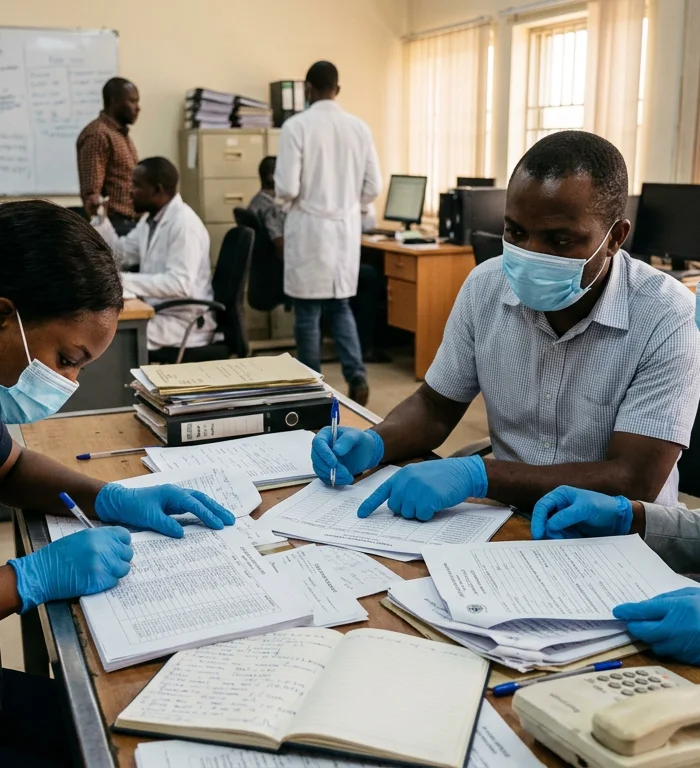
Nigeria is tracing 44 contacts after an Ebola case in Abuja, Coordinating Minister of Health and Social Welfare Muhammad Pate said in a Premium Times article published October 21.
For Nigeria, the October 21 Premium Times article places the case against a wider outbreak: WHO reported more than 8,700 confirmed cases and more than 4,200 deaths in the DRC as of October 6.
Pate said the Nigeria Centre for Disease Control and Prevention has laboratory capacity to detect the virus. He said authorities are working with the aviation sector to obtain passenger manifests and identify people who may have been exposed during the patient’s travel.
"The government is on top of it," Pate said during an appearance on NTA’s Network News at 9 p.m. on Tuesday.
Pate said countries including Indonesia had offered support, and that Nigerian public health officials were drawing on their experience from the country’s 2014 Ebola response.
The government had earlier confirmed that the patient, a woman who recently arrived on an international flight from Uganda, tested positive for Ebola. She is isolated and receiving care at a private hospital in the Federal Capital Territory, the article said.
Pate said the woman had no symptoms while travelling and became ill after reaching Nigeria. Contact tracing, the process of identifying and monitoring people who may have been exposed, has led authorities to quarantine measures for the 44 traced contacts.
The federal government said in an earlier statement that it was working with FCT authorities and partners to protect healthcare workers, patients and the public. "Nigeria successfully contained Ebola in 2014, and we have the experience and public health systems to respond to this case. However, containing Ebola requires everyone to play their part," it said.
Nigeria’s 2014 Ebola outbreak began after an infected traveller from Liberia arrived in Lagos. The country recorded 19 laboratory-confirmed cases, one probable case and eight deaths before the World Health Organization declared Nigeria free of transmission on October 20, 2014, after 42 days without a new case.
The regional context remains serious. WHO reported continuing transmission across dozens of health zones in the Democratic Republic of the Congo as of October 6. Kenya reported its first imported case on October 6 and confirmed a ninth case on October 20 involving a close family member of the first patient.
Uganda, where the Nigerian patient recently travelled from, recorded 20 cases between May and June before ending its outbreak after 42 days without a new confirmed case.
Several details remain uncertain. Pate said the virus detected in Nigeria was different from the Sudan and Zaire Ebola viruses, but he did not name it in the remarks cited by Premium Times. The DRC outbreak has been linked to the Bundibugyo virus, for which no licensed vaccine is currently available, but the article did not establish that Nigeria’s case involves the same virus.
The government said investigations are continuing and that the Presidential Task Force on Ebola Virus Disease and the NCDC will provide updates. It asked the public to contact the NCDC’s toll-free number, 6232, to seek information or report suspected cases.
Source: Premium Times article distributed by AllAfrica, October 21, 2026
More stories
- EU lawmakers back Muslim Brotherhood resolution by 381 votes
- UAE ministry seeks bids for 68km Dubai-RAK highway
- Philippine Congress faces scrutiny over two voided budget laws
- Economists see Bank of Japan rate at 1.50% in December
- Sarandos seeks Netflix reset around television and films
- US envoy Tom Barrack presses Gulf allies to rely less on US
- Runoff risk shadows Brazil election as Lula seeks term bid
- Anthropic IPO targets November debut despite AI scrutiny