

Philippine Congress faces scrutiny over two voided budget laws
The Supreme Court decision challenges how lawmakers expanded standby spending authority and raises pressure on the Marcos administration to account for…
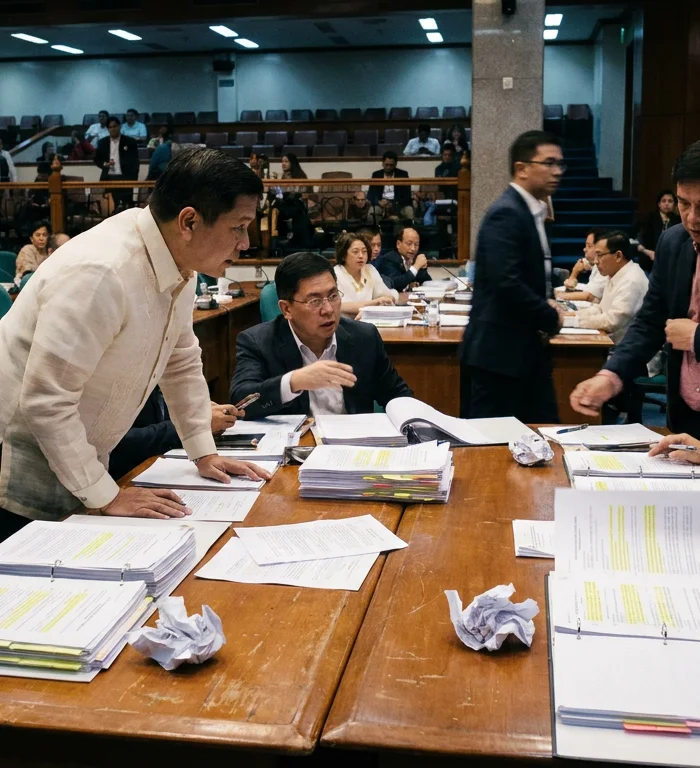
The Philippine Supreme Court declared the 2024 and 2025 General Appropriations Acts unconstitutional in a decision announced Oct. 20, Rappler columnist JC Punongbayan wrote in an Oct. 21 analysis.
The ruling puts congressional budget changes under pressure after lawmakers increased 2024 unprogrammed appropriations by P449.5 billion to P731.4 billion, about 2.6 times President Ferdinand Marcos Jr.’s proposal, the Rappler article said.
Unprogrammed appropriations are standby spending authority that can be used only when specified funding conditions are met. The court said Congress cannot use them to exceed the president’s proposed annual budget ceiling, according to the article.
The ruling, dated Oct. 7 and written by Senior Associate Justice Marvic Leonen, also struck down two provisions on the release of unprogrammed appropriations in the 2026 budget. The court did not invalidate the entire 2026 budget, abolish all unprogrammed appropriations or order all past payments returned, the article said.
The court also found a defect in the 2025 budget through a P17.992 billion increase in the Department of Public Works and Highways’ Special Road Fund, according to the article. The 2024 finding centered on the P449.5 billion increase above the president’s proposed standby allocation.
The decision adds legal weight to questions over Philippine budget practice under Marcos and Congress. It follows a December 2025 Supreme Court decision ordering the return of P60 billion transferred from PhilHealth to the Treasury to fund unprogrammed appropriations, the Rappler article said.
For 2026, the court rejected release triggers tied to higher collections from a specific non-tax revenue source or a new revenue source. Rappler said the court reaffirmed that aggregate collections must exceed total revenue targets before standby appropriations can be released, while allowing approved loans for foreign-assisted projects.
The article said the ruling examined Support for Assistance to Government Infrastructure and Social Programs, or SAGIP, a broadly defined budget item that left project selection and allocation to the executive branch after enactment. Of roughly P200 billion in SAGIP allotment releases in 2024, about P155.9 billion went to public works, including P85.8 billion for flood control, the article said.
The Supreme Court said SAGIP “paved the way for the new pork barrel system,” according to the Rappler article. Punongbayan wrote that those allotment releases were authorizations to incur obligations, not proof that projects were completed or that corruption occurred.
The article also cited comments recounted by the court from University of the Philippines School of Economics Professor Emerita Solita Monsod, who said lawmakers proposed infrastructure allocations and alleged a “parking fee” for projects outside their districts. Those allegations would require separate investigation.
The ruling does not convict any official of plunder or graft, and such cases would require separate proceedings and proof. Punongbayan wrote that the doctrine of operative fact may preserve consequences of an unconstitutional law where beneficiaries relied on it in good faith, but does not automatically protect officials responsible for the provisions.
Congress is finalizing the 2027 budget, according to the article. The decision means the combined total of programmed and unprogrammed appropriations must remain within the constitutional ceiling set by the president’s proposed budget.
Source: opinion article, Rappler, Oct. 21, 2026
More stories
- Economists see Bank of Japan rate at 1.50% in December
- Sarandos seeks Netflix reset around television and films
- US envoy Tom Barrack presses Gulf allies to rely less on US
- India leads IBSAMAR with cooperation across oceans in view
- Ukraine talks bring Witkoff to Oslo as US tensions deepen
- Britain sends Typhoon jets to defend Saudi Arabia airspace
- Starshield limits disrupt Ukraine drones, officials say
- Singapore P2P fares rise 12.3% in August