

US envoy Tom Barrack presses Gulf allies to rely less on US
Tom Barrack urged Gulf governments to strengthen regional defense partnerships, describing a reduced American role as a worldwide security guarantor.
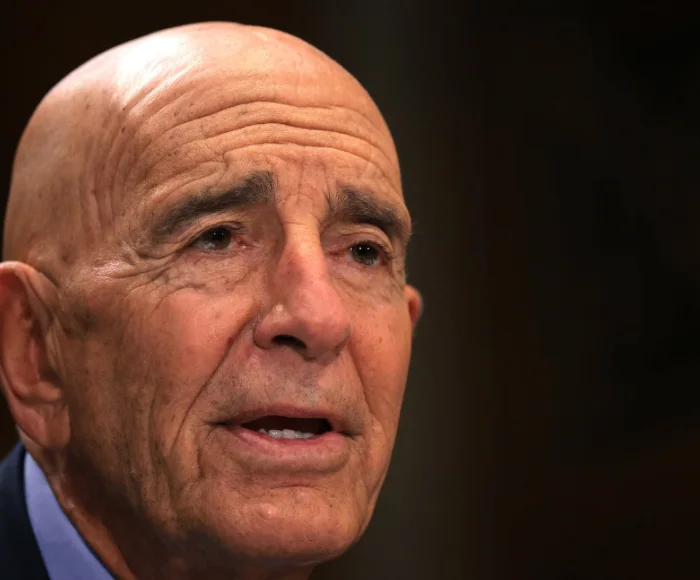
Tom Barrack urged Gulf governments to strengthen regional defense partnerships, describing a reduced American role as a worldwide security guarantor.
Speaking at the Global Security Forum in Doha, Barrack presented regional cooperation as an adjustment to Washington’s priorities rather than a withdrawal of American support. His remarks addressed how Middle Eastern governments should organize their defenses as the region faces the prospect of further US-Iran escalation.
Barrack, the U.S. ambassador to Turkey and President Trump’s special envoy for Syria and Iraq, challenged the assumption that American protection would remain the foundation of regional security. He characterized the change as a broader revision of longstanding international arrangements, not simply a response to the current conflict.
Barrack challenges the guarantor model
“America as the guarantor to the world, for the last 80 years, it is no longer there,” Barrack said. He added: “What’s happening in this administration is not an abandonment. It’s a message for realignment.”
That distinction leaves an important practical question: which responsibilities Washington expects its partners to assume, and which it intends to retain. Barrack’s comments offered a direction for regional governments, but did not establish a timetable or define specific changes to American defense commitments.
In his account, the postwar bargain linking American military protection with access to petroleum no longer matches Washington’s needs. He argued that Americans were unwilling to die for Middle Eastern interests and that Gulf governments understood the limits of US protection; both were assessments he advanced, rather than evidence of a newly announced policy.
Regional pacts become the proposed alternative
Barrack endorsed a shift toward a broader range of smaller partnerships. He cited what he described as a new defense agreement involving Saudi Arabia, Pakistan and Turkey as an example of the approach he favored.
The pact’s terms, implementation arrangements and obligations were not detailed in his remarks. Those distinctions matter: a political commitment to cooperate does not, by itself, establish how participating governments would respond to an attack or coordinate military operations.
If such partnerships acquire clear responsibilities and workable coordination, they could give participating states additional channels for organizing their defense. If their obligations remain unclear, a larger number of partners would not necessarily resolve the uncertainty over who would provide support during a crisis.
Iran conflict exposes limits of intervention
Barrack also acknowledged consequences that Washington had not anticipated from the war he said the US and Israel began in late February. He described regional developments as interconnected, with an intervention in one place capable of altering conditions elsewhere.
He connected that assessment to earlier interventions in Iraq, Libya and Afghanistan. “Every time we try and intervene and change the person or the regime, it seems to have been a mistake,” he said.
His argument therefore combined a call for regional responsibility with a warning about the limits of outside intervention. For Gulf governments, the unresolved issue is whether a larger regional role would supplement American backing or compensate for its reduction.
The next substantive test is whether Washington translates that message into defined commitments and whether regional partners clarify their own obligations. Until then, Barrack’s remarks describe a preferred security arrangement without settling how it would function under renewed pressure.
More stories
- Sarandos seeks Netflix reset around television and films
- India leads IBSAMAR with cooperation across oceans in view
- Ukraine talks bring Witkoff to Oslo as US tensions deepen
- Britain sends Typhoon jets to defend Saudi Arabia airspace
- Zelenskiy plans Ukraine talks in Oslo as US ties deteriorate
- Mali attacks kill at least 48 as civilians flee to Menaka
- Bessent says Iran sanctions close most external flights
- Fairford terror suspects freed on bail as Trump questions British handling