

South African parties split over Cape Town’s 30,000-home annual gap
Daily Maverick’s election episode used Cape Town to compare party positions on municipal land, short-term rentals, rent control and spatial apartheid.
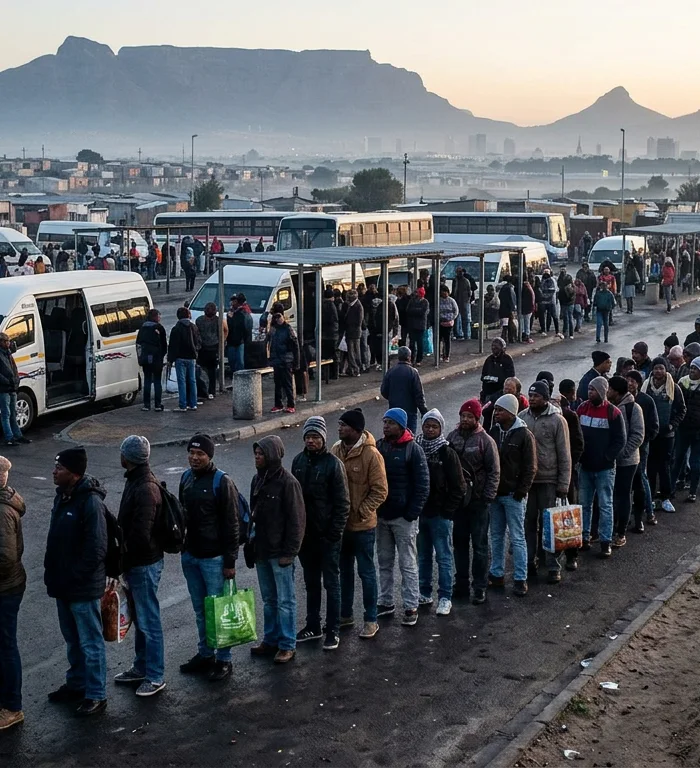
Six South African party representatives split over Cape Town’s housing response in a Daily Maverick election episode published Oct. 27, with the city’s deputy mayor citing a shortfall of about 30,000 homes a year.
The debate puts land use, rental regulation and municipal delivery at stake before South Africa’s Nov. 4 local elections: the shortfall equals about 82 homes a day, according to Atlas360 calculations.
Daily Maverick’s Politically Aweh episode brought together Eddie Andrews of the DA, Cameron Dugmore of the ANC, Dereleen James of ActionSA, Dr Tlaleng Mofokeng of the EFF, Dr Corné Mulder of FF+ and Songezo Zibi of Rise Mzansi, which is contesting the election alongside Good. Daily Maverick said it also invited MK.
Andrews, Cape Town’s deputy mayor, argued that the municipality should enable affordable housing rather than act as the sole supplier. “We see the private sector as our partners,” Andrews said, according to the episode, linking the approach to “investment-led growth.”
Dugmore said the ANC would halt municipal land sales “to foreigners” and rezone the inner city to allow buildings of as many as 20 floors. “The higher the buildings can go, the cheaper the units,” Dugmore said, according to Daily Maverick.
ActionSA’s James also proposed a land audit, a 99-day timetable and title deeds instead of leases. Zibi proposed that metros buy land, invest in infrastructure and provide serviced plots, with the state building for people who cannot afford to do so.
Mulder said municipalities could not fund a house for every resident and also backed serviced plots, alongside social housing. Mofokeng said the EFF would set time-bound plans to reduce existing housing backlogs, publish waiting lists and formalise informal settlements so city services could be provided.
The discussion also exposed divisions over spatial apartheid, the term used to describe the enduring distance between poorer communities and economic centres created by apartheid-era planning. Daily Maverick said Cape Town Mayor Geordin Hill-Lewis has called the phrase “propaganda language,” while Andrews acknowledged that apartheid pushed people to the city’s edges and said commuters could spend about 40% of disposable income on transport and lose roughly three hours a day.
James linked the issue to violence on the Cape Flats and said lower- and middle-income earners should be prioritised. She described that group as people earning roughly between R3,500 and R20,000 a month, and criticised developments where a two-bedroom flat costs R5 million. That price is 250 times the upper monthly income figure she cited, according to Atlas360 calculations.
On short-term rentals, Daily Maverick said almost all participating parties except the DA viewed them as worsening the housing problem. Zibi pointed to digital nomads, saying locals compete with renters able to pay in one month what residents pay over three. Dugmore said Airbnb was “not regulated at all” in Cape Town.
Daily Maverick said Cape Town’s draft short-term letting bylaw, whose public-comment period closed Oct. 5, would require registration of listings and commercial rates on homes rented short term for more than half the year. The outlet said the measure has not become law.
Andrews rejected the idea that short-term rentals were the core problem. “Market goes where market goes,” he said, according to Daily Maverick. He also said there was “no chance” of rent control in Cape Town.
Election tests
On Nov. 4, South Africa’s local elections will show how much municipal leverage each party has over housing, land release and service-delivery policy in Cape Town and other metros.
The short-term rental issue has a separate municipal track. After the Oct. 5 close of public comment, the checkable step is whether Cape Town advances, changes or drops the draft bylaw covering registration and commercial rates for homes rented short term for more than half the year.
The other dated pledges are party-specific. If the ANC or ActionSA gain authority in a relevant municipality after Nov. 4, their 100-day and 99-day land-audit commitments provide measurable deadlines for whether campaign proposals become municipal action.
More stories
- Ruto seeks Russian investment in Kenya's $380m trade push
- Sudan teachers seek 20% budget share with 8m children outside school
- Spain rail network faces scrutiny after 64 killed near Toledo
- Spain reports at least 30 dead in high-speed train crash
- Villa Vie disembarks 203 passengers in Cambodia over fuel costs
- NEITI faces methane data questions over 18 incomplete records
- Morocco election puts PAM first as coalition math shifts
- Russia NATO risk rises as Denmark warns on strikes in Europe