

Thailand rushes clean water to 20,000 households
Arsenic readings far above safe limits have turned a border water problem into a public-health and diplomatic issue with Myanmar and China.
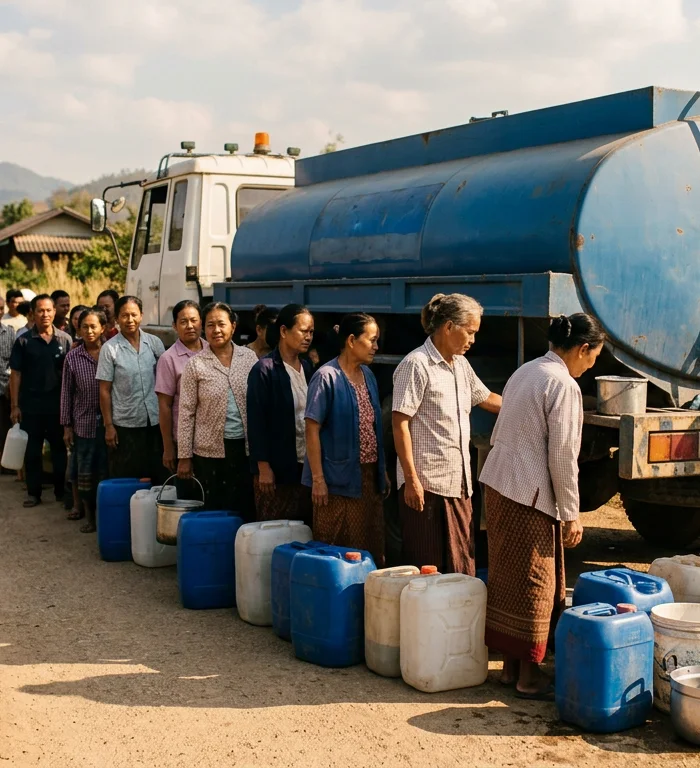
Thailand rushed clean water to more than 20,000 households in Chiang Rai on Nov. 18 after arsenic pollution linked to mining in Myanmar affected local supplies, The Straits Times reported.
Tap water to 14 villages in Mae Sai district was cut in November after tests found arsenic at 30 times the safe limit, while the Sai River tested at 25 times the drinking-water limit, the news report said.
Prime Minister Anutin Charnvirakul late on Nov. 17 ordered agencies to find alternative water sources and increase monitoring of tap water quality in Chiang Rai, deputy government spokeswoman Lalida Persvivatana said, according to the report.
Thai authorities sent two trucks to deliver clean drinking water to residents and are considering other river sources, the report said. The affected villages are near Thailand’s border with Myanmar, where mining activity has become harder to regulate during the country’s civil war.
Researchers at Naresuan University said last week that chemical analysis and satellite modelling traced much of the arsenic-bearing sediment in the Sai River to gold mining operations on the Myanmar side of the border, according to the report. That finding links the local disruption in Mae Sai to a wider concern over cross-border pollution in the Mekong basin.
Thai Foreign Minister Sihasak Phuangketkeow raised the Sai River contamination during a visit last week to Myanmar, where he met government officials, the report said. He described the increase in pollution as “dramatic” and blamed “waste water from mining”, calling it an “urgent matter that needs urgent attention”.
The Thai government said it has also discussed the issue with Beijing, while researchers said many mining operations in Myanmar are Chinese-run, according to the report. The article did not cite a response from Myanmar or China to the Thai concerns.
The Mekong River system supports communities across several countries, making contamination concerns larger than a single district. The Sai River is a Mekong tributary, and officials fear polluted water could move farther downstream.
Thai officials said arsenic was found in urine samples from 17 of 177 people tested in October in Nong Khai, a north-eastern province on the border with Laos, according to the report. The report did not state whether those findings were directly tied to the Mae Sai contamination.
Source: news report, The Straits Times, Nov. 18, 2026
More stories
- Germans oppose Ukraine aid as poll shows support slipping
- Kim Jong-un receives 10 envoys after constitutional shift
- Ukraine claims Libya strike sinks Russian naval corvette
- COP31 climate talks collapse over fossil fuels and funds
- Russian military faces 1,087 recorded suicides in Ukraine war
- US faces China, Russia in Africa minerals contest
- Hague court adds 17 months to Thaci sentence
- Israel panel undercuts Likud fraud claim over 19 Arab-led seats
- Indian refiners lift crude imports to record 5.6m bpd
- France Braces for Third Weekend of Protests as Youth Movements Gain Momentum Across Europe
Latest news
- Trump prepares tariffs on China and other major exporters
- New-car buyers pay record average $50,087 in October
- Banks face ECB reserve debate over liquidity and profits
- Investors see Anthropic debut gains fade below $83 a share
- Iraq orders federal control over Kurdish-area oilfields
- Nvidia shares retreat as AI rally cools before PCE data
- Macy’s parade faces balloon limits as storm winds approach