

France Braces for Third Weekend of Protests as Youth Movements Gain Momentum Across Europe
France protests drew 320,000 people on Saturday, the government estimated, as student-led demands expanded to living costs and housing.
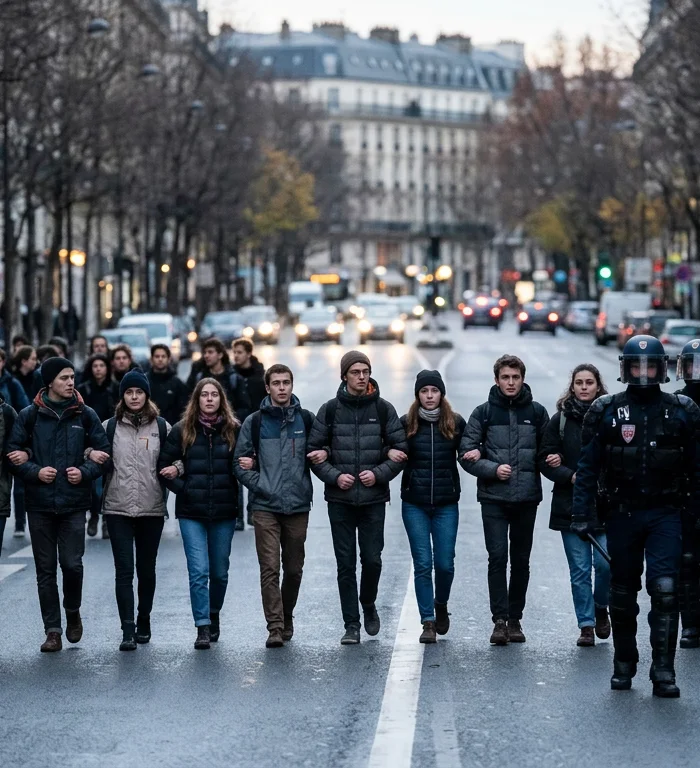
France protests drew 320,000 people on Saturday, the government estimated, as student-led demands expanded to living costs and housing.
The demonstrations marked a third successive weekend of mobilization, with participation below the government’s estimates of 550,000 on October 17 and 410,000 on October 24. Organizers put attendance above the official figures, leaving the size of the movement disputed.
Most participants demonstrated peacefully, although confrontations and isolated fires disrupted gatherings in Paris and elsewhere later in the day. French authorities reported more than 560 arrests nationwide by Saturday night; that figure does not establish how many people subsequently faced charges.
School demands draw a broader coalition
High school students began the movement the previous month, challenging deteriorating school premises, insufficient teaching staff and university admissions arrangements they regard as disadvantaging poorer applicants. Labor unions and opponents of President Emmanuel Macron subsequently joined, bringing demands beyond the education system.
That broader coalition was visible in Paris, where student groups marched alongside environmental campaigners and people protesting household expenses. An information technology employee attended in support of students and her mother, whose minimum-wage employment she said left her struggling financially.
Housing conditions also featured among the grievances. Corentin Cabreux, a 21-year-old student living in public student accommodation, described damp, damaged walls and infestations in his residence, an account that remains an individual allegation rather than an assessment of the wider housing system.
Paris restrictions reshape the march
Authorities deployed approximately 70,000 police officers and gendarmes nationwide after French Interior Minister Laurent Nuñez described the danger of disorder as a “very high risk”. In Paris, authorities moved march routes away from central commercial, government and visitor districts toward the city’s perimeter.
The main procession followed the Boulevards des Maréchaux, with music and Halloween outfits accompanying hours of peaceful marching. Near the endpoint at Porte de Charenton, some participants later threw bottles and fireworks toward officers, who used tear gas and stun grenades; peaceful demonstrators left the area.
Paris police also restricted access to Place de la Republique and Les Halles between 11 p.m. and 6 a.m. on Saturday and Sunday. A separate restriction required unaccompanied minors to leave the Champs-Elysees area by 9 p.m.
Those measures followed a Wednesday ruling in which a Paris court suspended an earlier restriction on minors’ movements. The court characterized that measure as a serious, unlawful interference with freedom of movement, placing the policing response alongside a dispute over civil liberties.
European rallies share education and housing demands
In Germany, the youth initiative “Gen Z regelt” organized demonstrations across more than 30 cities, advocating better education, healthcare, climate protection and affordability while opposing renewed military conscription. Organizers claimed participation in the tens of thousands, but an official attendance count was unavailable.
Students gathering at Berlin’s Brandenburg Gate sought greater spending on schools and housing. In Portugal, thousands assembled peacefully in central Lisbon over housing pressures, including families carrying miniature cardboard homes.
The demonstrations shared concerns about public services and affordability, but the supplied accounts establish neither common leadership nor a coordinated European campaign. For France, the immediate institutional tension remains between maintaining public order and protecting the right to demonstrate, with the court’s intervention already limiting one policing measure.
More stories
- Russian state-affiliated media raise UK posts 15% in September
- Delhi protests demand election chief quit over voter rolls
- US tip-off in Moscow case points to security cooperation
- US tip-off in Moscow case points to security cooperation
- Türkiye seeks 30% OIC trade share after $108bn nine-month flow
- Turkey's OIC trade reaches $108bn in first nine months
- French protests draw 320,000 in third cost-of-living wave
- Khamenei orders unrestricted response to any US or Israeli attack
- North Korea challenges Taiwan arms sales as jets arrive
- IMF chief urges fiscal tightening as global debt climbs