

French protests draw 320,000 in third cost-of-living wave
The interior ministry figure was about 22% below last weekend’s estimate, while police used teargas, stun grenades and water cannon in several cities.
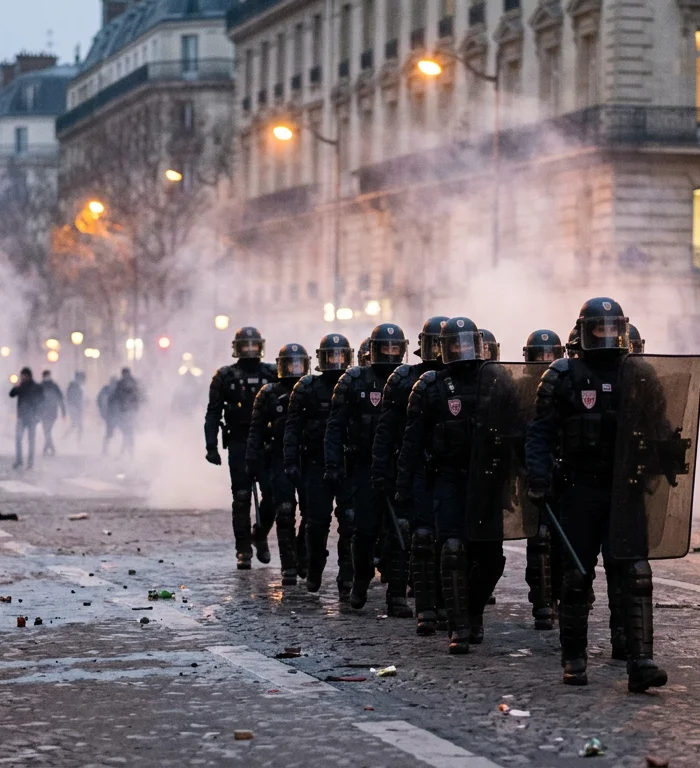
France’s interior ministry said about 320,000 people joined nationwide protests on Saturday, Oct. 31, as police clashed with masked groups after marches over living costs and public services.
A news article published by The Guardian cited ministry data showing turnout was down from an estimated 410,000 last weekend, a fall of about 22%, according to Atlas360 calculations.
The ministry put Paris attendance at 70,000. Demonstrators marched on boulevards in the capital’s south-eastern outskirts rather than through the city centre.
Interior Minister Laurent Nuñez had said earlier in the week that 70,000 police and gendarmes, including elite units, would be deployed. He warned that Saturday looked like “a very high risk” day.
In Paris, French media reported that masked people dressed in black pried up paving stones and threw them at officers, and that at least one incendiary device was thrown at security forces. Police responded with teargas and baton charges.
The Paris police prefecture said “A hardcore of several hundred rioters” was attacking officers with projectiles including a molotov cocktail. Officers were “manoeuvring to restore public order”, the prefecture said.
Violence was also reported in Lyon, where protesters threw projectiles and police fired teargas. In Toulouse, officers used water cannon against an unauthorised protest that attracted several thousand people, mostly young demonstrators.
The protests brought together school students, trade unions and gilets jaunes, or yellow vest, demonstrators. The groups were mobilising over living costs, inequality, school conditions and public services, placing social pressure on President Emmanuel Macron’s government.
Jérôme Rodrigues, a protester on the Paris march, said: “The French economy is doing badly no matter what happens, because today we’re being run by a group of incompetents who juggle billions while families are struggling with a few cents.”
Camille Guérin, a protester in Nantes, said: “We say no to the cost of living, no to the far right, yes to high school students’ demands, yes to giving citizens a voice.”
The unrest was not confined to France. In Germany, police used water cannon in Cologne after saying protesters had targeted officers with fireworks, while a Frankfurt march was temporarily halted after fireworks were set off.
The newspaper Bild reported that protesters threw bottles and eggs in Berlin, set barricades alight in Hamburg and faced pepper spray from police in some places. Police were also on alert in Barcelona after an anonymous TikTok network called Blocus urged new gatherings, and in Italy after recent clashes in Milan, Turin and Bologna.
The reports did not provide arrest or injury totals. That leaves the scale of enforcement action and harm unclear after a day in which the main marches were described as largely peaceful before clashes developed as evening approached.
Student protesters said they would stage new high school and university blockades on Tuesday. The observable test is whether those blockades take place and whether they spread beyond student groups.
Student protesters also said they would stage further blockades on Thursday. That is the same day as the Nov. 5 demonstration called by workers and trade unions, which Union Étudiante representative Sabrine Kharbach said students would join.
Source: News article, The Guardian, Oct. 31, 2026.
More stories
- Khamenei orders unrestricted response to any US or Israeli attack
- Trump administration widens Alaska election investigation
- COUP in Poland? Tusk accused of power grab as riot cops swoop on Constitutional Court
- Nigeria minister seeks clean-cooking finance for 2060 plan
- ICN warns on misinformation after Congo Ebola nurse killing
- Ukraine rail attacks expose Dnipro passenger safety risks
- Israeli settlers attack Palestinians, journalists in West Bank harvest
- Cyberattacks expose millions of records in Japan and South Korea