

COUP in Poland? Tusk accused of power grab as riot cops swoop on Constitutional Court
Poland’s Constitutional Tribunal says it has suspended its president, prompting a takeover accusation from President Karol Nawrocki.
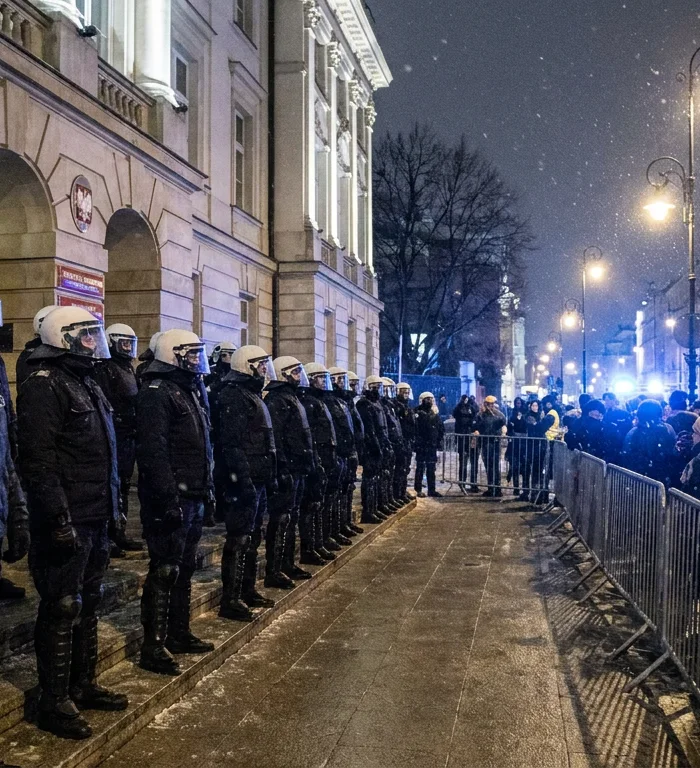
Poland's Constitutional Tribunal says it has suspended its president, prompting a takeover accusation from President Karol Nawrocki.
In an announcement late on October 30, the tribunal said Anna Korwin-Piotrowska, its most senior judge by tenure, had suspended court president Bogdan Swieczkowski and assumed leadership. The announcement put the court's leadership at the center of an existing confrontation over judicial appointments.
Nawrocki accused Prime Minister Donald Tusk of orchestrating a seizure of the institution in a statement delivered by an aide early on October 31. Tusk defended his government's approach in a social media post, describing decisive measures as necessary to reestablish lawful governance.
Nawrocki returns to confront leadership change
The Polish president interrupted an Africa trip, reversing course while airborne before going directly to the tribunal in Warsaw. Riot police were deployed outside, where a crowd numbering several hundred called for Swieczkowski to be returned to office.
Nawrocki requested immediate consultations among political leaders. His allegation of a forced takeover went beyond the tribunal's announcement, which described a suspension by a fellow judge; the two statements offered sharply different characterizations of the leadership change.
Swieczkowski previously served as a deputy justice minister in a Law and Justice administration and received his court appointment under Tusk's predecessor. Nawrocki is also aligned with that nationalist political camp, while Tusk leads a government committed to closer European cooperation.
Disputed appointments stretch back to 2015
The confrontation has roots in 2015, when Law and Justice attempted to fill judicial positions for which the outgoing government had already selected judges. The party's appointees subsequently secured a tribunal majority, and the EU accused its administration of weakening legal safeguards.
Tusk's coalition entered government in 2023 with a commitment to overhaul the tribunal and repair judicial institutions. Nawrocki, elected president in 2025, has opposed those changes, leaving the executive leadership divided over both the reform program and who should serve on the court.
The appointment impasse continued this year: Nawrocki withheld the oath from three judges out of six selected by parliament. Swieczkowski separately refused to admit judges chosen by the parliamentary majority supporting the government, extending the dispute from nominations to whether appointees could take their seats.
Recognition remains the tribunal's central obstacle
Parliament selected Tusk ally Maciej Berek for the tribunal in September, adding another politically connected appointment to the contested institution. The broader stalemate has left the court effectively unable to function, with the opposing political camps rejecting each other's judicial selections.
The immediate institutional question is whether the new leadership gains acceptance beyond those announcing it. If the opposing sides continue to reject appointments and leadership decisions, replacing the tribunal president alone would leave the underlying recognition dispute unresolved.
If Nawrocki's proposed consultations produce agreement on judicial appointments, they could offer a route toward restoring the tribunal's functioning. Without such agreement, the competing claims to authority would remain an obstacle to Tusk's reform program, making the response to Korwin-Piotrowska's announced leadership the next test of whether either camp is prepared to compromise.
More stories
- Khamenei orders unrestricted response to any US or Israeli attack
- Trump administration widens Alaska election investigation
- Nigeria minister seeks clean-cooking finance for 2060 plan
- ICN warns on misinformation after Congo Ebola nurse killing
- Ukraine rail attacks expose Dnipro passenger safety risks
- Pyongyang rejects sanctions push on labor, military ties
- Jayakumar highlights Ong's 1993-99 test of Singapore presidency limits
- Bolsonaro reaches Miami after defeat and fleeing Brasil
Latest news
- Analysts' top S&P 500 picks trail least-recommended stocks by 13%
- EU countries pledge 20.5m diesel barrels for winter supply
- p-tau217 blood test flags 38% five-year Alzheimer’s impairment risk
- Sanjay Gupta dies at 59, ending Hindi crime-thriller career
- K2 Pictures $32m fund seeks 50-film Japan slate
- Fitch cuts France outlook to negative at A+ rating