

SpaceX Achieves First Orbital Upper Stage Recovery via Mechanical Catch
SpaceX successfully caught the Starship upper stage with mechanical arms, a key step toward full reusability, despite a failed first-stage recovery.
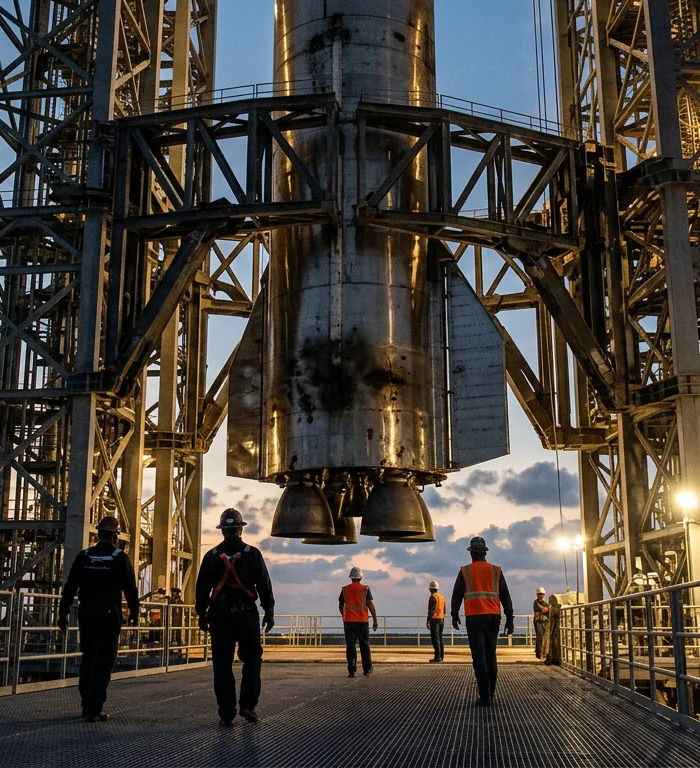
SpaceX successfully executed a mechanical recovery of the Starship upper stage at its Texas launch facility on November 14. During the 15th flight test, the spacecraft completed 14 orbits and deployed 26 Starlink V3 satellites before returning to the launch tower. The vehicle was secured by mechanical arms, a method distinct from traditional landing-leg deployments, marking a significant advancement in the company’s pursuit of a fully reusable launch architecture.
The recovery of the upper stage represents a critical milestone in reducing the operational costs and turnaround times associated with orbital missions. By demonstrating the ability to catch the larger spacecraft directly at the launch site, the company moves closer to its objective of rapid, multi-stage reusability. This capability is intended to streamline the logistics of heavy-lift space transport and satellite constellation maintenance.
Starlink V3
Despite the success of the upper stage recovery, the mission did not achieve a full double-recovery. The Super Heavy booster, which serves as the rocket's first stage, failed to return to the launch tower as intended. This outcome highlights ongoing technical challenges in synchronizing the recovery of both vehicle components within a single mission profile.
Future institutional focus will remain on the company's ability to transition from successful recovery to rapid refurbishment. The long-term viability of the Starship program depends on demonstrating that the recovered hardware can be inspected and prepared for subsequent flights with minimal intervention. Policymakers and industry stakeholders should monitor the frequency of these successful recoveries as a primary indicator of progress toward full system reusability and reduced launch costs.
More stories
- Europe faces attribution gap after 16 cyber, physical incidents
- PIF backs Grand Theft Auto as Saudi players embrace game
- Signal limits screenshots to curb AI access to messages
- Cognition runs Devin Mac workspaces on EC2 in 6 AWS regions
- Salesforce engineers cut 600-failure triage to 90 minutes
- Türkiye Desk: GTA 6 puts console access and network demand in focus
- FURSOY posts 500 MHz Linux-capable RISC-V core
- SpaceX catches Starship upper stage but loses its booster
- Anthropic wet lab moves AI startup into biology testing
- AI safety fight puts OpenAI tests under scrutiny
Latest news
- Trump prepares tariffs on China and other major exporters
- New-car buyers pay record average $50,087 in October
- Banks face ECB reserve debate over liquidity and profits
- Investors see Anthropic debut gains fade below $83 a share
- Iraq orders federal control over Kurdish-area oilfields
- Germans oppose Ukraine aid as poll shows support slipping
- Kim Jong-un receives 10 envoys after constitutional shift
- Ukraine claims Libya strike sinks Russian naval corvette