Spokane wildfire arrest puts arson charge at center now
A Spokane wildfire suspect was arrested on a first-degree arson charge as fires displaced about 67,000 people and destroyed hundreds of structures.
Atlas Newsdesk ·
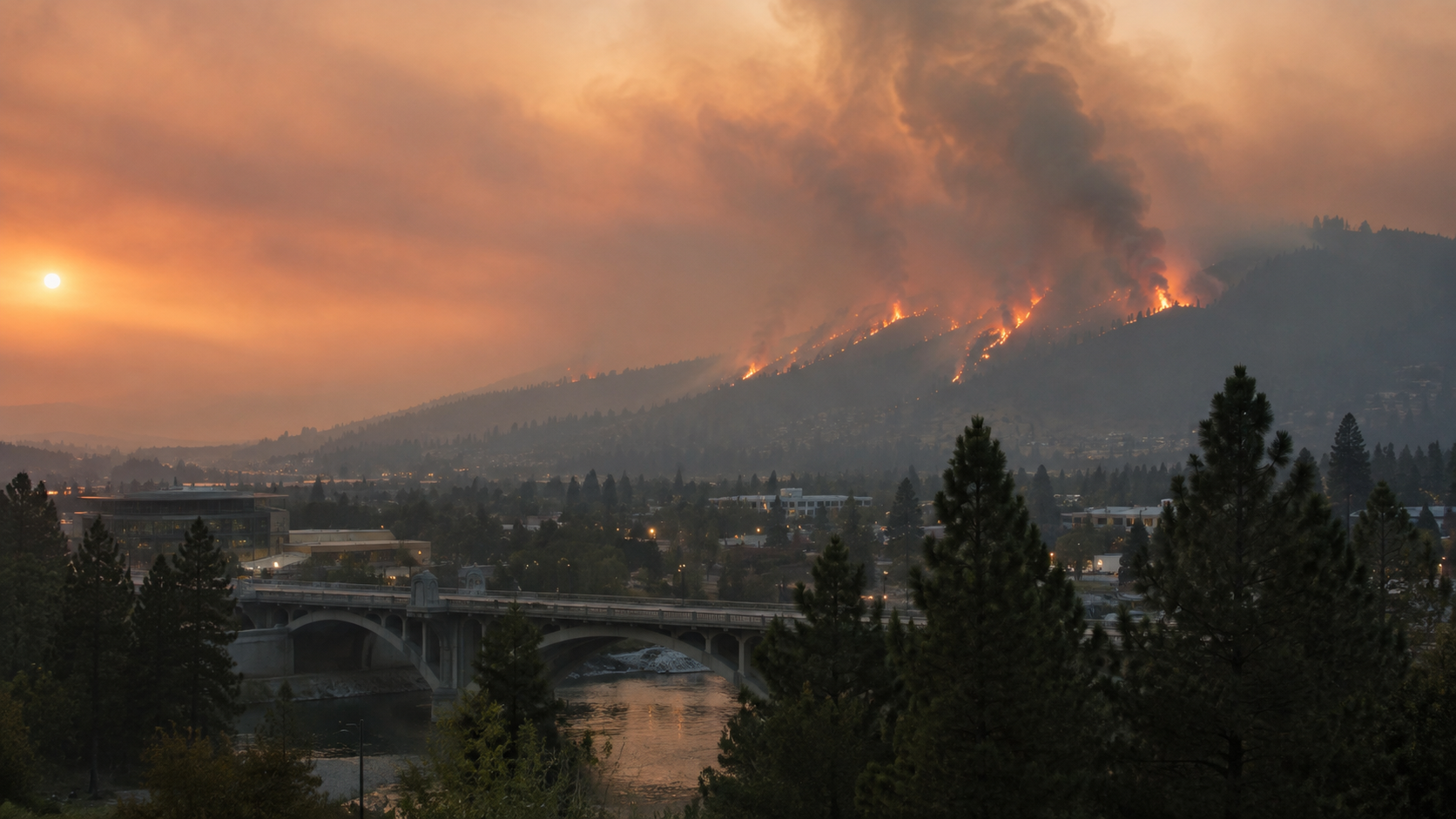
A Spokane wildfire arrest has put an arson case at the center of a fast-moving disaster that has displaced about 67,000 people.
Authorities arrested Aaron Farinacci, 37, on Monday in connection with the Old Trails fire, the largest of three fires burning near Spokane, Washington. Spokane County Sheriff John Nowels said Farinacci was charged with first-degree arson and detained under a $1 million bond.
Old Trails charge focuses case
The arson allegation rests in part on a witness account, according to Sheriff Nowels. He told reporters that a witness allegedly observed Farinacci down in the grass near the place investigators believe the Old Trails fire began.
The charge has not resolved the emergency facing Spokane County. Firefighters were still working the three blazes after they ignited over the weekend, while authorities kept evacuation measures in place for tens of thousands of residents.
Officials have not reported serious injuries, but they are trying to reach 14 people who have not answered mobile phone calls. Nowels said those people are not currently classified as missing.
8,026 acres around Spokane
The three fires had burned a combined 8,026 acres, or 3,248 hectares, according to the federal interagency fire information system InciWeb. Spokane is a city of about 230,000 residents near the Idaho border, placing the fires close to a regional urban center rather than in a remote forest zone alone.
Aerial assessments cited by officials indicate that between 700 and 1,110 structures have been destroyed since the weekend outbreak began. That range shows the scale of the damage is still being measured from the air before ground teams can verify losses property by property.
The displacement figure, about 67,000 people, gives the emergency a wider civic burden beyond the fire lines. Evacuees need shelter, road access, communications, medical support and information about whether homes and businesses remain standing.
Farinacci’s prior criminal record adds another layer to the case, but it does not determine the outcome of the arson charge. Police said he shot and killed his father in Mesa, Arizona, in 2010 during an argument about washing dishes, and also shot himself but survived.
Court records show Farinacci was initially charged with murder and later pleaded guilty in 2012 to manslaughter and aggravated assault. He was released from prison in 2020, according to the records cited in the case background.
Evacuation orders shape losses
The direct impact falls first on residents forced from homes around Spokane and on public agencies managing the response. For local officials, the priority is separating immediate life-safety decisions from the criminal investigation so that evacuation, firefighting and damage assessment do not depend on the pace of the court case.
The wider sector impact runs through emergency management, insurance, housing and utilities. If the lower end of the structure-loss estimate holds, recovery planning may focus on targeted neighborhoods; if the upper end is confirmed, the rebuilding burden becomes broader and could strain contractors, temporary housing and local government capacity.
The macro effect is likely local unless the Spokane fires become part of a wider season of destructive fires across the western United States. If similar events multiply, the mechanism moves through public spending, insurance losses, construction demand and household displacement rather than through one fire alone.
Three paths for recovery
If crews contain the fires quickly and the 14 unreachable people are contacted safely, the immediate pressure shifts toward shelter, debris removal and verified property counts. In that path, the global macro effect remains limited, Spokane’s public agencies move from crisis response to recovery administration, and insurers and builders begin claims and repair work.
If wind, heat or terrain slow containment, evacuation orders could last longer and the range of destroyed structures could rise after ground checks. That would deepen local economic disruption, raise costs for Spokane County and emergency agencies, and place heavier demand on the regional construction, rental housing and insurance sectors.
If prosecutors build a stronger arson case, the criminal proceeding will run alongside the recovery effort and could shape public accountability debates. If the evidence weakens, the investigation may need to widen while fire officials continue focusing on cause, containment and verified damage rather than a single suspect.