

SoilFER maps 3,600 soil samples to date for Kenya farmers
The FAO-KALRO programme is building a digital map across 45 of Kenya’s 47 counties to guide fertilizer use as climate shocks pressure crops.
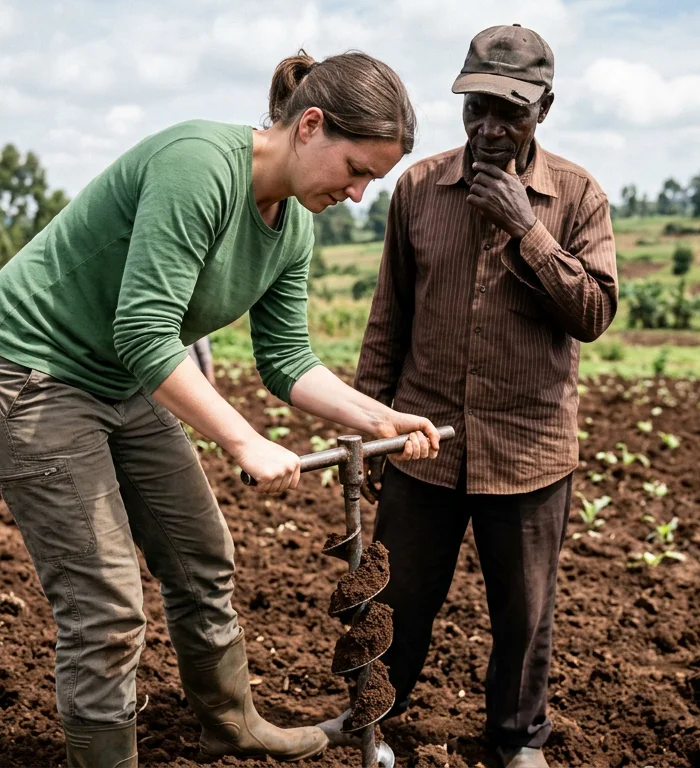
SoilFER has collected and mapped more than 3,600 soil samples to date across 45 Kenyan counties, UN News Service reported on Oct. 23.
The FAO-KALRO programme covers 45 counties to date, compared with Kenya’s 47 counties, giving the initiative near-national scope as farmers face intensifying climate shocks, according to UN News.
The Soil Mapping for Resilient Agrifood systems programme is designed to give farmers reliable soil information, including guidance on which fertilizer to use and how much to apply, UN News reported.
Agness Munialo, a farmer from Kakamega county in western Kenya who trained under the programme, said soil testing had changed how farmers approached crop production. “Farmers would use excessive chemicals, sometimes even more fertilizers in an attempt to get more yields. Now we know better,” she said.
Barrack Okoba, FAO-Kenya’s national coordinator for SoilFER, said accessible information was part of building agricultural resilience. “Part of resilience is to make sure that our information system is available and supporting farmers to build sustainable farm management,” he said.
Selected farmers are trained to identify and address soil degradation, earning the title “soil doctor” before sharing the knowledge with other farmers, according to UN News. The programme also covers soil composition, pH levels, a measure of acidity or alkalinity, and fertility.
The UN Food and Agriculture Organization and the Kenya Agricultural and Livestock Research Organization launched SoilFER in Kabete, with financial support from the United States Department of State and Japan, UN News reported.
Through FAO support, KALRO has renovated laboratories and equipped them to analyse soil samples collected across Kenya. The samples are georeferenced, meaning they are tied to precise locations, and results are sent directly to farmers’ mobile phones, according to the report.
Kenya’s Cabinet Secretary for Agriculture, Mutahi Kagwe, urged closer coordination among agricultural institutions and called for soil health to be integrated into their work. “I want to urge Kenyans that before thinking about what to plant or the fertilizer to use, think about soil testing,” he said.
The initiative is also drawing interest from younger Kenyans considering agriculture. Jackline Kioko, a KALRO intern, said the launch helped her understand how soil testing could guide decisions on her family’s farm.
UN News did not report measured changes in crop yields, the cost of the programme or how many farmers have received mobile-phone results. Those omissions leave the programme’s practical impact unmeasured in the published account.
The launch event also marked the start of the Kenya Soil Partnership, the Kenya Soil Laboratory Network and the national rollout of the Global Soil Doctors Programme. SoilFER was also being implemented as of Oct. 23 in Ghana, Guatemala, Honduras, Mozambique, Tunisia and Zambia.
More stories
- Russian war deaths top 460,000, Guardian says
- Monrovia mayor-designate seeks $14.5m city budget
- Iran's attacks hit 25 tankers near Strait of Hormuz
- Russia strikes Ukraine as Odesa faces electricity strain
- Bahrain reports two injuries after Iranian aerial attacks
- Baltic responders fight Sparta II fire after drone strike
- DR Congo starts Ebola vaccine trial in 9,700-case outbreak
- EU faces Vietnam rights pressure over $57.9bn trade gap
- Saudi airport attack kills 13, strains missile defenses
- Morocco draws $6 billion China EV supply-chain push
Latest news
- Nvidia board gets Trump input on Jensen Huang return as CEO
- Rwanda faces budget strain from 85% electricity access push
- ICE arrests at Seattle airport draw protests and scrutiny
- AI doubts leave Asian stocks facing a new investment test
- EU rejects COP31 deal as fossil fuel divisions block pact
- Deal Sheet: Fortis shutdown costs over 400 jobs
- Germany to pay about $11 a month into child pension accounts
- Laura Brand curbs prison messages after YouTube dispute