

Saudi airport attack kills 13, strains missile defenses
Experts cited by The National said missile inventory pressure, not absence of defenses, is the immediate concern after the Riyadh airport strike.
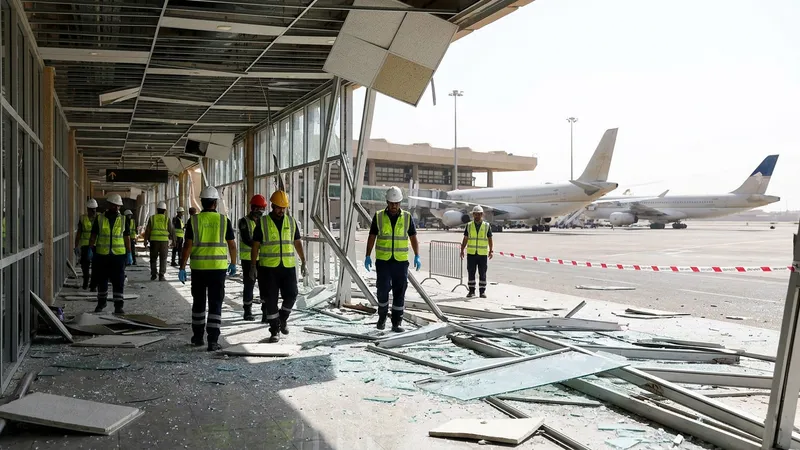
Saudi Arabia's air defenses came under scrutiny after officials said Houthi attacks killed 13 people at Riyadh's King Khalid International Airport on Saturday, The National said in an Oct. 12 news report.
The attack, which left 308 people wounded, matters because the kingdom is the world's second-largest Patriot operator and is also buying 7 Thaad batteries, The National's Oct. 12 report said.
Nawaf Obaid of King's College London's Department of War Studies said Saudi Arabia has built a dense defensive network across a very large country. Patriot is a ground-based air-defense system used against aircraft and missiles; Thaad, or Terminal High Altitude Area Defence, targets ballistic missiles at higher altitude.
“Saudi Arabia does not lack air defences,” Obaid told The National. “It possesses one of the world’s most sophisticated integrated air and missile defence architectures, protecting a country larger than Western Europe.”
He said the problem is not unique to Riyadh. “The fundamental challenge is that no existing system, including those protecting the United States, can guarantee the interception of repeated, simultaneous attacks involving ballistic missiles, cruise missiles and drones.”
Why defenses leaked
The National said the airport was hit by weapons thought to have been ballistic missiles, causing damage at one of the kingdom's major civilian aviation sites. The exact weapons used in the strike were not independently verified in the supplied material.
The pressure point is volume. Experts cited by The National said simultaneous attacks can force defenders to spend multiple interceptors while still leaving gaps, especially when threats include ballistic missiles, cruise missiles and drones.
Dr Lynette Nusbacher, a former military intelligence officer, said the Riyadh attack would normally have drawn a heavy defensive response. “An attack like the one we saw on Saturday on Riyadh Airport would in normal circumstances have been met with lavish application of Thaad at high altitude and Patriot on incoming,” she told The National. “But what is clear is that Thaad and Patriot are not available in quantity and we’re seeing leakage.”
Stocks face pressure
The National said heavy use of interceptors during the Iran war has increased the need to replenish missile-defense stocks. The report cited an estimate that the US has about 800 Patriot interceptors left from an original inventory of roughly 2,300, and said replacement could take as long as 30 months.
Military analyst Francis Tusa told The National that the pace of firing during the war put pressure on American supplies, affecting allies that rely on US-made systems. He said one attack on a US airbase in Jordan was estimated to have required as many as 80 Patriot interceptors in a single night.
The report also pointed to the Houthis' improving missile arsenal. It said the Iranian-derived Palestine-2 has a range of about 2,000 kilometres and manoeuvrability described as hypersonic capability, making interception harder in the final stage of flight.
Atlas360 reported on Oct. 12 that Saudi officials said Houthi attacks hit Riyadh's international airport and another facility, bringing Gulf aviation security back into focus. Atlas360 also reported on Oct.
11 that Riyadh airport's shutdown had been extended until at least 21:00 that day after 12 deaths had initially been reported.
The National said governments are likely to examine how airports can be protected after the Riyadh strike, while experts warned that close-range protection for every civilian and military site would be difficult given the number and size of possible targets.
More stories
- Lavrov urges Lebanon ceasefire after talks with minister
- Zelensky Backs Energy Ceasefire, Says Russia Resists
- Morocco draws $6 billion China EV supply-chain push
- China sanctions two ministers over Taiwan ties
- Zelensky Says Russia Keeps Hitting Ukrainian Energy Sites
- UAE's NCM issues 5.5-hour flood alert as hail hits
- Erdoğan’s Somali Spaceport Plan Tests Washington’s NATO Calculus
- FCA whistleblower handling review puts new board in focus
Latest news
- EA buyout lifts games M&A to $57.8 billion in Q3
- Nasdaq 100 breaks support as US indexes retreat
- Trump faces six-day tariff deadline with no public notice
- Tibidabo marks 125 years as Barcelona landmark
- Ollie Pope Exits Afghanistan Premier League Draft Amid Scrutiny
- Moto X lands on modern platforms Oct. 16 at $5.99
- Eisman says S&P 500’s AI exposure tops 65%
- Lam Research turns $1,000 into $31,755 over decade