

School unrest in France expands into social model debate
France protests began on Saturday as a movement rooted in school grievances widened to challenge living costs and public services.
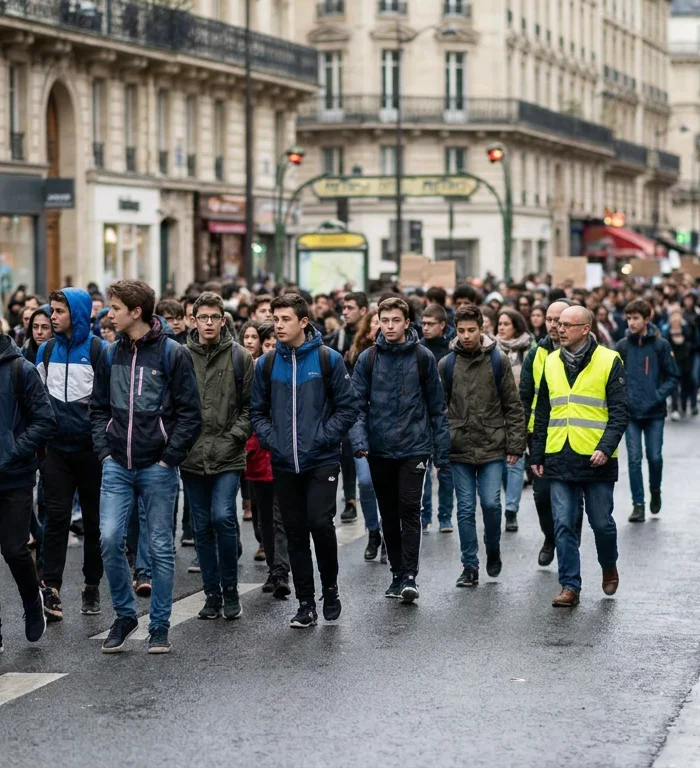
France protests began on Saturday as a movement rooted in school grievances widened to challenge living costs and public services.
The demonstrations brought together complaints about household expenses, educational conditions and inequality. The mobilization extended beyond the schools where it began, putting pressure on a French social model designed to offer economic protection and a minimum level of opportunity.
School grievances reach beyond Paris
The movement emerged in September among secondary-school students in disadvantaged communities north of Paris. Complaints initially focused on missing teachers and deteriorating buildings, before expanding into demands over public funding and the quality of services.
That progression connects two strands of the protests: what households can afford and what they receive from public institutions. Participants are challenging both expensive necessities and educational conditions, rather than organizing around a single price increase or an isolated school dispute.
A 19-year-old participant in Paris identified fuel expenses and inadequate classroom conditions as reasons for joining the demonstration. The protester's account linked immediate financial pressures with demands for additional teachers and suitable places to study, illustrating the range of grievances now attached to the movement.
Police guard central Paris landmarks
Officers deployed in force around central Paris on October 17, with a visible presence near the Avenue des Champs-Elysees and the Arc de Triomphe. Neither landmark lay along the approved paths for the capital's two authorized marches.
Elsewhere, demonstrators wearing fluorescent vests obstructed roads, while garbage containers burned in Marseille. The vest-wearing protesters recalled the unrest during President Emmanuel Macron's preceding term, although that resemblance alone does not establish common leadership or an identical set of demands.
Organizers had scheduled hundreds of gatherings around France, with anticipated participation running into the tens of thousands. Those figures described the planned scale of the mobilization, not a verified nationwide attendance count; the demonstrations were still getting under way.
Public services anchor broader demands
The movement's expansion places school resources alongside purchasing power in the same protest agenda. Its origins remain important: complaints about absent staff and poor facilities concern the delivery of public services, while fuel prices concern the expenses households must meet directly.
For students seeking better teaching conditions, the immediate issue is staffing and the state of their schools. For participants emphasizing everyday expenses, relief would involve a different set of decisions; the shared demonstrations do not by themselves establish agreement on a single remedy.
If the mobilization remains broad, any response focused only on schools would leave the household-cost grievances separately unresolved. Conversely, measures addressing living expenses would not themselves repair buildings or provide missing teachers, making the relationship between those demands central to any eventual response.
The immediate test is how the planned nationwide gatherings translate into actual participation. The extent of disruption beyond the reported road obstructions and incidents in Marseille also remains unsettled, as does whether the movement's expanding demands produce specific commitments on education or household expenses.
More stories
- Egypt offers Saudi defense help, seeks parliament's role
- Magyar puts Hungary's euro plans before first budget test
- Israeli settlers attack West Bank olive harvest, hurt two
- Zelenskyy says Starshield limits weaken Ukraine defenses
- Macua's Rutledge challenges mining boom after R1 trillion profit
- WHO backs Kenya Ebola response after second case
- Trump Russia sanctions waiver tests GOP midterm message
- Pope Leo presses Putin for safe routes for 2,000 in Oleshky
- AfD victory tests Merz after Saxony-Anhalt state shock
- Taiwan chip diplomacy puts $265 billion US bet in focus
Latest news
- Wall squats may lower blood pressure after four weeks
- 8-hour eating windows beat controls by 5 pounds in TRE trials
- Researchers link diabetic ulcers to stalled immune repair
- Loneliness and isolation linked to 5.8 fewer healthy years
- Weiss warns of breast cancer care gap after treatment
- CoreWeave gains ARK backing as borrowing concerns persist
- DeepSeek updates AI model as speed and cost rivalry grows
- CoreWeave bond yields hit 15% as AI funding doubts deepen