

Macua’s Rutledge challenges mining boom after R1 trillion profit
The advocacy-group leader used PwC and Oxfam figures to argue that mineral wealth distribution, not only investment flows, needs policy attention.
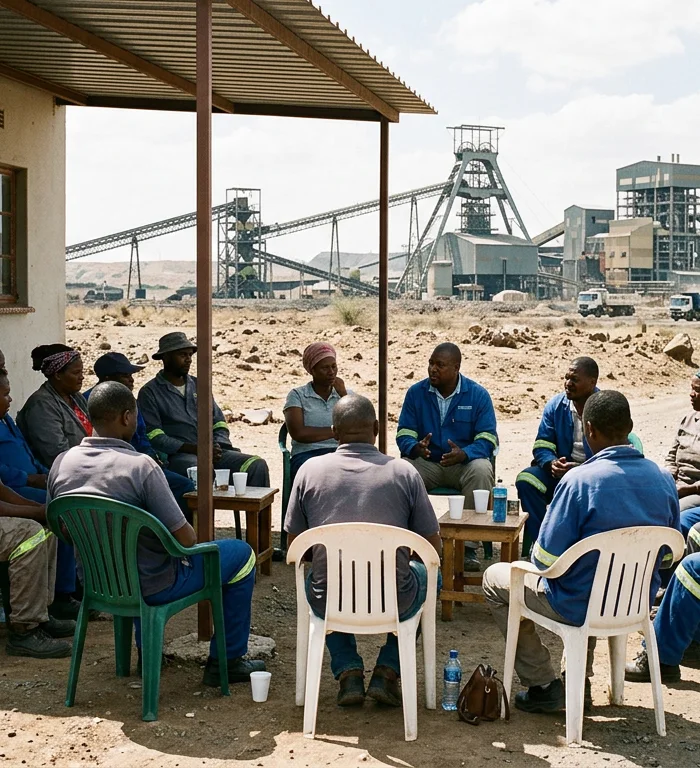
Christopher Rutledge challenged South Africa's mining boom narrative on Oct. 11, citing PwC figures showing almost R1 trillion in cumulative net profit from 2016 to 2026 in a Daily Maverick opinion article.
It matters because PwC's series, as cited by Rutledge, also showed about R691 billion paid to shareholders from 2016 to 2026, a scale comparison equal to roughly 69% of the profit tally. Oxfam South Africa put the richest 1% at 54.9% of private wealth in 2024.
Rutledge is executive director of the Mining Affected Communities United in Action and Women Affected by Mining United in Action Advice Office. The article was published as opinion and reflected his personal view.
Rutledge wrote that companies tracked by PwC reported revenue of R786 billion for the year, up from R569 billion. Net profit rose to R185 billion from R65 billion, according to the figures he cited from PwC's SA Mine 2026 report.
The same figures showed EBITDA, or earnings before interest, taxes, depreciation and amortisation, rising to R279 billion from R122 billion. Free cash flow increased to R201 billion from R75 billion. Shareholders received R82 billion during the year, with a further R70.27 billion in dividends declared after the reporting date, Rutledge wrote.
The intervention comes as industry-government engagement over mining policy has drawn attention in South Africa. The opinion article cited Daily Maverick's Oct. 7 reporting on improving ties between the Minerals Council South Africa and the Department of Mineral and Petroleum Resources, including work streams on investment, licensing, competitiveness and the Mineral Resources Development Amendment Bill.
Rutledge said the policy debate should not treat stronger profitability as sufficient evidence for extending the existing extraction model. His argument targeted the distribution of mineral gains, while acknowledging there is nothing inherently wrong with the state and industry discussing infrastructure, licensing and investment.
Oxfam South Africa's Hoarded Wealth, Dignity Denied report estimated that the richest 10% held 85.7% of national wealth, according to the opinion article. Rutledge wrote that the bottom half of the population had negative wealth, meaning debts exceeded assets.
The article did not say mining alone caused South Africa's inequality. Rutledge identified several other drivers, including apartheid dispossession, unemployment, education disparities, land ownership, financialisation, tax policy and weak public institutions.
Community spending remains the most contested part of the argument. Rutledge wrote that earlier PwC value-added statements often placed community investment at 1% or 2% of value distributed, including 1% in 2022 against 40% for shareholders and 2% in 2023 against 37% for shareholders.
PwC acknowledged that inconsistent reporting made a robust industry-wide picture of social investment impossible, according to Rutledge. Macua social audits have also claimed that up to 70% of company-reported community project value could not be independently traced or verified on the ground.
The source material did not include responses from the Minerals Council South Africa, the Department of Mineral and Petroleum Resources, PwC or individual mining companies. It also gave no dated next step for the Mineral Resources Development Amendment Bill.
More stories
- Egypt offers Saudi defense help, seeks parliament's role
- Magyar puts Hungary's euro plans before first budget test
- Israeli settlers attack West Bank olive harvest, hurt two
- Zelenskyy says Starshield limits weaken Ukraine defenses
- WHO backs Kenya Ebola response after second case
- Bunia health teams rebuild trust after 4,000 Ebola deaths
- Ethiopia's Tigray dispute pressures AU prevention drive
- Boko Haram ceasefire tests Nigeria’s back-channel talks
Latest news
- Wall squats may lower blood pressure after four weeks
- 8-hour eating windows beat controls by 5 pounds in TRE trials
- Researchers link diabetic ulcers to stalled immune repair
- Loneliness and isolation linked to 5.8 fewer healthy years
- Weiss warns of breast cancer care gap after treatment
- CoreWeave gains ARK backing as borrowing concerns persist
- DeepSeek updates AI model as speed and cost rivalry grows
- CoreWeave bond yields hit 15% as AI funding doubts deepen