Taiwan chip diplomacy puts $265 billion US bet in focus
Taiwan chip diplomacy at SEMICON focused on TSMC’s $265 billion Arizona investment, U.S. tariff pressure and EU efforts to attract chip capital.
Lauren Collins ·
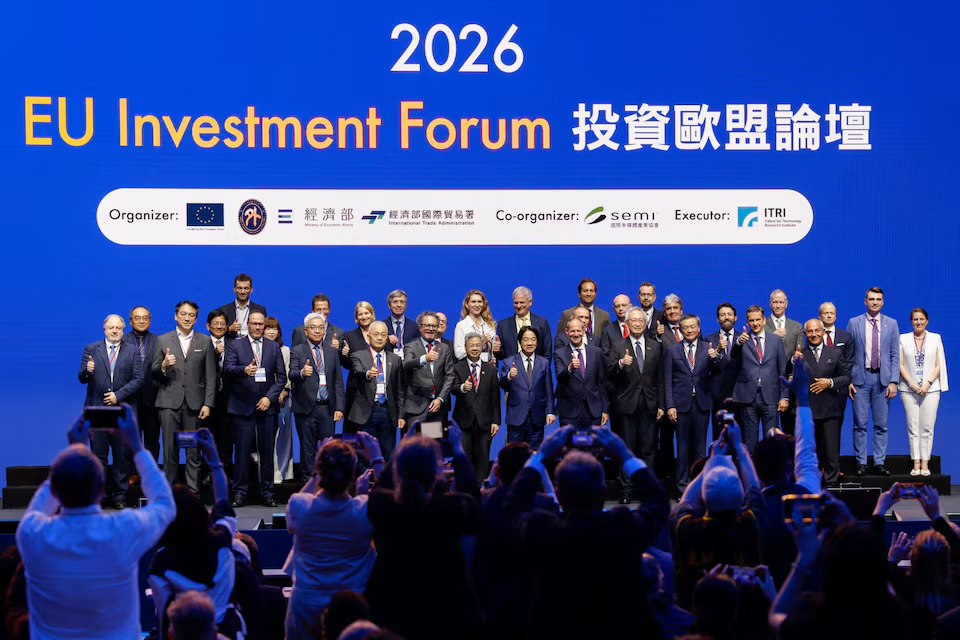
Taiwan chip diplomacy took center stage at SEMICON Taiwan as TSMC’s $265 billion Arizona push tested AI supply resilience.
TSMC’s Arizona anchor
Taiwanese officials used the trade show to present the island as a dependable democratic supplier for the AI era, while signaling that its chip capacity can be shared with aligned economies. President Lai Ching-te spoke at two events on the same day and said Taiwanese companies were expanding globally to “let resilience create shared prosperity.”
Taiwan’s argument rests on economic leverage it can use despite its constrained diplomatic position. Beijing says the island is one of its provinces and routinely seeks to limit its international role; Taipei has used its semiconductor network to build support where formal recognition is scarce.
The message also addressed Washington, Taiwan’s most important international backer and arms supplier. TSMC is investing $265 billion in Arizona factories, while Economy Minister Kung Ming-hsin said Taiwanese companies plan an additional $20 billion in U.S. investment, adding to the production shift already under way.
Tariff pressure at SEMICON
Taiwan and Washington reached an agreement earlier this year to increase investment in the United States in exchange for lower export tariffs, but the arrangement has not removed policy risk. U.S. Commerce Secretary Howard Lutnick said last week that semiconductor tariffs were coming for companies that do not make chips in the United States.
Bill Frauenhofer, the Commerce Department official overseeing the tariff agreement with Taiwan, framed the arrangement as cooperative during SEMICON. He said the “phenomenal partnership” was working and that both sides had “vested interests” in making it successful.
Industry executives focused less on keeping all production at home than on deciding where Taiwan-linked manufacturing should sit. Young Liu, chairman of Foxconn, Nvidia’s largest AI server maker, said companies had to “think about how to make with Taiwan, not in Taiwan; make with Taiwan in the country where the market is”.
Tien Wu, chief operating officer of ASE, backed that view during the panel. “Politically it is the right thing,” Wu said, adding, “And honestly, I don’t think we have a choice not to do that.”
EU pitch and investment paths
The European Union also used SEMICON to seek Taiwanese capital. European Commission official Kilian Gross presented the bloc’s Chips Act 2.0 to officials and companies, positioning Europe as another destination for advanced supply-chain investment.
Taiwan’s EU push has a security and diplomatic frame as well as an industrial one. Taipei and Brussels have backed Ukraine in Russia’s war and both face disputes with China, giving chip cooperation a political channel beyond factory incentives.
Deputy Foreign Minister Francois Wu told the French pavilion opening that Taiwan and France shared commitments to democracy, freedom and a rules-based international order. “We use technology to connect with the world, not to control it,” he said.
If U.S. tariff rules become clearer and investment credits remain usable, Taiwan’s companies can treat Arizona as the main overseas anchor while preserving high-end coordination at home. The macro effect would be less concentration in one geography; TSMC would gain policy cover in its largest security partner; suppliers would follow customers into U.S. clusters.
If tariffs widen or costs rise faster than subsidies offset them, companies may slow or sequence overseas projects. That would keep more capacity tied to Taiwan in the near term, leave AI customers exposed to cross-strait risk, and push equipment, packaging and server makers to seek parallel sites.
If Europe turns its Chips Act 2.0 pitch into bankable terms, Taiwanese firms could split expansion between the United States and the EU. The open questions are the final U.S. tariff schedule, the scale of European incentives and how far Beijing responds to Taiwan chip diplomacy with diplomatic or trade pressure.