Oil prices hover near six-week highs after Hormuz strikes
Oil prices held near six-week highs after U.S.-Iran tanker strikes lowered Middle East crude flows and cut Strait of Hormuz traffic to a May low.
Lauren Collins ·
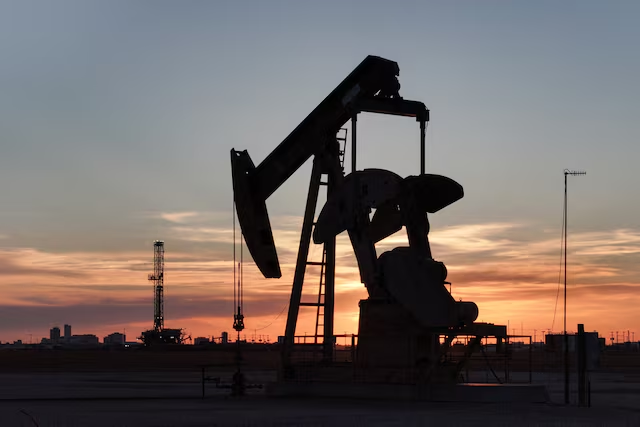
Oil prices held near six-week highs Monday after U.S.-Iran tanker strikes cut Middle East flows through the Strait of Hormuz.
At 0822 GMT, Brent crude futures traded at $96.19 a barrel, 9 cents lower on the session, a 0.1% decline. The contract had reached $97.93 earlier in the day, its strongest level since July 24.
In the prior week, Brent advanced about 8%; WTI's gain was close to 10% following the resumption of attacks between the U.S. and Iran. The moves left crude trading near the upper end of its recent range even as Brent edged lower Monday morning.
Brent nears July 24 peak
The U.S. Central Command said Saturday's American strikes hit three Iranian oil tankers, including one near Kharg Island, close to Iran's key crude export hub. The navy of Iran's Islamic Revolutionary Guard Corps said its own operations hit three tankers it said were using unauthorized Strait of Hormuz routes, plus three U.S. vessels in other areas.
Marisks, a maritime intelligence firm, described Saturday's attacks as a "major escalation." The firm said the incidents turned merchant vessels into tools of reciprocal economic pressure, weakening the separation between military confrontation and commercial shipping.
Hormuz traffic hits May low
Kpler said Monday that Strait of Hormuz crossings by commodity ships averaged 10 a day in the latest 10-day period, below any reading since May. The figure gave oil traders a concrete gauge of how security risk is filtering into vessel schedules.
Priyanka Sachdeva, head of market insights at Phillip Nova, said the shipping data were already affecting oil pricing. "If tanker traffic begins to slow materially, the market could price in a much larger supply shock. And there are already signs that this is happening," Sachdeva said.
Goldman Sachs said oil may rally to as much as $120 a barrel if attacks on shipping increase, compared with Brent's $96.19 level on Monday morning. The bank's conditional estimate ties the price risk to physical disruption rather than to a broader demand forecast.
OPEC+ holds October line
At Sunday's meeting, OPEC+ left its production stance for October intact, the producer group said in a statement. The group said it needs to agree on new quotas before deciding its next output steps, leaving the near-term supply response dependent on diplomacy inside the alliance.
Mohsen Rezaei, secretary of Iran's Supreme National Security Council, said a restricted zone outside the Strait of Hormuz would be announced in the coming days, according to state media. If enforced, that boundary would give insurers, charterers and crude buyers a new operating constraint around a route already showing weaker vessel traffic.
If attacks remain limited and daily transits stabilize near the recent 10-ship average, the macro effect would be mostly an oil-price risk premium rather than a clear supply break. In that case, producers would face less immediate pressure to change output plans, and tanker operators could keep routes open while charging more for risk.
If strikes widen or the restricted zone slows ship movements further, the mechanism changes: fewer cargoes would reach buyers on schedule, lifting import costs for consuming economies and testing Goldman Sachs's $120 scenario. OPEC+ would then face pressure to show whether spare barrels can offset delayed Middle East flows, while refiners and shipping firms would have to manage cargo timing, insurance and route exposure.