Strait of Hormuz corridor plan lifts Gulf oil risks again
Iran said a new Strait of Hormuz corridor and restricted Gulf zone are imminent after strikes on shipping pushed Brent above $97 a barrel.
Lauren Collins ·
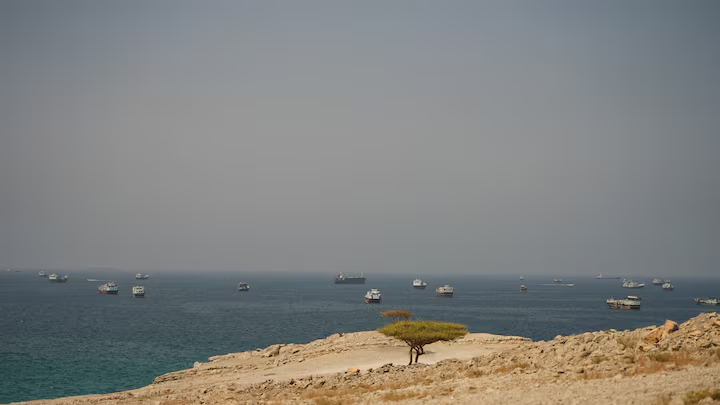
Iran said a new Strait of Hormuz corridor is days away, widening a Gulf shipping dispute after Brent climbed above $97 a barrel.
Mohsen Rezaei, secretary of Iran's Supreme National Security Council, said on state TV that Tehran would announce a restricted zone in the Gulf and publish maps for a new passage through the strait. He said ships entering the zone would be placed on a sanctions list, without giving operational details on enforcement.
Rezaei sketches Gulf zone
The proposed corridor would run through Iranian and Omani waters, Rezaei said, adding that Iran would have a management role once the maps are approved. He also linked Iran's commitment to keeping the Strait of Hormuz open to an end to what he described as American sabotage, threats and attacks.
The statement came after a weekend exchange of strikes involving shipping and military targets in the region. U.S. Central Command said U.S. forces struck three Iranian oil tankers on Saturday, including one off Kharg Island, after attacks by Iran's Islamic Revolutionary Guard Corps on U.S. warships.
Ten ships a day transit
Shipping data cited on Monday showed an average of 10 commodity vessels a day crossed the Strait of Hormuz over the previous 10 days, the lowest level since May. Before the conflict, about a fifth of global oil supplies moved through the waterway, making even partial disruption material for refiners, insurers and governments managing fuel costs.
Brent crude was quoted 0.8% higher above $97 a barrel on Monday, extending the previous week's gains after the strikes. The price move followed lower vessel traffic through the strait and renewed concern over Kharg Island, Iran's main crude export hub before the war.
Kharg remains Iran's choke point
Iran is the third-largest producer in the Organization of the Petroleum Exporting Countries and exported 90% of its crude through Kharg Island before the conflict. Those flows have been disrupted since a U.S. blockade of Iranian oil exports began in mid-April.
U.S. Central Command said on X that, as of Sunday, it had redirected 92 commercial vessels, disabled three and boarded two as part of blockade enforcement. Iran's Oil Minister Mohsen Paknejad said in a state TV interview that Kharg Island had been hit around 550 times in previous months but continued to operate.
President Trump added to the pressure on August 31 with a one-line social media post and an AI-generated video depicting Kharg Island being destroyed. Iranian authorities have said any attack on the island would draw a strong response.
Sanctions squeeze Tehran's economy
Iranian officials also framed the confrontation as an economic test. Parliament Speaker Mohammad Baqer Qalibaf said the main domestic front now included production, livelihoods, currency volatility, inflation, unemployment and market management.
Economy Minister Ali Madanizadeh said Tehran would respond to U.S. pressure through reforms and rejected the argument that sanctions would force a policy reversal. “I have to clarify one point: The responsibility of reforming Iran’s economy is with its government and people, not with the U.S. Treasury,” he said, according to state media.
U.S. Energy Secretary Chris Wright said oil was still moving through the waterway, with transits averaging more than 9 million barrels a day. He said pipelines bypassing the strait meant supplies were probably at two-thirds or more of pre-conflict flows, despite Iranian disruption.
Three routes from here
If Iran publishes the maps but keeps enforcement limited, the global macro effect would likely work through insurance costs and freight delays rather than a full supply stop. For Iran, that path preserves pressure on the US blockade while reducing the immediate risk to Kharg operations; for the tanker and refining industries, it keeps routing decisions dependent on daily security assessments.
If Tehran enforces the zone aggressively, lower traffic through the Strait of Hormuz would tighten available crude flows and keep fuel prices politically sensitive before November's congressional elections. If diplomacy instead revives the June ceasefire framework, the mechanism would be simpler: more predictable vessel passage, steadier Kharg exports and less pressure on energy buyers exposed to Gulf supply.