Police arrest former German spy chief August Hanning
BND espionage allegations against August Hanning center on about 2,000 documents, many classified, and a German treason inquiry.
Claire Dubois ·
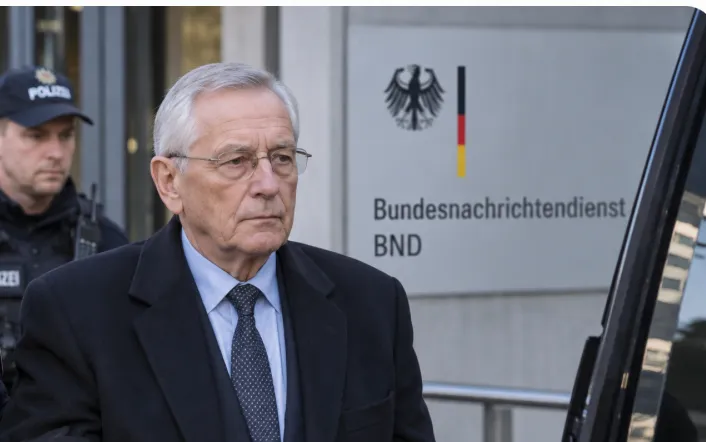
BND espionage allegations against August Hanning center on about 2,000 documents, many classified, and a German treason inquiry.
Federal prosecutors said Tuesday that police arrested Hanning, 80, the former head of Germany's foreign intelligence service, on suspicion of espionage, disclosure of state secrets, attempted treason and acting as an agent for a secret service. The prosecutor's office did not identify the foreign intelligence service for which he is suspected of working.
The case reaches into the upper ranks of the Bundesnachrichtendienst, or BND, and the Federal Interior Ministry. It also turns on the conduct of a second former senior BND employee, identified under German privacy rules as Manfred D., who prosecutors said was arrested in Bavaria.
A 2,000-document allegation
Prosecutors said Manfred D. is suspected of giving Hanning hundreds of classified documents after Hanning left the top BND job, allegedly in exchange for payment. The current findings point to about 2,000 documents over several years, many of them classified for internal BND use, according to the prosecutor's statement.
The alleged arrangement began in 2010, prosecutors said. They said Manfred D. continued passing information to Hanning until at least mid-2022, and that Hanning used some of the material in his private consulting work.
Ines Peterson, a spokesperson for the federal prosecutor's office, said one suspected episode involved classified material being used for an analysis prepared for an employee of a foreign intelligence service. That claim remains an allegation, and prosecutors have not said whether the foreign service in that episode is the same service referred to in the broader case.
Hanning's years in power
Hanning led the BND from December 1998 to November 2005, a period that placed him at the center of Germany's external intelligence apparatus. He later moved to the Federal Interior Ministry, serving as state secretary until November 2009.
Manfred D. worked as Hanning's chief of staff during Hanning's tenure at the BND, prosecutors said. He later worked under Hanning at the Interior Ministry and, from 2012 to March 2026, served as chief of staff to Hanning's successors at the BND, where prosecutors said he had access to classified files.
Police searched properties linked to both suspects as well as premises in Berlin, according to the prosecutor's office. Hanning was arrested in Nordwalde, near Münster, while Manfred D. was taken into custody in Bavaria, according to reports cited in the source material.
Parliament braces for scrutiny
The arrests drew immediate attention from lawmakers who oversee Germany's intelligence services. Marc Henrichmann, chair of the parliamentary intelligence oversight committee, said Germany would not tolerate the betrayal of secrets and warned that those who align with enemies of liberal democracy would be found.
Konstantin von Notz, an opposition lawmaker who also sits on the oversight committee, called the allegations deeply troubling and urged a swift, thorough investigation. Their responses point to the institutional stakes: the case concerns not only alleged document leaks, but trust in the controls around classified material after senior officials leave office.
The prosecutor's office has not disclosed whether Hanning or Manfred D. have responded to the accusations. It also has not named the foreign intelligence service allegedly involved, leaving a central question open for investigators, courts and parliamentary overseers.
Three paths for Berlin
If prosecutors substantiate the alleged document transfers and show foreign intelligence use, the case would likely intensify scrutiny of post-government consulting, access controls and oversight inside Germany's security establishment. For the BND, the mechanism would be reputational and operational: a proven breach by people with senior access could force tighter internal compartmentalization.
If the evidence proves narrower, the damage may remain concentrated on the two suspects and the handling of files after Hanning left public office. In that scenario, the wider intelligence sector would still face pressure to explain how former officials and trusted insiders interact with classified systems after career transitions.
If the unidentified foreign service becomes central to the proceedings, the case could carry diplomatic consequences beyond Germany's domestic institutions. For Germany's allies, the practical issue is whether sensitive political or intelligence material moved outside authorized channels; for the BND, the next test is whether prosecutors can convert a large document allegation into a case that holds in court.