

Israeli Political Parties Initiate Unity Government Negotiations Amid Parliamentary Deadlock
Israeli political factions are negotiating a potential unity government to resolve a parliamentary deadlock, with security concerns regarding Iran serving as…
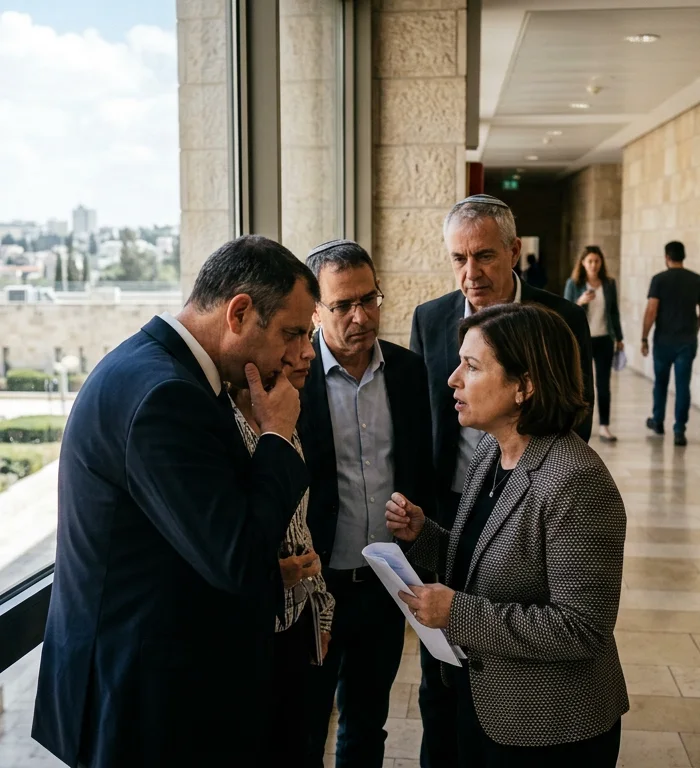
Israeli Prime Minister Benjamin Netanyahu’s Likud party has commenced formal negotiations with political rivals to explore the formation of a unity government. This outreach follows the recent national election, which resulted in a fragmented Knesset where neither the incumbent bloc nor the opposition led by Gadi Eisenkot secured a clear parliamentary majority.
The current legislative impasse necessitates the support of smaller factions to reach the 61-seat threshold required to govern. While the Eisenkot-led coalition holds a numerical advantage when accounting for allied parties, the inclusion of Arab factions—which hold 19 seats—remains a significant point of contention. Key figures within the opposition, including former defense minister Avigdor Lieberman, have publicly signaled opposition to relying on Arab party support, complicating the path to a stable coalition.
Netanyahu is leveraging regional security concerns, specifically the threat posed by Iran, to advocate for a broad-based government. He has proposed setting aside political boycotts to prioritize national security, suggesting a unity framework as the most viable solution to address external military challenges. Conversely, Eisenkot has maintained that Netanyahu is an outgoing leader, though he has not ruled out the possibility of Likud joining a government under his own leadership.
Israeli Prime Minister Benjamin
Discussions have also included the potential for a rotation agreement, a mechanism previously utilized in Israeli politics to bridge ideological divides between coalition partners. Such an arrangement would involve splitting a four-year term between the two leaders. However, historical precedent suggests that these power-sharing agreements are prone to instability, as evidenced by the collapse of the 2021 coalition after 18 months.
Beyond the immediate coalition negotiations, the security landscape remains a critical factor. Eisenkot has cautioned against unilateral military action unless an immediate threat to national security is identified. The two leaders have recently held high-level security briefings to align on military strategy, signaling that regardless of the final government composition, the management of regional tensions will remain the primary driver of domestic policy and political maneuvering in the coming weeks.
More stories
- Germans oppose Ukraine aid as poll shows support slipping
- Kim Jong-un receives 10 envoys after constitutional shift
- Ukraine claims Libya strike sinks Russian naval corvette
- COP31 climate talks collapse over fossil fuels and funds
- Russian military faces 1,087 recorded suicides in Ukraine war
- US faces China, Russia in Africa minerals contest
- Trump, Putin and Xi to hold historic trilateral in Shenzhen
- UK and EU seek 3 deals in Burnham reset
- Iraq government sacks nine officials over oil-smuggling claims
- Canada and UK back $1.3tn climate finance goal at COP31
Latest news
- Trump prepares tariffs on China and other major exporters
- New-car buyers pay record average $50,087 in October
- Banks face ECB reserve debate over liquidity and profits
- Investors see Anthropic debut gains fade below $83 a share
- Iraq orders federal control over Kurdish-area oilfields
- Nvidia shares retreat as AI rally cools before PCE data
- Macy’s parade faces balloon limits as storm winds approach