

France and Malaysia Establish Strategic Partnership to Enhance Defense and Mineral Security
France and Malaysia have entered a strategic partnership to bolster defense cooperation and secure rare earth supply chains, marking a shift in Malaysia’s…
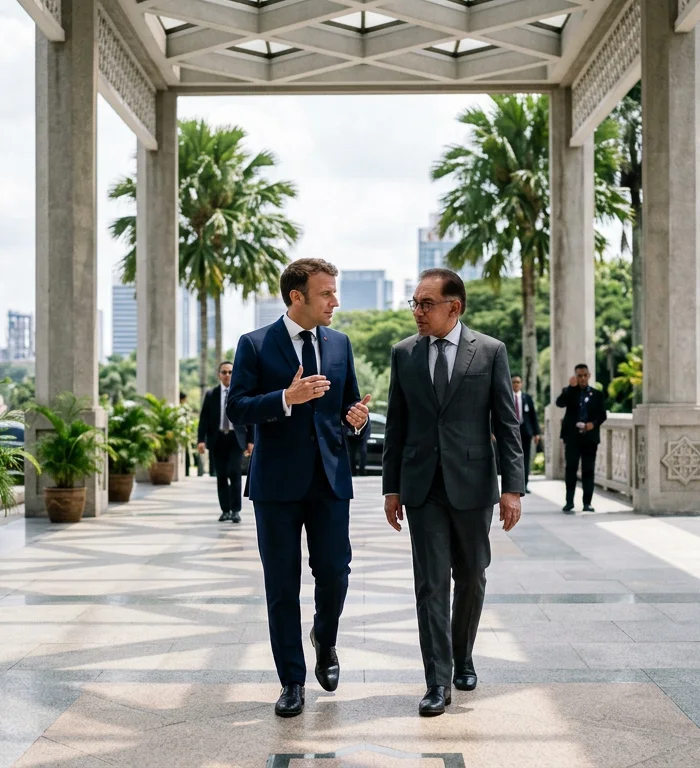
France and Malaysia have elevated their bilateral relationship to a strategic partnership, formalizing cooperation across defense, energy transition, and critical mineral supply chains. This diplomatic shift follows a high-level meeting between French President Emmanuel Macron and Malaysian Prime Minister Anwar Ibrahim in Kuala Lumpur, aimed at reducing mutual reliance on external powers for industrial and security needs.
A central component of this agreement involves the relaxation of Malaysia’s 2024 export ban on raw rare earth materials. Malaysia will now permit conditional shipments of these materials to France to facilitate joint processing initiatives. This move supports a collaborative project between the French firm Carester and the Malaysian miner Malaco, which includes a planned separation plant in Perak state capable of processing approximately 13,000 metric tons of rare earths annually.
French President Emmanuel Macron
From a security perspective, the partnership includes a commitment to establish a regional center dedicated to countering hybrid threats. Additionally, France’s Airbus has secured an agreement to supply helicopters to the Malaysian Air Force. These defense initiatives occur as Malaysia actively reassesses its procurement strategy following the revocation of a missile export license by Norway, which prompted concerns regarding the reliability of Western and NATO-aligned defense suppliers.
For policymakers, the alignment signifies a strategic pivot by Malaysia to integrate its domestic refining capabilities into Western supply chains, specifically targeting the reduction of dependence on Chinese rare earth production. The success of this partnership will depend on the operational integration of the Carester-Malaco joint venture and the ability of both nations to maintain consistent defense procurement standards amidst shifting geopolitical alliances. Observers should monitor the implementation of the hybrid threat center and the specific volume of rare earth exports authorized under the new conditional framework.
More stories
- Germans oppose Ukraine aid as poll shows support slipping
- Kim Jong-un receives 10 envoys after constitutional shift
- Ukraine claims Libya strike sinks Russian naval corvette
- COP31 climate talks collapse over fossil fuels and funds
- Russian military faces 1,087 recorded suicides in Ukraine war
- US faces China, Russia in Africa minerals contest
- Portugal targets more than 20,000 electric cars with subsidies
- Kallas faces EU role doubts after seven-member Ukraine talks snub
- Portugal police remove 171 housing protest structures
- Serbia records higher turnout as students challenge Vucic
Latest news
- Trump prepares tariffs on China and other major exporters
- New-car buyers pay record average $50,087 in October
- Banks face ECB reserve debate over liquidity and profits
- Investors see Anthropic debut gains fade below $83 a share
- Iraq orders federal control over Kurdish-area oilfields
- Nvidia shares retreat as AI rally cools before PCE data
- Macy’s parade faces balloon limits as storm winds approach