Islamabad MoU leads Pakistan's peace pitch at SCO summit
Pakistan promoted the Islamabad MoU as a 14-point route to ease the US-Iran conflict while advancing a separate Mecca defense pact.
Raj Patel ·
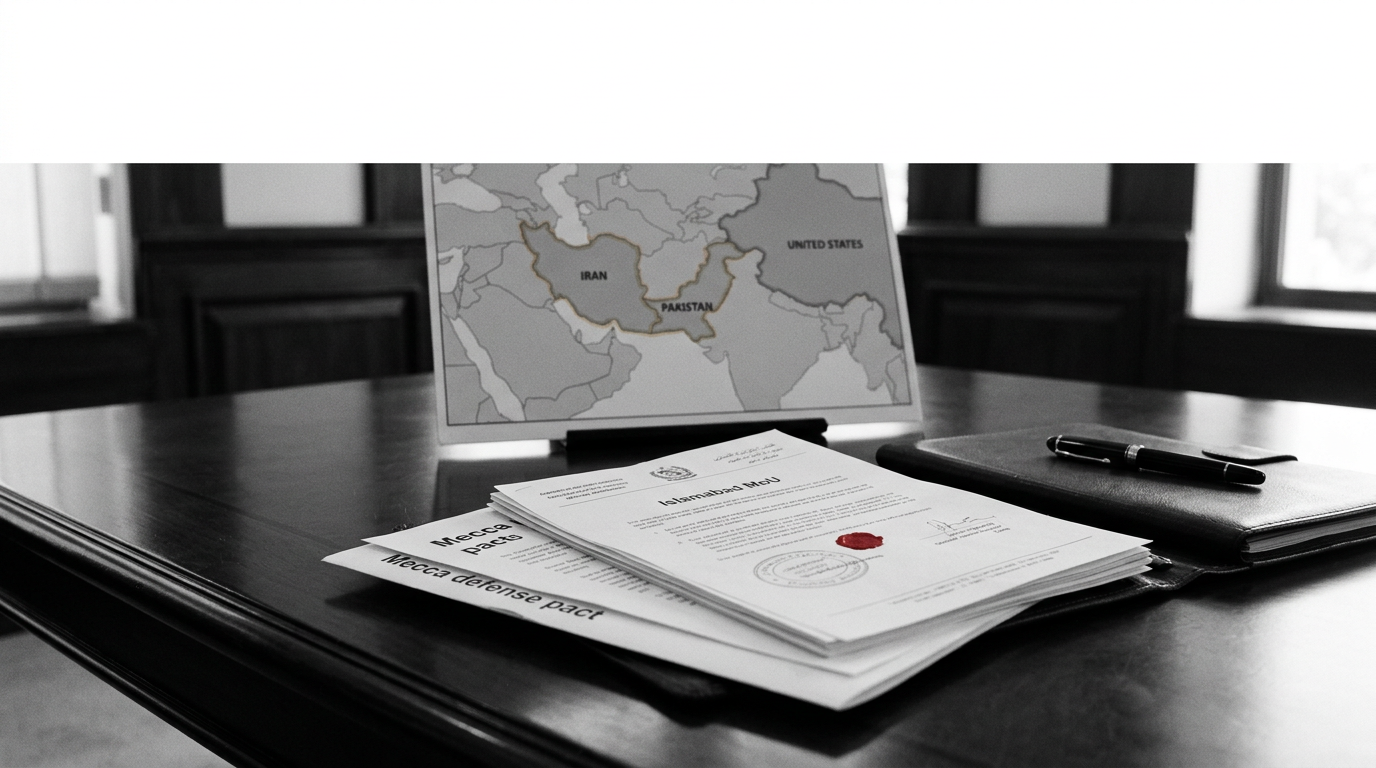
Pakistan promoted the Islamabad MoU, a 14-point US-Iran framework, as the strongest route to regional de-escalation at Tuesday's SCO summit.
Sharif sells a 14-point framework
Prime Minister Shehbaz Sharif told Shanghai Cooperation Organisation leaders that the agreement reached in Islamabad offered the best available path toward ending the conflict and restoring stability. He said Pakistan's diplomatic effort had produced an agreement he described as the “most viable and enduring pathway to lasting peace.”
The memorandum was signed in June by President Trump, Iranian President Masoud Pezeshkian and Sharif, according to the account presented by Pakistani officials. The pact temporarily halted hostilities and was tied to efforts to keep the Strait of Hormuz open, a narrow waterway whose status matters to energy flows and shipping costs.
Hormuz gives the pact weight
Sharif's remarks followed President Trump's dismissal of concerns that the Iran conflict was stretching US military capacity. Trump called it “a relatively little war for us,” framing the American burden as limited even as Pakistan emphasized the regional risks.
The two messages point to different political needs around the same conflict. Washington is presenting the operation as contained, while Islamabad is positioning the memorandum as proof that mediation by a Muslim-majority nuclear state can reduce pressure around Iran and the Gulf.
For Pakistan, the diplomatic claim carries practical value as well as regional prestige. A credible pause in hostilities would support its case that Islamabad can serve as a channel between powers that do not normally trust the same intermediaries.
Mecca pact widens security layer
Sharif also used the SCO platform to discuss a separate trilateral defense pact signed in Mecca by Turkey, Saudi Arabia and Pakistan. The agreement brings together a NATO member, a major oil producer and a nuclear-armed South Asian state in a pledge to respond jointly to outside threats against any one of them.
The prime minister said the Mecca agreement was defensive and “not directed towards any state.” That wording appeared aimed at limiting concern that the pact could formalize a new bloc in a region already shaped by rival security guarantees and overlapping military partnerships.
Pakistan's foreign minister Ishaq Dar said six or seven other Muslim-majority countries were interested in joining the Mecca Defense Agreement. Dar met his Turkish and Saudi counterparts on Monday for the pact's first talks, where ministers discussed how expansion might work.
Scenarios turn on compliance
If the Islamabad MoU continues to hold, the immediate effect would be to lower the risk of disruption around Hormuz and reduce the need for emergency military deployments by outside powers. For Pakistan, that would strengthen Sharif's claim that Islamabad can deliver diplomatic results; for shipping, energy and insurance firms, it would reduce one layer of operational uncertainty.
If the framework weakens, the mechanism would run in the opposite direction: renewed attacks or threats near Hormuz would lift security costs and push governments back toward military signaling. Pakistan would then face the reputational cost of a mediation effort that did not survive contact with the conflict, while regional defense arrangements such as the Mecca pact would draw closer scrutiny.
A third path is partial compliance, where the memorandum limits direct confrontation but fails to settle the terms of a durable peace. Under that outcome, global macro pressure would remain tied to energy and freight risk, Pakistan would retain a diplomatic role without a clean victory, and Gulf-facing industries would keep planning for interruptions rather than assuming normal trade.
The main open question is whether the June memorandum can be enforced beyond the first pause in fighting. A second question is whether the Mecca pact stays a narrow defensive arrangement or becomes a wider security platform as more governments test the terms of joining.