

Indonesia wildfires threaten 67,800-year-old cave art
Heat and smoke may worsen corrosion and soot damage at Sulawesi sites as Indonesia faces its most intense fires since 2015.
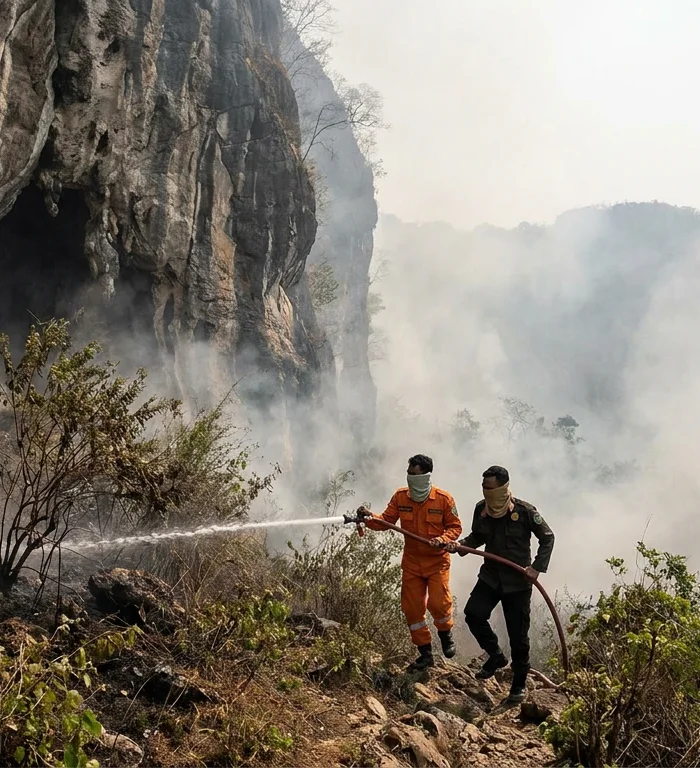
Indonesia’s wildfires are threatening Sulawesi cave paintings dated to at least 67,800 years old, according to a Reuters report published by The Straits Times on Oct. 23.
The risk has grown as Indonesia faces its most intense forest and land fires since 2015, with more than 270 hectares burned near the Maros-Pangkep cave site from Sept. 30 to Oct. 18.
The affected area includes limestone caves in South Sulawesi that hold some of the oldest known prehistoric art. Researchers from Australia’s Griffith University dated one Maros-Pangkep artwork, showing human-like figures interacting with a pig, to at least 51,200 years old.
Another site on Muna Island, off Sulawesi, contains a reddish hand stencil dated to at least 67,800 years old, according to the report. The fires have spread beyond the worst-hit islands of Sumatra and Borneo into Sulawesi, where dry conditions have complicated firefighting.
“The first and most destructive effect is the heat. Even without direct fire touching the paintings, it could ruin them because it changes the temperature around the paintings and accelerates the process of corrosion,” Griffith University archaeologist Basran Burhan said.
Burhan said smoke can deposit soot on the artworks. “They create soot on the paintings and cover them, so that the paintings will become blurred and difficult to identify,” he said.
Firefighter Muhammad Ikfar said fires burned near the Maros-Pangkep site for more than a week earlier in October and came within 800 metres of the cave. Ikfar said crews were still working on October 22 and October 23 to put out fires elsewhere in the park, where conditions were dry and no rain had fallen.
The caves sit in a karst area, a limestone terrain of ridges, towers and caverns, within a national park and UNESCO Global Geopark. That status adds conservation significance to the immediate firefighting task, but the report did not give details on any formal emergency protection plan for the paintings.
Indonesia’s wider fire season has been intensified by a severe El Niño, which has raised temperatures and reduced rainfall, leaving forests and peatland more exposed to burning, according to the report. The material did not provide a national burned-area total or damage assessment for the cave art itself.
“If we don't do something about this quick, if there isn't any tactical mitigation efforts for this incident we will lose one of the most amazing evidence of human history in Maros-Pangkep,” Burhan said. “And that is a great shame.”
Source: news report, The Straits Times – Asia, Oct. 23, 2026
More stories
- Germans oppose Ukraine aid as poll shows support slipping
- Kim Jong-un receives 10 envoys after constitutional shift
- Ukraine claims Libya strike sinks Russian naval corvette
- COP31 climate talks collapse over fossil fuels and funds
- Russian military faces 1,087 recorded suicides in Ukraine war
- US faces China, Russia in Africa minerals contest
- UN climate fund earmarks $20m for Nepal flood recovery
- Ethiopia's coffee sector faces $453m EU export risk
- Seoul guards South Korea investment terms in U.S. talks
- Norway targets Telenor in Myanmar crimes probe after raid
Latest news
- Trump prepares tariffs on China and other major exporters
- New-car buyers pay record average $50,087 in October
- Banks face ECB reserve debate over liquidity and profits
- Investors see Anthropic debut gains fade below $83 a share
- Iraq orders federal control over Kurdish-area oilfields
- Nvidia shares retreat as AI rally cools before PCE data
- Macy’s parade faces balloon limits as storm winds approach