Seoul guards South Korea investment terms in U.S. talks
A lawmaker said President Trump may announce South Korea investment details Friday, though Seoul says the $350 billion pledge remains under negotiation.
Lauren Collins ·
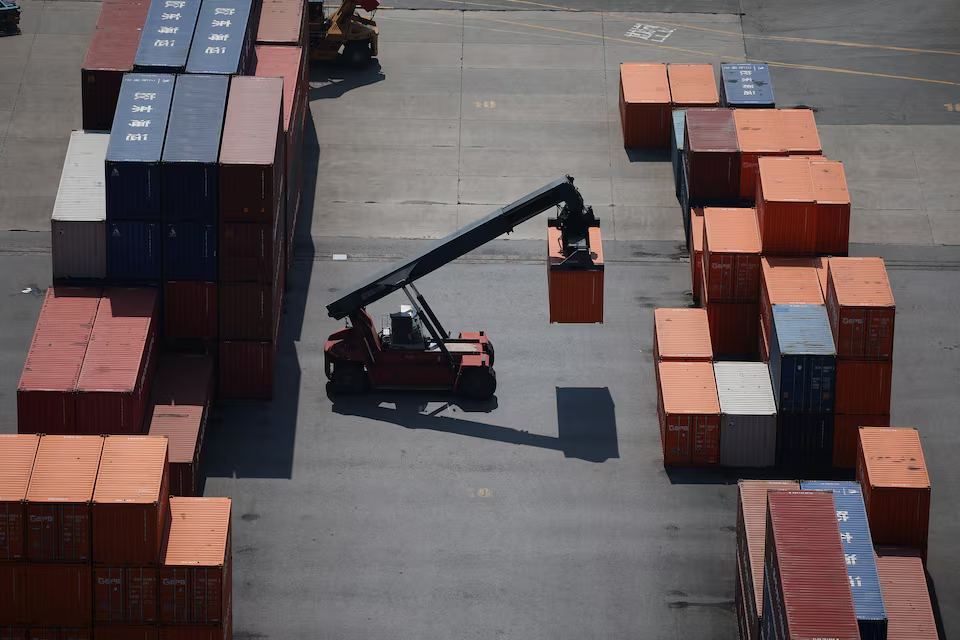
South Korea investment plans tied to a $350 billion U.S. pledge face a possible Friday disclosure by President Trump, a ruling-party lawmaker said.
Yoon Hu-duk of the Democratic Party made the claim during a parliamentary hearing for Lee Hyoung-il, the nominee for finance minister. Lee said negotiations with Washington were continuing and that he would speak once the talks were complete.
The exchange put fresh public pressure on a trade package agreed last October by President Trump and South Korean President Lee Jae Myung. Seoul has not confirmed the project list, and Yoon did not say how he obtained the details he cited.
Yoon names five project areas
Yoon said the investment package under discussion included a Texas gas project, eight nuclear reactors and a liquefied natural gas plan in Alaska. He also described a possible U.S. request involving the reprocessing of roughly 4,000 tons of nuclear material, along with a carbon capture project.
Those items remain unverified by the South Korean government. Yoon’s office later said the government had not confirmed the details raised at the hearing, while the Industry Ministry declined to comment.
Lee Hyoung-il did not address the project list directly. He told lawmakers he could not disclose the contents of bilateral negotiations, keeping the government’s formal position limited to the existence of continuing talks.
Tariff cap frames the pledge
The October trade deal linked South Korea’s $350 billion investment commitment to a U.S. tariff cap of 15% on South Korean imports. Of that total, $150 billion was set aside for shipbuilding, leaving the rest of the package to cover other manufacturing and energy-related projects.
Implementation has moved more slowly than the agreement itself. After delays in carrying out the deal, President Trump threatened South Korea earlier this year with higher tariffs, making the investment timetable part of a broader trade-risk calculation for Seoul.
One unresolved issue is the size of the projects now being discussed against Seoul’s stated ceiling. Asked whether the package could exceed a $200 billion limit, Lee said the government intended to remain within that amount and was negotiating on that basis.
Thursday briefing becomes next test
South Korean Industry Minister Kim Jung-kwan said on Sunday that the two governments were near agreement on many points, while several issues still had not been settled. Opposition lawmaker Bae June-young said parliamentary committees were expected to receive a briefing on Thursday about the planned U.S. investments.
If a Friday announcement produces a defined project list within the $200 billion ceiling cited at the hearing, Seoul would gain a clearer path to preserving the 15% tariff cap. For global trade, that would reduce one source of friction between two allied manufacturing economies; for shipbuilding, nuclear power, LNG and carbon capture companies, it would give investors a firmer pipeline of potential U.S. work.
If the talks slip again or the projects exceed Seoul’s ceiling, the tariff dispute could return to the center of the relationship. That would leave South Korean exporters facing a renewed policy risk, while U.S.-linked energy and industrial projects would have less clarity on financing, timing and political backing.
The main open question is whether the two governments can translate a headline investment pledge into project commitments that both sides can defend domestically. Until Seoul confirms the list, the figures cited in parliament remain claims from a lawmaker rather than settled terms of the agreement.