Gordie Howe Bridge opens as tariffs strain auto trade ties
The Gordie Howe Bridge opened in Ontario after a tariff dispute reshaped the ceremony and raised stakes for North American auto trade.
Atlas Newsdesk ·
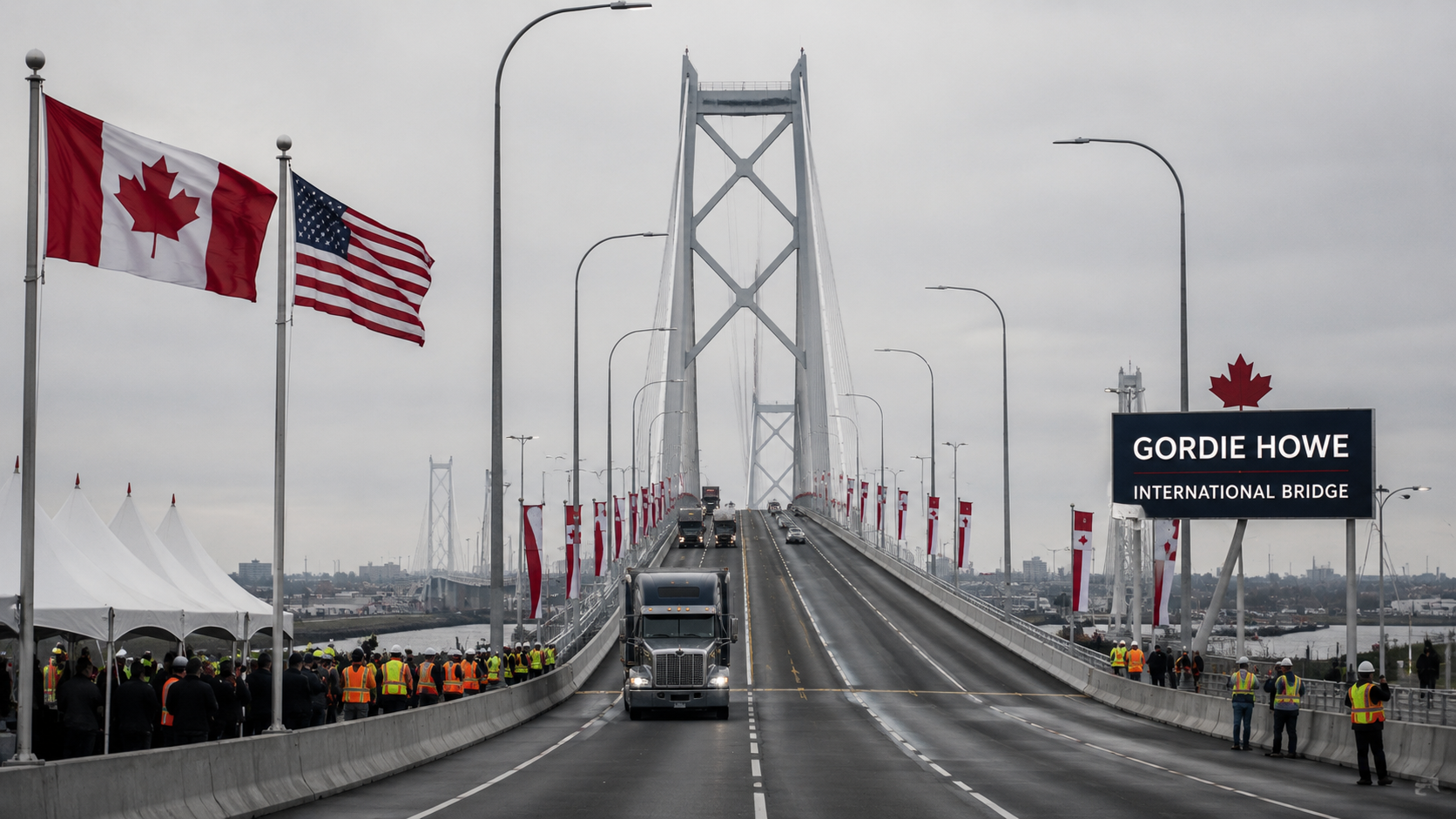
Gordie Howe Bridge opened on the Canadian side Friday, giving automakers a new Michigan-Ontario trade route as tariffs strain ties.
The 1.5-mile crossing connects Michigan with Ontario after more than a decade of planning. Canadian officials framed the span as a practical fix for tourists and commercial trucks moving between the US and one of Canada’s core manufacturing regions.
Tariffs reshape the ceremony
The opening did not follow the joint script originally planned by both governments. Canadian officials canceled a shared celebration after President Donald Trump threatened 50% tariffs on a range of Canadian goods on July 20.
No American officials spoke at the Canadian-side event, although Pete Hoekstra, the US ambassador to Canada, had earlier said he planned to attend. Prime Minister Mark Carney was also absent, leaving Ontario Premier Doug Ford and Mark Wiseman, Canada’s ambassador in Washington, among the senior Canadian figures present.
The ceremony had already faced a delay after US Commerce Secretary Howard Lutnick sought changes to the bridge’s financial terms. Carney’s government and the Trump administration later reached a side agreement allowing the opening to proceed, with the US receiving a profit share for 15 years.
Ford links bridge to retaliation
Ford used the event to pair symbolism with a warning. Wearing a red Canadian hockey jersey bearing Howe’s name, he said Ontario “will be ready to respond on any new American tariffs. We will not back down.”
He also tried to separate the trade fight from public sentiment on both sides of the border. “I know Canadians love Americans and I know Americans love Canadians — and I know that bond will last for another over 200 years,” Ford said.
Ontario has already answered US tariffs with provincial measures, including a ban on retail sales of American wine and spirits in government-run liquor stores. That response has angered Trump and his officials, making Ford one of the most visible Canadian provincial leaders in the dispute.
Trump answered the snub during the ceremony on Truth Social, saying Canada’s decision to leave out the United States was “fine.” He tied the canceled invitation to tariffs paid to the US, keeping the bridge opening inside the wider trade confrontation.
A hockey name carries politics
The bridge is named for Gordie Howe, the Canadian hockey star who spent most of his career with the Detroit Red Wings. Members of Howe’s family attended the event, reinforcing the original idea of the project as a symbol of cross-border familiarity.
That symbolism now sits beside a harder commercial reality. The bridge is designed to improve the movement of trucks and travelers across a border that is central to the North American auto supply chain, where delays can ripple through plants, parts suppliers and logistics firms.
For automakers, the bridge’s value depends on whether physical efficiency can offset policy friction. A faster crossing can cut bottlenecks, but tariff uncertainty changes cost calculations for vehicles and components moving between Canada and the US.
Auto corridor faces two paths
If the tariff threat recedes and the side agreement holds, the bridge could become a stabilizing asset for the regional economy. In that case, the global macro effect would be modest but positive for North American trade flows, the bridge would gain traffic credibility, and automakers would have a stronger logistics route between Ontario and Michigan.
If 50% tariffs take effect, the mechanism changes. Higher duties would raise cross-border costs, weaken the benefit of faster transport, pressure the bridge’s early commercial case and push the wider auto sector to reconsider sourcing, pricing and shipment timing.
The open questions are specific: whether the threatened tariffs are imposed, how Canada responds next, and whether the 15-year profit-share arrangement becomes a model for future border infrastructure disputes. The bridge is open, but the politics around the traffic it carries are not settled.