

Ghalibaf signals end to Iran’s ‘neither war nor peace’ policy
Parliament Speaker Mohammad-Baqer Ghalibaf demands Washington meet seven conditions for engagement, signaling a shift toward aggressive regional defense.
Shift in Tehran's defense stance
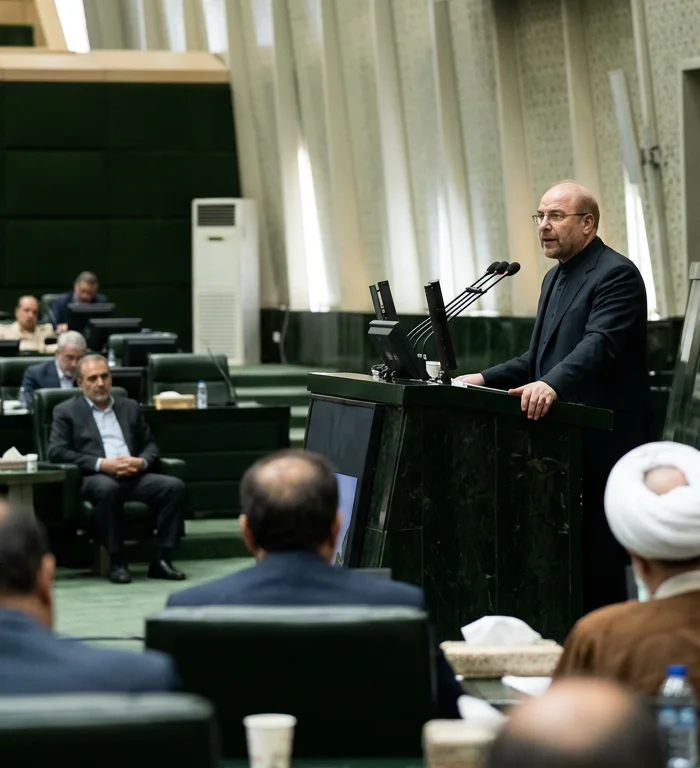
Iranian Parliament Speaker Mohammad-Baqer Ghalibaf announced on Sunday that the Islamic Republic will no longer adhere to a policy of standing in a state of neither war nor peace. Addressing lawmakers during an open parliamentary session, Ghalibaf declared that the era of strategic patience is concluding, according to a report from the semi-official Mehr agency.
Ghalibaf stated that Tehran remains indifferent to whether Washington chooses negotiations or conflict. He asserted that the door to any formal agreement remains conditional on the US accepting seven specific, yet unspecified, requirements. The Speaker warned that the country's armed forces are prepared to dictate the parameters of any territorial confrontation should the US engage in further miscalculations.
Missile development as strategic leverage
The remarks coincided with national commemorations honoring the late Major General Hassan Tehrani Moghaddam, recognized as the primary architect of Iran's missile program. Ghalibaf used the occasion to emphasize the role of the Islamic Revolutionary Guard Corps (IRGC) Aerospace Force in regional deterrence.
Ghalibaf characterized the IRGC Aerospace Force as a pillar that has successfully converted systemic threats into strategic advantages. He claimed the force has frustrated plots orchestrated by both the US and Israel while providing support to regional allies, including Palestinian militant groups.
Regional security and global implications
This rhetorical shift signals a potential departure from the cautious diplomatic approach previously favored by the government. By explicitly prioritizing missile capabilities and challenging the 'grey zone' status quo, the legislative branch is exerting pressure on the executive to adopt a more proactive and escalatory posture toward the incoming US administration.
Iranian Parliament Speaker Mohammad The hardening of this stance raises the threshold for back-channel diplomacy aimed at economic recovery.
If the parliament successfully binds the executive to these seven conditions, the capacity for de-escalation may diminish, heightening the risk of direct kinetic confrontations across regional proxy theaters.
Monitoring future escalations
The central open question is whether this parliamentary rhetoric will translate into measurable shifts in Iranian military behavior. Observers will be looking for signs of accelerated ballistic missile testing or a change in the frequency of proxy operations in the Persian Gulf and Levant.
More stories
- Germans oppose Ukraine aid as poll shows support slipping
- Kim Jong-un receives 10 envoys after constitutional shift
- Ukraine claims Libya strike sinks Russian naval corvette
- COP31 climate talks collapse over fossil fuels and funds
- Russian military faces 1,087 recorded suicides in Ukraine war
- US faces China, Russia in Africa minerals contest
- French school protests cost exam pupils up to 150 class hours
- UN agencies seek aid for 30.3m facing DR Congo hunger
- Philippine Congress faces scrutiny over two voided budget laws
- Economists see Bank of Japan rate at 1.50% in December
Latest news
- Trump prepares tariffs on China and other major exporters
- New-car buyers pay record average $50,087 in October
- Banks face ECB reserve debate over liquidity and profits
- Investors see Anthropic debut gains fade below $83 a share
- Iraq orders federal control over Kurdish-area oilfields
- Nvidia shares retreat as AI rally cools before PCE data
- Macy’s parade faces balloon limits as storm winds approach